

Newsletter 5862-014
The 3rd Year of the 5th Sabbatical Cycle
The 32nd year of the 120th Jubilee Cycle
The 12th day of the 4th month, 5862 years after the creation of Adam
The 5th Sabbatical Cycle after the 119th Jubilee Cycle
The Sabbatical Cycle of the Tithes to the Widows and Orphans
May 30, 2026
Shabbat Shalom to the Royal Family of Yehovah,
Last Sabbath I heard about the Peace Agreement with Iran, and I was livid with the information I was given at that time. I almost called Ryan to have an emergency podcast about this event. I was up all night stewing. I know Bible prophecy is going to happen, but I am still shocked when I actually see it taking place before my eyes.
Part of me hopes these end-time horrors will not come to pass. But reality soon brings me back to earth. The news over this past week has backtracked on the initial reports, but they are still stunning. I do hope you are all getting ready and returning to Yehovah. Iran is not going to give up the uranium. Prophecy tells us so. It also tells us they do enrich it and they will deploy it. Yes, your Bibles tell you this.
The opportunities to change or postpone this prophecy are fast slipping away from President Trump. The inevitable is coming.
Another silent plague taking place right now is the Mississippi dropping below record lows once again. But this is now happening in May, two months before when it is normally expected in July. How is this going to affect the USA and New Orleans?
Join Our Sabbath Meetings
Join Our Sabbath Meetings
There are many people in need of fellowship and who are sitting at home on the Sabbath with no one to talk to or debate with. I want to encourage all of you to join us on Shabbat, and to invite others to come and join us as well. If the time is not convenient then you can listen to the teaching and the midrash after on our YouTube channel.
What are we doing and why do we teach this way?
We are going to discuss both sides of an issue and then let you choose. It is the work of the Ruach (Spirit) to direct and to teach you.
The medieval commentator Rashi wrote that the Hebrew word for wrestle (avek) implies that Jacob was “tied”, for the same word is used to describe knotted fringes in a Jewish prayer shawl, the tzitzityot. Rashi says, “thus is the manner of two people who struggle to overthrow each other, that one embraces the other and knots him with his arms”.
Our intellectual wrestling has been replaced by a different kind of struggle. We are wrestling with Yehovah as we grapple with His Word. It is an intimate act, symbolizing a relationship in which Yehovah and you and I are bound together. My wrestling is a struggle to discover what Yehovah expects of us, and we are “tied” to the One who assists us in that struggle.
Today, many say Israel means “Champion of God”, or better — the “Wrestler of God”.
Our Torah sessions each Shabbat teaches you and encourages you to constantly challenge, question, argue against, as well as view alternative views and explanations of the Word. In other words, we are to “wrestle with the Word” to get to the truth. Jews worldwide believe that you need to wrestle with the Word and constantly challenge Dogma, Theology, and views or else you will never get to the Truth.
We are not like most churches where “The preacher talks and everyone listens.” We encourage everyone to participate, to question and to contribute what they know on the subject being discussed. We want you to be a champion wrestler of the Word of Yehovah. We want you to wear the title of Israel, knowing that you not only know but are capable of explaining why you know the Torah to be true with logic and facts.
We have a few rules though. Let others talk and listen. There is no discussion about UFO’s, Nephilim, Vaccines or conspiracy-type subjects. We have people from around the world with different world views. Not everyone cares who is the President of any particular country. Treat each other with respect as fellow wrestlers of the word. Some of our subjects are hard to understand and require you to be mature and if you do not know, then listen to gain knowledge and understanding and hopefully wisdom. The very things you are commanded to ask Yehovah for and He gives to those who ask.
Jas 1:5 But if any of you lacks wisdom, let him ask of God, who gives to all liberally and with no reproach, and it shall be given to him.
We hope you can invite those who want to keep Torah to come and join us by hitting the link below. It is almost like a Torah teaching fellowship talk show with people from around the world taking part and sharing their insights and understandings.
We start off with some music and then some prayers and it’s as though you were sitting around the kitchen back in Newfoundland having a cup of coffee and all of us enjoying each other’s company. I hope you will grace us with your company someday.
Sabbath services begin at 12:30 PM EDT where we will be doing prayers, songs and teaching from this hour.
Shabbat midrash will begin at about 1:15 pm Eastern.
We look forward to you joining our family and getting to know us as we get to know you.
Joseph Dumond is inviting you to a scheduled Zoom meeting.
Topic: Joseph Dumond’s Personal Meeting Room
Join Zoom Meeting
https://us02web.zoom.us/j/3505855877
Meeting ID: 350 585 5877
One tap mobile
+13017158592,,3505855877# US (Germantown)
+13126266799,,3505855877# US (Chicago)
Dial by your location
+1 301 715 8592 US (Germantown)
+1 312 626 6799 US (Chicago)
+1 346 248 7799 US (Houston)
+1 669 900 6833 US (San Jose)
+1 929 436 2866 US (New York)
+1 253 215 8782 US (Tacoma)
Meeting ID: 350 585 5877
Find your local number: https://us02web.zoom.us/u/kctjNqPYv0
Torah Portion
Torah Portions
We read through the entire Torah along with the Prophets and the New Testament once over the course of 3 1/2 years. Or according to the Sabbatical Cycle which means we read it all twice over a 7-year period. This allows us to cover more in-depth rather than being rushed to cover as much as is covered on an annual basis. We allow all to comment and take part in the discussions.
Septennial Torah Portion
If you go to Torah Portion in our archived section, you can then go to the 1st year, which is the 1st year of the Sabbatical Cycle, the one we are in now, as we state at the top of every Newsletter. There, you can scroll down to the proper date and see that this Shabbat, we could very well be midrashing about:
Numbers 8
Job 19-21
Hebrews 9
We are in the 1st Sabbatical Cycle in 2024-2025. We go through the entire Bible twice in a 7 year cycle. This means we cover the entire Bible once every 3 1/2 years. It gives us more time to debate and discuss each portion we read.
If you missed last week’s exciting discoveries as we studied that section, you can go and watch past Shabbats on our media section.
2026 Is a Third Tithe Year
2026 Is a Third Tithe Year
I want to begin by apologizing for not being more faithful in reminding us all of our duties in this third tithe year.
We are in the third year of the current 5th Sabbatical Cycle (2024–2030). According to the biblical pattern given in Deuteronomy 14:28-29 and 26:12-15, every third year is designated as the Third Tithe Year — the year set aside specifically for the widows, the fatherless (orphans), the Levites, and the stranger in your gates.
This is not the regular first and second tithe used for the Feasts and supporting the work of the ministry. The Third Tithe is an additional tithe (10% of your increase) given directly to care for those who cannot care for themselves.
Sightedmoon.com has taught this consistently for many years: 2026 is a Third Tithe Year (Aviv 2026 to Aviv 2027).
If you have widows or orphans in your own family or immediate circle, this is the year to support them intentionally. The command is clear — do not neglect them.
If you do not have family members in need, or if you want to do more, you can support the widows and orphans who reach out to Sightedmoon.com. Many are struggling in this time of rising costs and uncertainty. Your Third Tithe gift this year will be used directly to help those in genuine need.
Deuteronomy 14:29 tells us that when we obey this command, “the Lord your God may bless you in all the work of your hand which you do.”
This is not optional. It is one of the specific ways Yehovah tests and blesses His people — especially in a year like 2026, when the signs of scarcity are increasing.
Let us be faithful in the Third Tithe this year.
If you would like to support the widows and orphans through Sightedmoon.com, you can do so here:
https://sightedmoon.com/donate/
May Yehovah bless you as you obey Him in this important command.
Sightedmoon AI is Now Live
Sightedmoon AI is Now Live

It has now come to pass.
Sightedmoon.com now has its own AI trained to answer your questions according to the understanding we have gained from the Sabbatical and Jubilee cycles.
Yes, you read that right.
As part of the tools offered through Pray.com, we now have the ability to train a dedicated AI that represents Sightedmoon.com and our teachings. James has been working on this project since we attended the NRB in 2025. It has been a long process with many challenges — two steps forward and one step back at times.
When Pray.com offered this opportunity, I jumped on it. After much testing and reprogramming, we now have an AI that pulls directly from our website and teachings. At first it gave generic Christian apologetics answers that were not accurate to what we teach. We corrected that by training it specifically on Sightedmoon.com material and adding detailed instructions.
We are still fine-tuning it. We discovered a few more issues during testing, and I am currently working with Pray.com to get more character space so we can add additional instructions. The current limit is 10,000 characters, which has been challenging, restricting some of our commands.
I am asking all of you to help test and perfect this new tool.
Please go to Sightedmoon.com and try the new AI. Ask it hard questions. Ask it complicated ones. Tell it when it gets something right and when it gets something wrong. Your feedback will help us improve it faster.
And yes — it is just a tool.
Why People Fear New Technology
Throughout history, every major technological breakthrough has triggered fear, panic, and fierce resistance. What we are seeing today with Artificial Intelligence is not new — it is part of a very old pattern.
Writing (Ancient Greece): Socrates warned it would weaken memory and produce “the appearance of wisdom, not true wisdom.”
The printing press was accused of spreading heresy. (1400s–1500s): Scholars feared it would flood the world with garbage and cause information overload.
When trains first appeared, doctors warned that traveling faster than 20 mph would cause brain damage, paralysis, strokes, and death. People feared the noise would drive them mad and that sparks from the engines would burn down towns. Religious leaders called them “the work of the devil.”
When automobiles (horseless carriages) arrived, the fear was even greater. In Britain, the Red Flag Act required a man to walk 60 yards ahead of every car waving a red flag. Horses were terrified, and many believed cars would destroy society and kill thousands. Early drivers were often attacked.
Electricity (late 1800s) was called “the devil’s power,” and many refused to have it in their homes, fearing it was dangerous or demonic. President Benjamin Harrison had staff turn lights on/off because he was scared of electrocution.
Telephone: People feared voices traveling through wires were unnatural and demonic or that it would destroy privacy and personal relationships.
In every case, the same fears appeared:
“This will destroy society.”
“This is unnatural or demonic.”
“This will harm our children and moral fabric.”
And in every single case, those fears eventually gave way to acceptance as the technology proved useful.
Today It Is AI
Now we have Artificial Intelligence, and once again many sincere believers are afraid. They worry it will replace human thinking, spread deception, or become dangerous.
At Sightedmoon.com we have implemented AI not to replace God’s Word or human discernment, but to help answer questions faster, organize deep biblical research on the Sabbatical and Jubilee cycles, and make these important teachings more accessible.
The real issue is never the tool itself.
The real issue is how we use it.
Just as the train, the automobile, the telephone, and electricity became powerful tools for spreading the Gospel, AI can also be used for good — to help more people study the appointed times, understand the signs of the seasons, and prepare as Joseph did. We can translate almost every language into our own language with the push of a button that uses AI.
We are not trusting in AI.
We are trusting in Yehovah — and using every tool He allows us to have, with wisdom and discernment, to serve Him more effectively.
The Abraham Accords and the Illusion of Peace
The Abraham Accords and the Illusion of Peace
On Saturday, May 23, 2026, I heard President Trump’s initial announcement about a peace deal with Iran. I was very upset and up for most of the night because of all the implications this meant. But as the week went along, more information came out. Let me walk you through everything that has happened.
Saturday, May 23, 2026
President Trump announced on Truth Social that a peace deal with Iran was “largely negotiated” and would be announced soon. He highlighted the reopening of the Strait of Hormuz as a key immediate outcome. Importantly, uranium/nuclear issues were explicitly not part of the initial framework — they were to be negotiated over the next 30–60 days.
Sunday–Monday, May 24–25
Iran quickly pushed back. Iranian officials and state media stated there was no final deal and that talks were still ongoing. Trump slightly walked back his comments, saying negotiators should “not rush” and that the deal “isn’t even fully negotiated yet.”
Tuesday–Wednesday, May 26–27
Trump added a major new condition: any comprehensive deal with Iran must include more Arab/Muslim nations joining the Abraham Accords (normalizing with Israel) at the same time. Iran rejected linking the nuclear/Strait issues to the Abraham Accords. Oil prices remained elevated due to ongoing uncertainty.
Current Status (as of May 28)
There is no finalized deal. The uranium issue remains completely unresolved. Iran continues to assert control over the Strait of Hormuz. Trump has tied any comprehensive agreement to a broader regional normalization push via the Abraham Accords.
“Peace and Safety” – The Abraham Accords, Iran, and Biblical Warning
The Abraham Accords were first signed on September 15, 2020, between Israel, the United Arab Emirates, Bahrain, and the United States. They marked a historic shift: Arab nations normalizing relations with Israel without first requiring a resolution to the Palestinian issue. The current administration is now pushing hard to expand them further.
On the surface, these agreements look like genuine progress toward peace in the Middle East. Yet the Bible gives us a clear warning about exactly this kind of development:
For when they shall say, Peace and safety! Then sudden destruction comes on them, as travail upon a woman with child. And they shall not escape.
1 Thessalonians 5:3
The prophet Jeremiah spoke similarly:
They have also healed the hurt of the daughter of my people slightly, saying, Peace, peace, when there is no peace. — Jeremiah 6:14
How We Know We Are in the Final Days
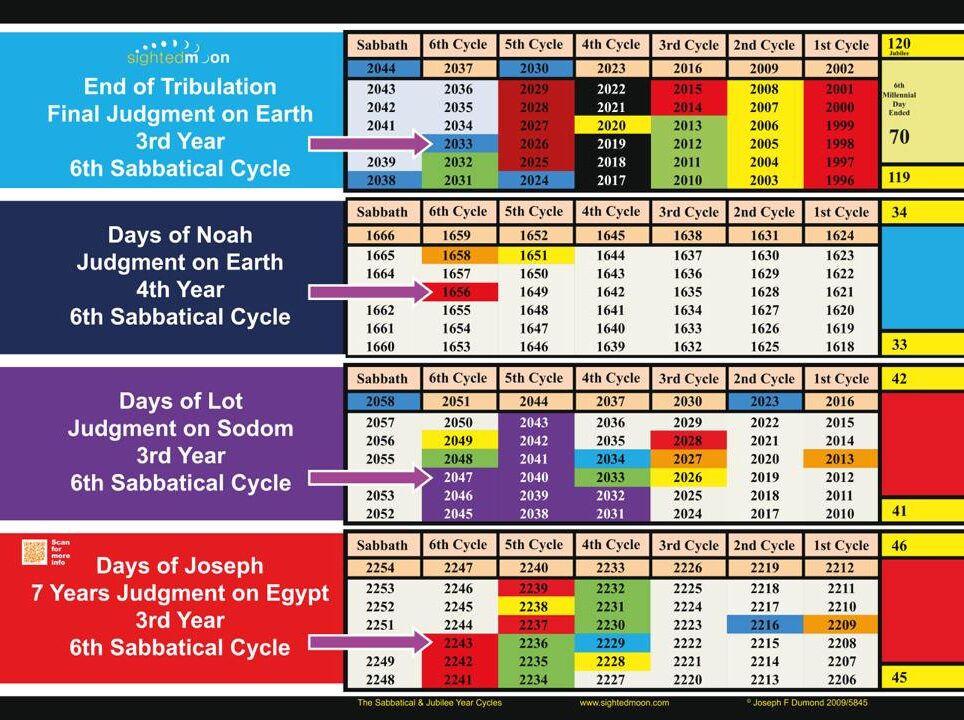
We have counted 120 Jubilee cycles from Adam. We have compared “as it was in the days of Noah” and “as it was in the days of Lot” with our own Jubilee cycle and discovered a stunning pattern. Final judgment comes in the 3rd and 4th year of the 6th Sabbatical cycle. Even the time of Joseph’s famine finishes in the 3rd year of the 6th Sabbatical cycle. That same famine began in the 4th year of the 5th Sabbatical cycle, which, when compared to our 120th Jubilee cycle, points directly to the years 2026–2027.
The closing of the Strait of Hormuz — cutting off 1/5th of the world’s oil and 1/3rd of the world’s fertilizer — is contributing to spiking costs of growing and delivering food around the world. Combined with the record-breaking El Niño developing in the Pacific and existing droughts in various countries, all of this together is producing the birth pains at the end of this age. It ends with Satan being locked away in 2033, so the birth pains must come before that.
The Abraham Accords, combined with the current Iran negotiations, fit this pattern remarkably well. They create an appearance of peace while deeper issues — especially Iran’s nuclear program at 60% enrichment — remain unresolved. Weapons-grade material can be reached in a matter of weeks.
Iranian Strategy & the Bigger Picture
Iran has a long record of using negotiations to buy time. This aligns with Islamic military doctrine (including the concept of hudna — a temporary truce) that encourages making peace when weak, then breaking it when strong enough to prevail. By dragging out talks, Iran appears to be waiting for favourable political conditions in the United States — particularly the November 2026 midterm elections.
Trump’s approval rating has fallen to the 36%–40% range. Democrats lead the generic ballot by +5 to +9 points, making it very possible they flip the House. This would severely limit Trump’s ability to respond forcefully.
The United States has already expended a significant portion of its precision munitions. Replenishing stocks will take 4+ years, and many rely on rare earth elements controlled by China. Even if the Strait of Hormuz were reopened today, it would take 4 to 6 months for global supply chains to normalize.
We are watching a classic setup: diplomatic efforts create an illusion of peace while military and nuclear realities move forward in the background. This matches the biblical pattern perfectly.
The Iranian Regime’s Personal and Doctrinal Drive for Revenge
The situation with Iran has become even more dangerous and personal. On February 28, 2026, Israeli and U.S. strikes killed Supreme Leader Ayatollah Ali Khamenei. His son, Mojtaba Khamenei, who has since become the new Supreme Leader, was severely injured in the same attack. He suffered facial disfigurement, leg injuries (possibly a fractured foot), and other wounds. Multiple family members, including his wife, were also killed.
This personal loss has given Mojtaba Khamenei and the hardline factions around him a powerful motive for revenge. The IRGC (Islamic Revolutionary Guard Corps) has repeatedly vowed “decisive revenge” and “severe punishment” for the killing of the previous Supreme Leader. Iran’s parliament is even reviewing a bill that would offer a €50 million reward to anyone who assassinates President Trump or Israeli Prime Minister Netanyahu. Additionally, recent reports revealed an Iran-linked plot targeting Trump’s daughter Ivanka, further illustrating the regime’s deep hostility.
While Mojtaba himself has not made a direct public statement saying he will use a nuclear weapon “as soon as he can,” the overall posture of the regime has become highly vengeful.
The Nuclear Shift
There has been a noticeable rhetorical shift within the regime. In April 2024 and again in early 2026, senior IRGC commander Ahmad Haghtalab (head of nuclear security) publicly stated that if Israel threatens or attacks Iran’s nuclear sites, Iran would “revise its nuclear doctrine” and drop previous “considerations.” This is widely understood as a direct hint that Iran is ready to abandon its long-standing claim that the program is “only for peaceful purposes.”
Other IRGC-linked figures and parliament members, such as Javad Karimi Ghodousi, have said Iran could be “a week away from testing” a nuclear device if the Supreme Leader gives permission. Hardline factions within the IRGC have been pushing for a doctrinal shift toward nuclear weapons, especially after the February 2026 strikes. The previous fatwa by the late Supreme Leader against nuclear weapons is now being quietly sidelined.
Iran has uranium at 60% — very close to weapons-grade. It is buried deep underground at the moment. Western intelligence and the IAEA assess that Iran could produce weapons-grade material (90%+) in a matter of weeks if the order is given. The official line from the Foreign Ministry is still “peaceful purposes,” but this is increasingly seen as diplomatic cover while the IRGC pushes for breakout capability.
Zechariah 5 and the Bigger Picture
Here is the connection to Zechariah 5, which describes a large flying scroll (roughly 30 ft × 15 ft) with an evil woman in a lead box, containing a curse that consumes houses. I see the imagery of a “flying roll” with a lead box and an evil woman in it as symbolically consistent with a nuclear missile in a lead-shielded container. The dimensions match those of the Iranian Shahab missile.
A Vision of a Flying Scroll
Zec 5:1 And I again lifted up my eyes and looked. And behold! A flying scroll.
Zec 5:2 And he said to me, What do you see? And I answered, I see a flying scroll; its length is twenty cubits, and its width ten cubits.
Zec 5:3 And he said to me, This is the curse that goes forth over the face of the whole earth; for from now on everyone who steals shall be cut off according to it; and everyone who swears from now on shall be cut off according to it.
Zec 5:4 I will bring it forth, says Jehovah of Hosts; and it shall enter into the house of the thief, and into the house of him who swears falsely by My name. And it shall remain in the midst of his house, and shall devour it, and its timber and its stones.
A Vision of a Woman in a Basket
Zec 5:5 Then the angel who talked with me went forth and said to me, Now lift up your eyes and see what this is that goes forth.
Zec 5:6 And I said, What is it? And he said, This is the ephah that goes forth. And he said, This is their form in all the earth.
Zec 5:7 And behold, a lead cover was lifted up, and a woman was sitting in the middle of the ephah.
Zec 5:8 And he said, This is wickedness. And he cast it into the midst of the ephah. And he cast the lead stone over its opening.
Zec 5:9 And I lifted up my eyes and looked, and behold, two women came out. And the wind was in their wings; for they had wings like the wings of a stork. And they lifted up the ephah between the earth and the heavens.
Zec 5:10 And I said to the angel who talked with me, Where are they going with the ephah?
Zec 5:11 And he said to me, To build a house for it in the land of Shinar; and it shall be established and set there on its own base.
This entire sequence fits the broader “peace and safety” warnings in Scripture (1 Thessalonians 5:3 and Jeremiah 6:14) very well — diplomatic efforts and normalization talks (Abraham Accords) happening at the same time as the underlying nuclear threat continues to grow in secret.
As watchmen, we are called not to fear, but to stay alert and speak the truth. The Abraham Accords may bring temporary calm, but Scripture warns us not to be deceived by a peace that does not include genuine righteousness and covenant relationship with the God of Israel.
Each day during the 10 Days of Awe, the trumpets are sounded, calling sinners back to repentance before the books are closed on the 10th and final day — the Day of Atonement, when Satan is to be locked away. If your name is not found written in the Book of Life, you will not enter the place of safety during the great trial that is coming and is almost here.
Comparing this period to our current Jubilee cycle, those 10 days prophetically represent 10 years — from 2024 to 2033. On the Day of Atonement in 2033, we fully expect Satan to be locked away. The Great Tribulation is expected during the three years before that, beginning in 2030.
For when they shall say, Peace and safety! Then sudden destruction comes on them, as travail upon a woman with child. And they shall not escape.
1 Thessalonians 5:3
Thessalonians is telling us that they will claim “peace and safety,” and then sudden destruction will come. The Trumpet plagues of Revelation have begun. The birth pains have begun. The trumpets are sounding — the signs are all converging.
Are you awake and repenting? Are you returning to Yehovah and obeying Him?
At the end of the Day of Atonement service, the shofar sounds one final, long, sustained blast called the Tekiah Gedolah — the Great Trumpet Blast. This is the loudest and longest note of all. It is the closing blast, the final call. In the same way, there will come a final Tekiah Gedolah — the last trumpet — when the door of mercy closes and it will be too late to get your name written in the Book of Life.
The question is urgent: When that final Great Trumpet sounds in 2033, will you be ready?
A Must Watch Video
The Historic Low of the Mississippi River in 2026
The Historic Low of the Mississippi River in 2026
A National Supply Chain Crisis
The Mississippi River, America’s most vital inland waterway, is once again at critically low levels in 2026 — marking the fourth consecutive year of severe low-water conditions during key shipping seasons.
At the Memphis gauge, the river has dropped to approximately 28% of normal flow, one of the lowest readings in modern records. The U.S. Army Corps of Engineers has been forced to dredge the same river bends repeatedly, trying to keep navigation channels open. This is no longer viewed as a temporary drought by many hydrologists — it is becoming a new baseline for the river system.
Persistent drought across the Upper Midwest, Ohio Valley, and Southern Plains has dramatically reduced water flow. The latest USDA reports show that roughly 30–37% of the U.S. winter wheat crop is now rated poor to very poor, with some analysts projecting abandonment rates as high as 10–12% in key growing regions. This is one of the worst winter wheat outlooks in decades.
Ripple Effects Across North America’s Food Supply and Economy
When the Mississippi River runs this low, the impact is felt across the entire nation’s supply chain. The river system normally moves roughly 500–660 million tons of cargo annually, including nearly half of all U.S. grain exports (corn, soybeans, and wheat). With barge traffic severely restricted, shippers are forced to use fewer, lighter tows or switch to far more expensive rail and truck transport.
This drives up transportation costs dramatically. In past low-water years, barge rates spiked from $30–$50 per ton to over $200 per ton. Those higher costs are passed on to farmers (lower net prices at the elevator) and ultimately to consumers (higher grocery bills). Combined with the loss of 30%+ of the winter wheat crop due to drought, North America is facing significantly higher food prices in the coming months — especially for bread, pasta, livestock feed, and processed foods.
Fuel prices are also adding pressure. The ongoing disruption in the Strait of Hormuz has kept oil prices elevated (Brent crude around $95–$100+ per barrel), increasing the cost of diesel for trucks, farm equipment, and food transportation. This compounds the problem: higher fuel costs + reduced crop yields + logistics bottlenecks = rising food inflation across the United States and Canada.
Biblical Perspective: The Curses of Leviticus 26 and 28
These events are not random. They align directly with the warnings in Leviticus 26 and Deuteronomy 28 — the blessings and curses tied to keeping or breaking the Sabbatical cycle.
Leviticus 26:19–20 states:
“I will break the pride of your power, and I will make your heavens like iron and your earth like bronze. And your strength shall be spent in vain, for your land shall not yield its produce, nor shall the trees of the land yield their fruit.”
Deuteronomy 28 adds:
“The sky over your head will be bronze, the ground beneath you iron… The Lord will strike you with wasting disease, with fever and inflammation… You will sow much seed in the field but you will harvest little.”
We are seeing these curses unfold in real time: drought-hardened ground, failing winter wheat crops, disrupted shipping, and rising costs for food and fuel. The Mississippi River crisis, the loss of a major portion of the winter wheat harvest, and the lingering effects of the Strait of Hormuz disruption are all contributing to the birth pains of scarcity the Sabbatical cycles have warned about for years.
What Low Water on the Mississippi Means for Grain Farmers and Consumers
What Low Water on the Mississippi Means for Grain Farmers and Consumers
For American farmers — especially in the Midwest and Mississippi Valley — the persistently low water levels on the Mississippi River in 2026 are creating a severe economic squeeze.
Nearly half of all U.S. corn, soybeans, and wheat exports normally move via barge down the Mississippi River system to Gulf ports for international shipment. When water levels drop, barges cannot load to full capacity. Operators are forced to run lighter tows or switch to much more expensive rail and truck transportation. This creates a classic price squeeze:
Why grain prices fall for farmers but rise for consumers:
- At the farm gate (farmers get less):
Local elevators and buyers lower the cash price they offer farmers (this is called a weaker basis). They do this to cover the dramatically higher transportation costs. In past low-water years, barge rates have spiked from the normal $30–$50 per ton to over $200 per ton. Farmers receive significantly less money for their grain at harvest — exactly when they need to sell the most. The reduced export volume also means less overall demand at the elevator level. - At the consumer level (prices rise):
The increased transportation and logistics costs are passed down the supply chain. Higher shipping expenses, combined with reduced overall supply from drought-damaged crops (including the loss of roughly 30–37% of the winter wheat crop this year), drive up the final retail price of food. Bread, pasta, livestock feed, processed foods, and even meat prices all feel the pressure.
This is the classic “farmers get less, consumers pay more” dynamic caused by logistics breakdowns in a major export corridor.
How Bad Is It Really? Farmer Bankruptcies and Comparisons
The situation is serious and getting worse:
- Chapter 12 farm bankruptcies (the chapter specifically for family farms) surged 46% in 2025 to 315 filings — the highest since 2020. Early 2026 numbers show continued increases, with April 2026 alone seeing a 130% jump in some regions.
- Total farm debt is projected to hit a record $624.7 billion in 2026.
- Midwest states (the heart of the Mississippi River basin) are being hit hardest. Nebraska, Iowa, Illinois, and others are seeing the largest increases in financial distress.
Comparison to previous years:
- The 2012 drought was devastating but mostly a one-year event.
- The 2022–2024 low-water years were already historically bad, but 2026 is shaping up to be the fourth consecutive year of major disruption. This multi-year pattern is what makes it particularly dangerous — farmers have less financial cushion left after three straight difficult seasons.
- Many farmers are already operating with razor-thin margins due to high input costs (fertilizer, fuel, equipment) and volatile commodity prices. Repeated low-water events are pushing a growing number toward bankruptcy or forced land sales.
If farmers cannot export efficiently, they face:
- Increased storage costs (if they hold grain longer)
- Wider basis discounts at local elevators
- Potential permanent loss of international customers to competitors like Brazil and Argentina
For many, especially smaller and mid-sized operations, this is becoming an existential threat to long-term viability.
The Mississippi River crisis, combined with the severe winter wheat losses and high fuel costs from the Strait of Hormuz disruptions, is creating a perfect storm for American agriculture in 2026.
Global Market Impact: Who Benefits When America Struggles?
The Mississippi River bottleneck hurts U.S. farmers and the U.S. economy far more than the global market. The world currently has enough surplus — particularly from South America — to absorb the shortfall without causing major global shortages. However, American agriculture takes a significant financial hit.
Brazil and Argentina Crops in 2026
- Brazil is on track for a record soybean harvest of approximately 178–182 million metric tons in the 2025/26 season. Corn production is also strong, with estimates around 134–138 million tons. Favorable weather in key growing regions has supported large planted areas and solid yields.
- Argentina is also producing strong volumes. Corn production is forecast near record levels (around 58–61 million tons), while soybean output is solid despite some regional challenges.
South American exporters are quickly stepping in to fill gaps left by reduced U.S. shipments. This means:
- Global grain supply remains relatively stable.
- World food prices see only modest upward pressure rather than dramatic spikes.
- U.S. farmers lose market share and revenue to Brazilian and Argentine competitors.
In short, while the low Mississippi River levels create chaos for American logistics and farm income, the world market has sufficient surplus (mainly from South America) to prevent a major global food crisis in 2026. The pain is felt most acutely inside the United States.
This dynamic perfectly illustrates the curses described in Leviticus 26 and Deuteronomy 28: reduced yields, higher costs, loss of competitiveness, and economic pressure on God’s people when they fail to keep His Sabbatical cycles. The land does not yield its full strength, transportation is hindered, and the nation’s agricultural blessing is diminished — all while other nations benefit.
The Saltwater Threat to New Orleans’ Drinking Water
The Saltwater Threat to New Orleans’ Drinking Water – What Would Actually Happen
When the Mississippi River’s flow drops too low, a dangerous phenomenon occurs: the saltwater wedge from the Gulf of Mexico pushes upstream. This denser saltwater slides beneath the lighter freshwater, forming a wedge that can travel many miles upriver.
If the current low-water trend continues into summer and fall 2026, here is the likely sequence of events:
Phase 1: Early Warning (Late May – June 2026)
- The U.S. Army Corps of Engineers and local water authorities begin issuing warnings as chloride levels rise at monitoring stations south of New Orleans.
- The wedge advances past Plaquemines Parish and toward Belle Chasse.
- Public announcements urge residents and businesses to conserve water and prepare for possible disruptions.
Phase 2: Emergency Declaration (June – July 2026)
- Saltwater reaches key municipal water intakes (likely around Belle Chasse or further upstream).
- The City of New Orleans and surrounding parishes declare a water quality emergency.
- Residents are advised to:
- Use bottled water for drinking and cooking.
- Avoid using tap water for infants, dialysis patients, or those with compromised immune systems.
- Flush pipes regularly to reduce metal leaching (high chloride accelerates corrosion).
- Businesses (restaurants, hotels, hospitals, food processors) must switch to bottled or trucked-in water for operations. Many will face temporary closures or reduced hours if they rely heavily on water.
Phase 3: Full Crisis Mode (July – September 2026, potentially longer)
- Chloride levels exceed safe drinking water standards (250 mg/L).
- Water sources for New Orleans:
- Primary: Emergency temporary pipelines or siphons pulling freshwater from further upstream (above the wedge).
- Secondary: Massive increases in bottled water distribution (FEMA, state, and private suppliers).
- Tertiary: Trucked-in or barged freshwater for critical facilities (hospitals, power plants, schools).
- Reverse osmosis treatment plants (if activated) would be running at full capacity, but they are expensive and cannot supply the entire metro area quickly.
Duration:
- In 2023, the crisis lasted several weeks. In a worse 2026 scenario with sustained low flow, it could last 3 to 8 months (July 2026 through February 2027 or longer), depending on rainfall and river levels. Repeated multi-year droughts make recovery slower each time.
Economic and Daily Life Impact:
- Households: Thousands of residents relying on bottled water for all drinking/cooking needs. Increased costs for families (hundreds of dollars per month for larger households).
- Businesses: Restaurants, hotels, breweries, and food manufacturers face major disruptions. Some may temporarily shut down or operate at reduced capacity.
- Hospitals & Medical Facilities: Strict protocols for dialysis and immunocompromised patients. Higher operational costs.
- Infrastructure Damage: Accelerated corrosion of pipes, leading to more leaks and higher long-term repair bills.
Even if river levels improve temporarily, experts warn that repeated multi-year droughts are making saltwater intrusion more frequent and harder to manage. A permanent engineering solution (larger underwater sill, pipeline from upstream, or diversion projects) is still years away and would cost hundreds of millions of dollars.
This is not a minor inconvenience — it is a major regional crisis that exposes the fragility of New Orleans’ water supply when the Mississippi River weakens.
Joseph…just read your Post about Israel’s Memorial Day tribute and the heart-rending stories of the 3 Israeli soldiers lost and the impact on their families. I also remember the THOUSANDS of soldiers who have been killed on the other side…in GAZA, Lebanon, and Iran,etc.They also have families that are grieving. Yes, I know that Haamass ,Hezbolah, the Ayatolah/IRGC are evil, and that Israel must defend itself. I also know that on Oct 7th when the attack /massacre happened thaat Israeli Defence Forces were ordered to STAND DOWN for at least 6 Hours before responding. And that Bibi years earlier had argued in the Keneset to not take out Hanass, but to preserve them and actually fund them through the Gulf States as a counter balance to the PLO /M. Abbas ruling in the West Bank. Israel and Bibi tried to do things man’s way, rather than relying on YHWH to help them.You can vewrify all this through the work of Steven Bun Nun or de Noon at nhis site Israeli News Live.
Shalom Herman,
Thank you for writing and for sharing your thoughts. I appreciate that you took the time to respond.
You are right to feel grief for all the families who have lost loved ones — Israeli, Palestinian, and others. War is heartbreaking, and every innocent life lost is a tragedy. But Yehovah is in charge and we both know there are going to be billions mourning in the very near future.
On the specific points you raised:
* Netanyahu’s policy toward Hamas: Yes, this is well-documented. For years, the Israeli government under Netanyahu allowed Qatari money to flow into Gaza. The stated strategic reason was to keep Hamas strong enough to act as a counterweight to the Palestinian Authority in the West Bank, thereby avoiding pressure for a unified Palestinian state. This policy has been reported by major Israeli outlets (Times of Israel, Haaretz, etc.) and has been heavily criticized inside Israel.
* IDF response on October 7: There were serious delays and operational failures that morning. Many families and soldiers have testified about this in Knesset hearings. However, the claim of a deliberate, top-down “stand-down order for 6+ hours” as a premeditated plan is not supported by credible investigations. It appears to have been a combination of intelligence failures, complacency, and poor coordination rather than an intentional allowance of the attack.
Regarding sources like Steven Ben-Nun / Israeli News Live: While he sometimes reports accurate information, he is generally considered a conspiracy-oriented commentator. I prefer to stick with verified reporting from multiple sides when discussing these sensitive matters.
Ultimately, I agree with you that Israel must defend itself against Hamas, Hezbollah, and the Iranian regime. At the same time, I believe we are watching the fulfillment of biblical patterns — the pursuit of “peace and safety” while deeper spiritual and prophetic realities continue to unfold.
My focus remains on calling people back to obedience to Yehovah’s commandments and preparing as Joseph did before the years of scarcity. That is the burden the Lord has placed on me.
Thank you again for writing. I pray for the peace of Jerusalem and for all families who are mourning but that is only going to come once the athortiy of Chaos is destroyed, which as you know is the true meaning of Shalom.
Joe, went to Tucson, AZ last week by car. Overpassed the Rio Grand several times on I25, it was bone dry at Las Cruces, and just a trikle at Albuquerque. Then overpassed the Arkasas River more north and east on the I40, it was bone dy
How about the reenactment of Sodom and gomorrah,June 1-4 at dead sea festival.
Joseph: Aside from the Mississippi, the Euphrates, Nile and Jordan rivers are at new lows. Time to Wake Up?
Second comment, sorry. Be sure you watch “Must Watch Video”, a short comprehensive WAKE UP CALL on the history of Islam and what’s facing believers in the US. Also check out ALI TABRIZ on YouTube. Thank you Joseph