

Newsletter 5862-011
The 3rd Year of the 5th Sabbatical Cycle
The 32nd year of the 120th Jubilee Cycle
The 21st of the 3rd month, 5862 years after the creation of Adam
The 5th Sabbatical Cycle after the 119th Jubilee Cycle
The Sabbatical Cycle of the Tithes to the Widows and Orphans
May 9, 2026
Shabbat Shalom to the Royal Family of Yehovah,
The more I read about this El Nino growing in the Pacific Ocean, the more severe and extreme it sounds, causing drought and crop failures starting in 2027. This week I am following up on this story and urge you all to get ready. Stock up and have a supply of food and water ready. Do not wait until the store shelves are empty. To my brethren in the Philippines, this El Nino may have very dramatic consequences on your nation as early as this fall. I have for many years been warning you to prepare water-creating devices for what is coming. We are now going to find out who listened and who did not. You still have a little time, but not much.
I want to share with you a major celebration that just took place amongst the Jews and show you why we do not keep it. Lag BaOmer.
Epic Fury Ends — But the Blockade Continues: Who Really Won?
Operation Epic Fury — the U.S.-led military campaign against Iran that began on February 28, 2026 — has officially been declared over by the Trump administration. The major combat phase has concluded, and the White House has notified Congress that the “hostilities” have terminated.
Yet the truce remains extremely fragile. Even as both sides claim victory, Iran and the U.S. continue to exchange missiles. On Thursday, Iran attacked three U.S. destroyers attempting to pass through the Strait of Hormuz. The naval blockade of Iranian ports and enforcement actions in the Strait remain fully in effect. The administration calls this a defensive posture, but the economic pain it is causing is very real.
During the 38-day campaign, the United States burned through roughly 50% of its key missile armaments — including hundreds of Tomahawk cruise missiles, JASSM standoff weapons, and significant numbers of Patriot and THAAD interceptors. Replenishing those stocks will take years and billions of dollars.
Meanwhile, American families are already feeling the pinch. National average gasoline prices have climbed above $4.55 per gallon and are still rising. With the Strait of Hormuz effectively choked off, global oil flows remain disrupted. Food prices are following fuel higher, inflation is ticking upward again, and analysts warn that interest rates could soon follow.
The Real Question: Who Won?
The central issue now is the 440 kilograms of 60% enriched uranium still in Iranian hands. As we detail this in this week’s newsletter, this material is one short technical step from weapons-grade and enough for nine to ten nuclear warheads.
- If the uranium remains in Iran, many will say Iran won this round by surviving the campaign and keeping its nuclear threshold capability.
- If the U.S. and Israel somehow force its removal, then the operation achieved its core strategic goal.
Right now, the uranium appears to still be hidden and intact. If Iran keeps it, experts estimate they could produce their first nuclear weapon deliverable on a missile in 6 to 18 months (depending on how aggressively they proceed and how much international help they receive).
Political Pressure and the Midterms
The 2026 midterm elections are only six months away. Republicans know that sustained high fuel prices, rising grocery costs, and renewed inflation are political poison. President Trump desperately needs a deal that reopens the Strait of Hormuz and restores normal oil shipments.
Even if a breakthrough is reached in the coming weeks, experts say it will take many more months — well past the November midterms — before shipping lanes are fully cleared and prices at the pump begin to ease.
This is the uncomfortable reality facing the administration: the shooting war may be over, but the economic war — and the political clock — is still ticking.
As we watch these events unfold inside the 3rd year of the 5th Sabbatical Cycle and the 32nd year of the 120th Jubilee Cycle, the pattern is becoming clear. If prophecy is being fulfilled as we understand it, Iran will retain its uranium and build the bomb the Bible warns us of; Trump will face mounting domestic pressure, and the blockade will ultimately fail to deliver the decisive victory many expected. The systems we depend on are fragile. The birth pains are intensifying.
We also have a new crescent moon to go and search for next week. I want to lay out a clear and decisive article showing you exactly which calendar Yehshua would have been keeping when He was here on earth. There is no room for a 364 Enoch, Jubilee, or Zadok calendar from the ancient sources.
Join Our Sabbath Meetings
Join Our Sabbath Meetings
There are many people in need of fellowship and who are sitting at home on the Sabbath with no one to talk to or debate with. I want to encourage all of you to join us on Shabbat, and to invite others to come and join us as well. If the time is not convenient then you can listen to the teaching and the midrash after on our YouTube channel.
What are we doing and why do we teach this way?
We are going to discuss both sides of an issue and then let you choose. It is the work of the Ruach (Spirit) to direct and to teach you.
The medieval commentator Rashi wrote that the Hebrew word for wrestle (avek) implies that Jacob was “tied”, for the same word is used to describe knotted fringes in a Jewish prayer shawl, the tzitzityot. Rashi says, “thus is the manner of two people who struggle to overthrow each other, that one embraces the other and knots him with his arms”.
Our intellectual wrestling has been replaced by a different kind of struggle. We are wrestling with Yehovah as we grapple with His Word. It is an intimate act, symbolizing a relationship in which Yehovah and you and I are bound together. My wrestling is a struggle to discover what Yehovah expects of us, and we are “tied” to the One who assists us in that struggle.
Today, many say Israel means “Champion of God”, or better — the “Wrestler of God”.
Our Torah sessions each Shabbat teaches you and encourages you to constantly challenge, question, argue against, as well as view alternative views and explanations of the Word. In other words, we are to “wrestle with the Word” to get to the truth. Jews worldwide believe that you need to wrestle with the Word and constantly challenge Dogma, Theology, and views or else you will never get to the Truth.
We are not like most churches where “The preacher talks and everyone listens.” We encourage everyone to participate, to question and to contribute what they know on the subject being discussed. We want you to be a champion wrestler of the Word of Yehovah. We want you to wear the title of Israel, knowing that you not only know but are capable of explaining why you know the Torah to be true with logic and facts.
We have a few rules though. Let others talk and listen. There is no discussion about UFO’s, Nephilim, Vaccines or conspiracy-type subjects. We have people from around the world with different world views. Not everyone cares who is the President of any particular country. Treat each other with respect as fellow wrestlers of the word. Some of our subjects are hard to understand and require you to be mature and if you do not know, then listen to gain knowledge and understanding and hopefully wisdom. The very things you are commanded to ask Yehovah for and He gives to those who ask.
Jas 1:5 But if any of you lacks wisdom, let him ask of God, who gives to all liberally and with no reproach, and it shall be given to him.
We hope you can invite those who want to keep Torah to come and join us by hitting the link below. It is almost like a Torah teaching fellowship talk show with people from around the world taking part and sharing their insights and understandings.
We start off with some music and then some prayers and it’s as though you were sitting around the kitchen back in Newfoundland having a cup of coffee and all of us enjoying each other’s company. I hope you will grace us with your company someday.
Sabbath services begin at 12:30 PM EDT where we will be doing prayers, songs and teaching from this hour.
Shabbat midrash will begin at about 1:15 pm Eastern.
We look forward to you joining our family and getting to know us as we get to know you.
Joseph Dumond is inviting you to a scheduled Zoom meeting.
Topic: Joseph Dumond’s Personal Meeting Room
Join Zoom Meeting
https://us02web.zoom.us/j/3505855877
Meeting ID: 350 585 5877
One tap mobile
+13017158592,,3505855877# US (Germantown)
+13126266799,,3505855877# US (Chicago)
Dial by your location
+1 301 715 8592 US (Germantown)
+1 312 626 6799 US (Chicago)
+1 346 248 7799 US (Houston)
+1 669 900 6833 US (San Jose)
+1 929 436 2866 US (New York)
+1 253 215 8782 US (Tacoma)
Meeting ID: 350 585 5877
Find your local number: https://us02web.zoom.us/u/kctjNqPYv0
Torah Portion
Torah Portions
We read through the entire Torah along with the Prophets and the New Testament once over the course of 3 1/2 years. Or according to the Sabbatical Cycle which means we read it all twice over a 7-year period. This allows us to cover more in-depth rather than being rushed to cover as much as is covered on an annual basis. We allow all to comment and take part in the discussions.
Septennial Torah Portion
If you go to Torah Portion in our archived section, you can then go to the 1st year, which is the 1st year of the Sabbatical Cycle, the one we are in now, as we state at the top of every Newsletter. There, you can scroll down to the proper date and see that this Shabbat, we could very well be midrashing about:
Numbers 5
Job 7-10
Hebrews 3-4
We are in the 1st Sabbatical Cycle in 2024-2025. We go through the entire Bible twice in a 7 year cycle. This means we cover the entire Bible once every 3 1/2 years. It gives us more time to debate and discuss each portion we read.
If you missed last week’s exciting discoveries as we studied that section, you can go and watch past Shabbats on our media section.
El Nino 2026 Forecast
Galápagos in Crisis
El Niño and the Revelation Prophecy of the Seas Turning to Blood
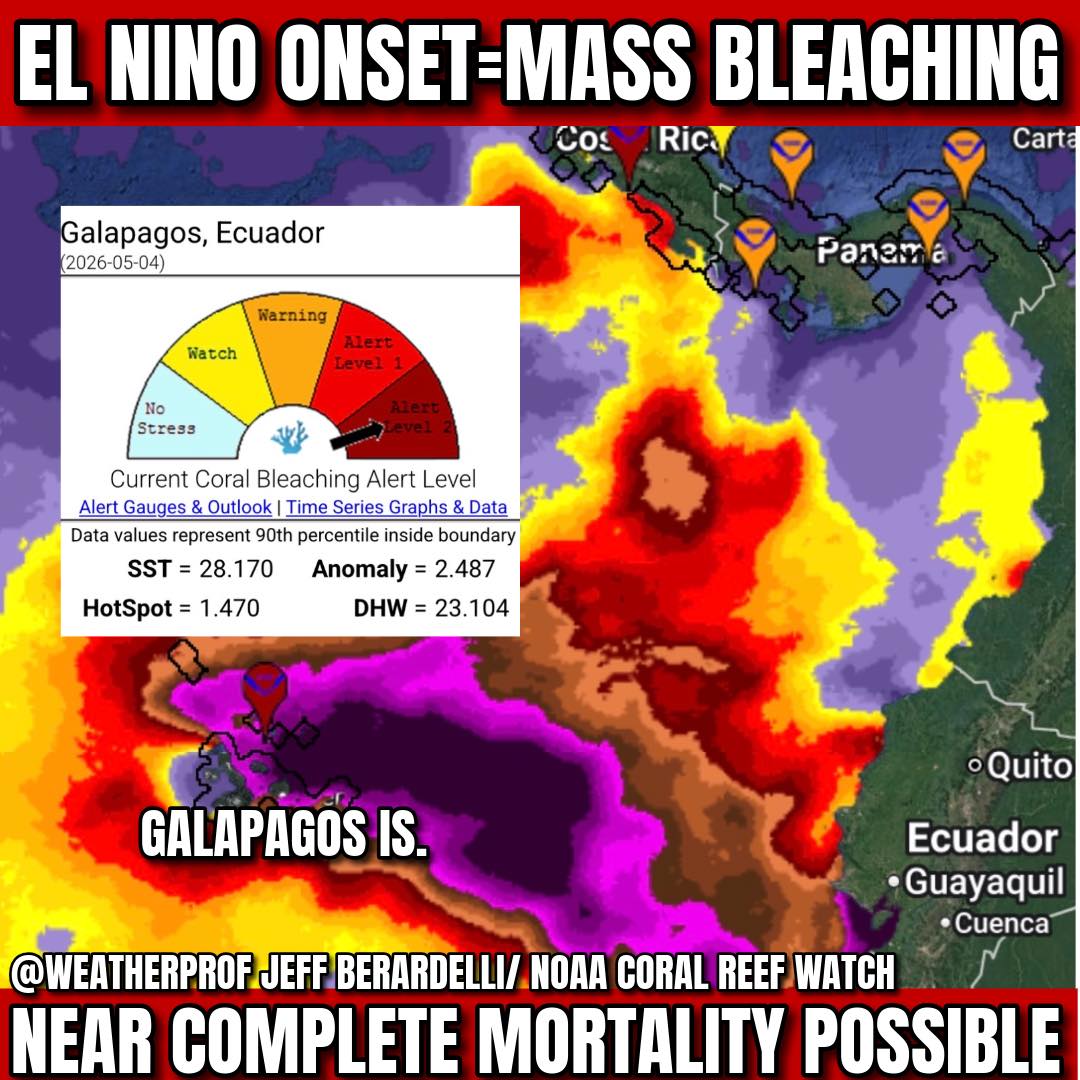
As we shared in last week’s Newsletter (“The 40 Days After Shavuot”), a potentially very strong El Niño is developing in the Pacific for late 2026. Meteorologist Jeff Berardelli recently highlighted the growing emergency: sustained marine heat stress has now reached 20+ weeks in the waters around the Galápagos Islands. NOAA’s Coral Reef Watch warns this level means “Near Complete Mortality” of shallow-water coral reefs.
The Galápagos Penguins — already listed as Endangered with only a few thousand left — are facing a life-threatening event. These birds rely on the cold, nutrient-rich upwelling of the Cromwell Current to bring fish to the surface. When El Niño warms surface waters by +5–10°F, that upwelling shuts down like a lid on a pot. The entire food chain collapses: phytoplankton dies off, fish disappear, and predators starve.
This is not theory. The 1982–83 super El Niño killed 77% of the Galápagos penguin population. The 1997–98 event caused a similar ~65% crash. Scientists describe it as a cascade: primary productivity collapses, and the ecosystem sickens from the bottom up.
The Galápagos Islands are the living laboratory that helped inspire Charles Darwin’s theory of evolution — a place of unparalleled biodiversity found nowhere else on earth. Now that same unique ecosystem is under severe stress.
The Revelation Connection: Waters Turning to Blood and Fish Dying
This brings us to one of the most sobering prophecies in the Book of Revelation.
In the second trumpet judgment (Revelation 8:8-9):
“The second angel sounded his trumpet, and something like a huge mountain, all ablaze, was thrown into the sea. A third of the sea turned into blood, a third of the living creatures in the sea died, and a third of the ships were destroyed.”
And again in the second bowl judgment (Revelation 16:3):
“The second angel poured out his bowl on the sea, and it turned into blood like that of a dead person, and every living thing in the sea died.”
Many readers have asked: Could the increasing intensity of El Niño events be connected to this prophecy?
Not a literal fulfillment yet — we have not seen one-third of the world’s oceans turn to literal blood. But we are watching a powerful shadow and precursor of exactly what John described.
During strong El Niño events, scientists have documented massive harmful algal blooms (red tides) that literally turn stretches of ocean reddish-brown and kill huge numbers of fish and marine life. The warm, stagnant waters create perfect conditions for these toxic blooms. The result? Dead fish washing ashore by the thousands, oxygen-depleted “dead zones,” and entire food webs collapsing — precisely the imagery of “the sea turned into blood” and “every living thing in the sea died.”
What we are seeing in the Galápagos right now is a localized but dramatic picture of that judgment: waters that can no longer sustain life, coral reefs dying en masse, and iconic species like the penguins facing starvation.
Why This Matters in the Sabbatical and Jubilee Cycles
As we have been teaching for years, the curses of Leviticus 26 and Deuteronomy 28 intensify as we approach the end of this age. Famine, pestilence, and destruction of the land and seas are part of the warning signs.
El Niño is a natural cycle — but its increasing frequency and severity on top of long-term warming are making each event more destructive. The very mechanisms God built into creation (upwelling, nutrient flows) are being disrupted on a scale that mirrors the judgments written 2,000 years ago.
This is not coincidence. It is a sign.
The same waters that once teemed with life are now showing us what happens when the life-giving systems are shut off. Just as the Nile turned to blood in Egypt as a judgment, we are seeing pockets of the sea behave the same way today.
The prophecy is clear: one day a third of the sea will turn to blood and the fish will die on a global scale. What we are seeing in the Galápagos is a warning shot — a small-scale rehearsal so that those with eyes to see will understand the times.

Philippines Faces Severe Drought
Philippines Faces Severe Drought
The Same El Niño Now Threatens Millions
As we reported in this week’s Newsletter about the unfolding crisis in the Galápagos Islands, the same powerful El Niño event now developing in the Pacific is set to bring the opposite disaster halfway around the world — to the Philippines.
While the eastern Pacific suffers from extreme marine heat and ecosystem collapse, the western Pacific (including the Philippines) is forecast to experience significantly reduced rainfall, prolonged dry spells, and outright drought through the remainder of 2026 and into early 2027.
PAGASA (the Philippine Atmospheric, Geophysical and Astronomical Services Administration) raised the country to El Niño Alert on April 22, 2026. Current models give a 79% chance of El Niño developing during the June–August period, with conditions likely persisting until early 2027. This aligns with NOAA and international forecasts for a moderate-to-strong event.
What This Means for the Philippines
El Niño disrupts normal weather patterns by weakening the rains that the Philippines depends on. Expected impacts include:
- Widespread drought and dry spells — Especially in central and eastern parts of the country.
- Agriculture under threat — Rice, corn, and other staple crops will face water shortages, leading to lower yields, higher food prices, and potential food security issues.
- Water shortages — Reservoirs, rivers, and groundwater levels will drop, affecting households, farms, and industry.
- Energy concerns — Reduced hydroelectric power could lead to brownouts.
- Health and safety — Extreme heat, dust, and increased risk of wildfires.
- Fewer typhoons — While this may sound positive, it also means less rain from tropical systems.
Western Luzon may see some relief from the Southwest Monsoon, but overall the second half of 2026 looks much drier than normal.
This is the very same El Niño mechanism we described in the Galápagos article: warm surface waters shutting down the normal upwelling and nutrient flows. On one side of the Pacific it kills marine life; on the other side it withholds the rain.
Another Shadow of Revelation’s Prophecies
These twin disasters — dying seas in one region and dying lands in another — echo the judgments described in the Book of Revelation.
In the second trumpet (Revelation 8:8-9), a third of the sea turns to blood, and a third of the living creatures in the sea die.
In the second bowl (Revelation 16:3), the sea becomes like the blood of a dead man, and every living thing in it dies.
We are not yet seeing one-third of the global oceans literally turn to blood. But we are watching the mechanisms that could produce such judgments already at work on a regional scale: waters that no longer support life and lands that no longer receive the rain needed for life.
The same El Niño event is simultaneously destroying marine ecosystems in the east and threatening agriculture and water supplies in the west. This is a powerful illustration of how quickly the birth pains can intensify.
As we continue in the 3rd year of the 5th Sabbatical Cycle and the 32nd year of the 120th Jubilee Cycle, these events line up with the increasing curses warned about in Leviticus 26 and Deuteronomy 28 — drought, famine, and distress upon the land.
What Should We Do?
The signs are speaking loudly. The earth is groaning under the weight of the times we are in (Romans 8:22).
- Watch the weather patterns and the increasing intensity of these cycles.
- Repent and return fully to Torah — keep the Sabbaths, Holy Days, and Sabbatical years.
- Prepare — Water storage, food reserves, and community support will be critical in the months ahead.
- Pray — For the people of the Philippines, for farmers facing crop failure, and for mercy upon the nations.
What we are seeing in the Galápagos and now in the Philippines are not random events. They are warnings — small-scale rehearsals of the greater judgments yet to come.
The clock is running. The signs are increasing.
Lag BaOmer 2026
Lag BaOmer 2026
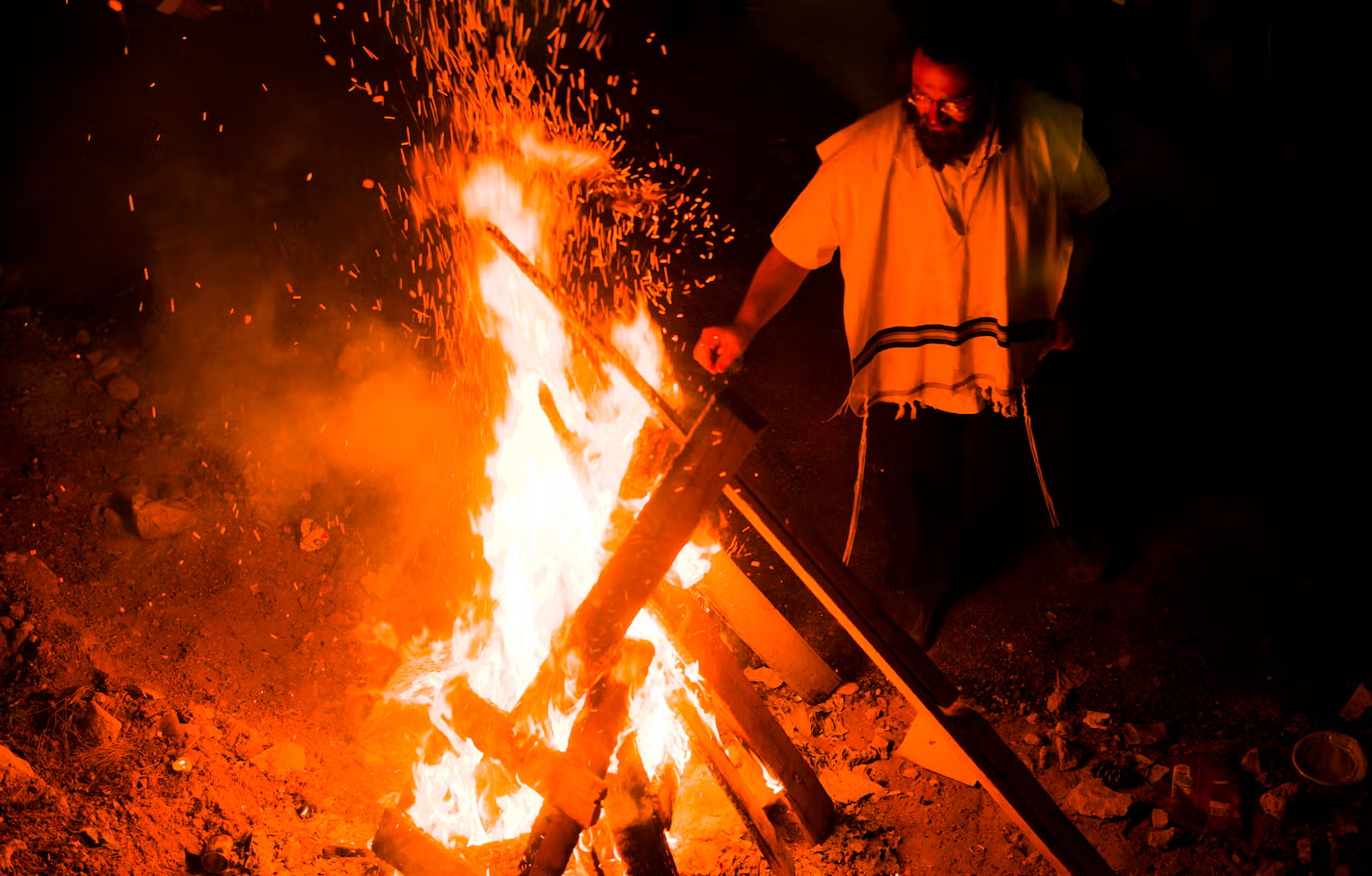
Lag BaOmer 2026 is observed on Tuesday May 5, 2026 (starting Monday night), marking the 33rd day of the Omer count. It is a joyful, festive day in the Jewish calendar, celebrating the anniversary of the passing of Rabbi Shimon bar Yochai and the end of a plague among Rabbi Akiva’s students.
Lag BaOmer literally translates to “the 33rd day of the Omer.” The Hebrew word Lag comes from letters Lamed (which represents the number 30) and Gimel (3), equaling 33. BaOmer means “in the Omer,” referring to the 49-day period between Passover and Shavuot.
Lag BaOmer doesn’t exist in the Torah. It’s not a major pilgrimage festival like Passover, Shavuot or Sukkot. It lives in the margins of the calendar, emerging from layers of rabbinic tradition, historical memory, and later mystical interpretation. It is in the same category as Chanukah and Purim which are also not found in the Torah.
And diaspora Judaism, especially in its modern forms, tends to prioritize what is structured, text-based, and universally understood. Lag BaOmer is none of those things. It’s messy. It’s folkloric. It’s built on fragments — like the tradition that a deadly plague struck the students of Rabbi Akiva, one of the most influential sages in Jewish history, and that it ceased on this day — alongside mystical associations and scattered customs that don’t resolve into a clean narrative.
So, why do I not teach you about Lag BaOmer? Why do we not celebrate this amazing festival each year as we count the Omer? (I say this tongue-in-cheek.) For the very same reason I do not keep nor endorse the keeping or celebrating of Rosh Hashanah as the New Year, Chanukah, Purim and those on the following list:
- Tu B’Shevat (Tu Bishvat) — 15th of Shevat
The “New Year for Trees.” A minor joyful day focused on nature, planting trees, and eating the Seven Species of Israel (fruits and nuts). It developed in the Middle Ages and became especially popular in the Kabbalistic and modern Zionist periods. - Tu B’Av — 15th of Av
An ancient day of joy mentioned in the Talmud (one of the happiest days of the year in Temple times). Today it is often celebrated as a kind of “Jewish Valentine’s Day” with matchmaking, singing, and romance. It falls six days after Tisha B’Av. - Shushan Purim — 15th of Adar (in walled cities like Jerusalem)
An extension of Purim for certain locations.
Major and Minor Fast Days (Besides Yom Kippur)These commemorate tragedies, mostly related to the destruction of the Temples:
- Tzom Gedaliah (Fast of Gedaliah) — 3rd of Tishrei (right after Rosh Hashanah)
- Asarah B’Tevet (10th of Tevet) — Marks the start of the siege of Jerusalem
- Ta’anit Esther (Fast of Esther) — 13th of Adar (day before Purim)
- Shiva Asar B’Tammuz (17th of Tammuz) — Breaching of Jerusalem’s walls
- Tisha B’Av (9th of Av) — The saddest day on the Jewish calendar. It commemorates the destruction of both Temples and many other tragedies. A full 25-hour fast with mourning customs.
If you can find them written in Leviticus 23 and supported by Torah and Yehovah, then please by all means correct me. I will fast on the 9th of Av in remembrance of the two times the Temple was destroyed by Yehovah for our sins as well as the time when the 10 spies brought back an evil report.
Here is one of the early fire lighting and jumping rituals I could find.
Roman – Parilia (April 21)This is the clearest example of large ritual bonfires in spring.
- Parilia (also spelled Palilia) was the annual rural festival on April 21 honoring the Roman god Pales (a deity — sometimes described as male, female, or a pair — protector of shepherds, flocks, and herds).
- Ritual: Shepherds swept the pens, then built bonfires from straw, olive branches, laurel, juniper, pine, and sulfur. The smoke and flames purified the animals and stalls. Herdsmen and sheep were made to jump over the bonfire three times. Simple offerings (milk, cakes) were given, and prayers asked Pales to remove any accidental sins and grant fertility/protection.
- It later became tied to the legendary birthday of Rome itself.
- Primary source: Ovid’s Fasti (Book 4) — a detailed, first-hand poetic description of the exact ritual from the early Imperial period, drawing on older Roman tradition. Other Roman writers (Varro, etc.) confirm the pastoral fire-jumping and purification.
This was a genuine spring bonfire custom, done explicitly to Pales for the health and increase of livestock at the start of the grazing season.
Large ritual bonfires are a central and ancient feature of the spring festival.
- Holi / Holika Dahan (the bonfire night before the main color-throwing day) falls on the full moon of Phalguna (March). This is explicitly a spring festival celebrating the end of winter and the triumph of good over evil.
- Ancient sources:
- The Atharvaveda Parishishta (an appendix to the Atharvaveda, one of the oldest Vedic texts) refers to Holaka (or Holi) as an “evening of bonfires” involving burning wood or cow-dung cakes. It describes it as a recognized festival with ritual burning.
- The Puranas (especially the Narada Purana and others) give the full mythological basis: the story of Prahlada and the demoness Holika, who tried to burn the devotee of Vishnu but was herself consumed by the fire. The bonfire (Holika Dahan) reenacts this — an effigy of Holika is burned while Prahlada is spared through divine protection.
- The ritual involves building a large communal bonfire, circumambulating it, offering grains or household items, and saying prayers. It symbolizes purification, the burning away of evil/negativity, and the arrival of spring fertility.
This is one of the clearest and best-documented ancient spring bonfire traditions in the Indo-European world.
Allow me to share one Easter tradition with you from Germany.
Osterfeuer Tradition
Osterfeuer, or Easter bonfires, are a very old tradition that harks back a long time. It is said that even the ancient Egyptians lit huge bonfires to drive winter away and welcome the sun. This custom spread out to what later became Northern Germany, and by the Early Middle Ages, Christians adopted the pagan spring ceremonies and incorporated them into their liturgical Easter services.
At that time, a small fire – the Easter Fire – was lit and consecrated by a priest. Once the congregation had gathered around the Easter Fire, the priest would light the Paschal candle from the fire and carry it into the dark church. This was meant to symbolise the beginning of a new Easter Vigil and the rebirth of Christ.
Why Northern Germany?
The tradition has some practical appeal as well: this early-spring rite coincides with the trimming of the many hedges, trees and stretches of woodland that are used in northern Germany to separate plots and farmland. As these trimmings need to be disposed of, huge Osterfeuer bonfires are piled high every Easter and lit up to the delight of the communities in neighbouring villages and rural areas.
Over the course of centuries, these large bonfires have become a seasonal tradition allowing neighbours and communities to catch up and get reacquainted after a long and harsh winter. Guarded by the local Freiwillige Feuerwehr associations, it goes without saying that no Easter bonfire is complete without a steady supply of beer, mulled wine and grilled goods. After all, this is something that most Christians and pagans alike can agree on.
Bonfire traditions are not limited to the north of Germany, though they are called by different names in other areas: the Eifel region has its Hüttenbrennen (lit. ‘burning of the huts’) and the region around Lake Constance celebrates the Funkenfeuer (lit. ‘spark fires’). However, these usually take place significantly earlier in the year. This is also one of the reasons why Osterfeuer are not to be confused with the quite distinct North Frisian tradition of Biikebrennen, where piles of wood and reed would be burned to bid farewell to the seamen at the beginning of whaling season.
Regular Osterfeuer in Hamburg
Hailing from a rural tradition, Easter bonfires are most common in Hamburg’s suburban neighbourhoods and the outskirts. Two of the most notable bonfires are the Osterfeuer at the Elbstrand Blankenese and the giant bonfire at Horner Rennbahn, both happening on Holy Saturday evening.
But there are also some smaller bonfires on Holy Saturday and Easter Sunday night from Stellingen and Eidelstedt all the way to Langenhorn and the Wandsbek neighbourhoods of Poppenbüttel, Bergstedt and Volksdorf.
This research has come about because of a video one of our Executives shared with me, and I thought it was worth sharing with you all along with this other research. The following is the transcript from that video below. I strongly urge you all to watch and make yourself aware of this.
Full Transcript (as of May 2026)Elon Gilad:
Tonight in Israel, hundreds of thousands of people will celebrate Lag BaOmer. Religious Jews will gather on Mount Meron to honor Rabbi Shimon bar Yochai. Secular Israelis will light bonfires for Bar Kokhba. Both stories feel ancient. Both feel obvious. And both are wrong. Holidays are not invented in one moment by one person. They’re built layer on layer. The day everyone is celebrating tonight has at least five distinct layers underneath it, laid down across 500 years by communities on three continents who would not have recognized each others’ customs. Let me show you.Sometime in the 5th century, somebody at a synagogue in the Beit She’an Valley painted a list onto a pillar in red paint. A list of fasting days. And on that list, for the first time in any document anywhere, the 18th of Iyar appears. Not as a celebration, as a fast. A 7th century liturgical poem from the land of Israel gives this fast a name: Tsom Yehoshua, the fast of Joshua. As in Joshua bin Nun, the conqueror of the land. But that’s strange — earlier rabbinic sources actually place Joshua’s death in the month of Nisan, not Iyar. So what is that date?Here’s what actually happened. On the night of May 18th in the year 363, a massive earthquake rolled across the Galilee. We can date it precisely from destruction levels. The Talmud has a tradition that on the day Joshua died, the earth shook. Joshua in the rabbinic imagination is associated with earthquakes. So when the Galilean Jews mark this real earthquake on their calendar, they pick the figure already linked to earthquakes in their tradition. The earthquake fast becomes the fast of Joshua. That is layer one.Layer two is added four centuries later in Babylonia. The head of the great Babylonian Academy of Sura, Rav Natronai Gaon, gets asked, “Why don’t Jews marry during the Omer?” — the seven weeks between Passover and Shavuot. He cites a Talmudic story: Rabbi Akiva had 24,000 students. They all died mysteriously between Passover and Shavuot. That is why we mourn during the Omer.There’s a problem. The older versions of this story don’t have that line at all. The real reason is simpler. The Romans had a strict taboo against weddings during the month of May. May was when the spirits of the dead came back — meaning bad luck. Jews living in the Roman world picked up that taboo, transposed it into the matching Hebrew month of Iyar, and later forgot why. So now the whole Omer is a mourning period built on a Roman pagan custom with a Talmudic cover story. Already two layers in. Two completely different reasons attached to the same date. And we’re not close to where Lag BaOmer is now.Layer three is the first time this date becomes a celebration. In late 12th century France, a rabbi named Avraham ben Nathan writes the first surviving book to use the phrase “Lag BaOmer” at all. By the early 15th century in Germany, the great Ashkenazi authority known as the Maharil describes Lag BaOmer not just as the day Omer mourning ends, but as the day Jews actively rejoice. Students get the day off. They go out into the woods. They light bonfires. They run foot races. They shoot bows and arrows.These should sound familiar. Every single one of them is borrowed. April 30th, the night when Lag BaOmer most often falls, is Walpurgisnacht — the Germanic Christian/pagan folk festival celebrated across Central Europe with bonfires, people running through the fields, and archery contests. The same cluster of customs transposed wholesale into the Jewish calendar. The bonfires are not Jewish. The arrows are not Jewish. The day off is not Jewish.Layer four moves the holiday to the mountain — to Mount Meron in the Upper Galilee — and to the supposed grave of Rabbi Shimon bar Yochai. For centuries before the 16th century, the pilgrimage to Meron existed, but it was not about Rabbi Shimon at all. Medieval pilgrim accounts agree: it was about the graves of Hillel and Shammai. Rabbi Shimon was a footnote.The shift happened in the 16th century in Safed. And it happens because of one specific text — and the text contradicts itself. Rabbi Isaac Luria, the Ari, the most influential kabbalist of his generation, arrives in Safed in the 1570s and dies a few years later. His student, Hayyim Vital, writes his teachings down after his death.In Vital’s book, there’s a passage that becomes the entire basis for the modern Lag BaOmer pilgrimage. The passage says: “My teacher, the Ari, once went to Meron with his whole family on Lag BaOmer. They stayed there three days. Another student told me that in an earlier year, the Ari took his 3-year-old son there on Lag BaOmer to give him his first haircut.”That single passage is the basis for the bonfires at Meron, the first haircut at three, and the hundreds of thousands of people climbing Mount Meron every spring.But Vital’s own book contradicts him. Two pages before the famous Meron passage in the same chapter, Vital writes: “On these 49 days of the Omer, my teacher did not cut the hair of his head except on the eve of Passover and the eve of Shavuot. He did not cut his hair on Rosh Chodesh Iyar and Lag BaOmer under any circumstances.” The Ari did not cut his hair on Lag BaOmer.Vital himself flags it. He ends the Meron story with: “However, I do not know if my teacher was already an expert in the wondrous wisdom that he attained afterwards.” In other words, Vital wasn’t sure. He was passing on hearsay from another student. The whole tradition rests on a rumor.The first published Jewish book to claim that Rabbi Shimon bar Yochai actually died on Lag BaOmer doesn’t appear until 1731, almost 160 years after the Ari was already dead. That is layer four.Four layers deep — none of them match.Layer five comes last, and it comes from the secular side of the Jewish world. For most of Jewish history, Bar Kokhba, the 2nd century revolutionary who led a catastrophic revolt against Rome that got hundreds of thousands of Jews killed, was not a hero. He was an embarrassment. The Talmud sometimes calls him Bar Koziva — “son of a lie.”But the Zionists rebranded him. In 1911 in Warsaw, a rabbi named Yitzhak Nissenbaum publishes a book called Hagut Lev. And in it, he proposes that Lag BaOmer is the anniversary of a Bar Kokhba victory over the Romans. He had no evidence. He says so. He just thinks the day must have been important once, and asks his readers to imagine it back into existence.And the Zionist movement runs with it. The bonfires borrowed from Walpurgisnacht 500 years earlier are reframed as Bar Kokhba signal fires. The bows and arrows are reframed as Bar Kokhba weapons. By the 1950s, every Israeli child is taught Lag BaOmer is about Bar Kokhba. None of them know it comes from medieval Germany.So tonight, on the same date, three different holidays are happening on top of each other, and most of the people celebrating each version don’t realize the others exist.In Bnei Brak and on Mount Meron, religious Jews are celebrating the death day of a Talmudic rabbi based on a story his own kabbalist refused to vouch for. In Tel Aviv and Haifa, secular kids are lighting bonfires for a victory invented in Warsaw in 1911 using customs that began as German pagan rituals. And underneath both of them, almost forgotten, is a Galilean fast for an earthquake from 363 recorded once on a synagogue pillar in red paint and almost lost.Five layers. None of them know each other. Holidays aren’t invented in one moment. They’re built layer on layer. The Lag BaOmer celebrated tonight in Israel is something none of its ancestors would have recognized.Now you know.
440 Kilograms
440 Kilograms
The 440 Kilograms That Could Still Erase Israel – And the Prophetic Warning No One Wants to Hear
“No weapon forged against you will prevail, and you will refute every tongue that accuses you. This is the heritage of the servants of the LORD.” (Isaiah 54:17)
Two devastating wars have been waged against Iran’s nuclear program in less than a year. In the 12-Day War of June 2025, Israeli F-35s and American B-2 bombers struck Fordow, Natanz, and Isfahan. Then came Operation Epic Fury in February 2026 – the joint U.S.-Israeli campaign that decapitated the regime, eliminating Supreme Leader Ali Khamenei and shattering missile production lines and air defenses.
Yet quietly, beneath the rubble and the headlines, roughly 440 kilograms of uranium enriched to 60% – material that sits just one short technical step from weapons-grade 90% – remains in Iranian hands.
What Does “One Short Technical Step” Actually Mean? (Explained Simply)
Think of uranium enrichment like climbing a tall staircase. Getting from raw, natural uranium (0.7% pure) all the way up to 60% takes the vast majority of the effort – thousands of spinning centrifuges, years of work, and over 55,000 “Separative Work Units” (SWU), the standard measure of enrichment effort.
Once you’re already at 60%, jumping the final stretch to 90% (weapons-grade) is like climbing the last few stairs. IAEA calculations show it would require only about 564 SWU – roughly 1% of the work already invested in that stockpile. The hard part is done. The centrifuges are already configured for high enrichment. It’s now a relatively quick, straightforward technical process.
Conservatively, that 440 kg stockpile is enough fissile material for nine to ten nuclear warheads (about 42 kg per weapon). Israel, a country the size of New Jersey, facing a regime whose founding charter calls for its destruction.
What Iran Actually Did – And the Place They Buried It
In the days before the June 2025 strikes, commercial satellite imagery captured a flatbed truck carrying 18 bright-blue containers entering the southern tunnel entrance at the Isfahan Nuclear Technology Center (June 9, 2025). Nuclear analysts from the Institute for Science and International Security (ISIS) and others identified those containers as specialized transport casks capable of holding highly enriched uranium (HEU).
IAEA Director General Rafael Grossi stated in March 2026 that “a large percentage” of the 440.9 kg stockpile – roughly 200 kg or more – was stored at Isfahan when the first war broke out, and “it has been there ever since.” Even after the February 2026 strikes, the majority of this material is believed to remain intact in the underground tunnels.
Yes – this is exactly the place Iran deliberately buried the material after the first attack. They saw the strikes coming and rushed the HEU into deep mountain tunnels designed to protect their most valuable nuclear assets. The bombs fell on concrete and steel, but the finished product was already safely hidden underground.
The Analysis – Building on Nahanyah Naphtalie’s Urgent Warning
Nahanyah Naphtalie’s recent article rightly highlighted this overlooked reality: two wars accomplished historic damage but left the most critical element untouched. As he wrote, “no campaign that leaves the Iranian regime in possession of ten bombs’ worth of near-weapons-grade material can be called complete.”
We can now add even more detail:
- Pickaxe Mountain (Kuh-e Kolang Gaz La) near Natanz remains untouched by either war and is being actively hardened. This deeply buried tunnel complex – potentially intended for new enrichment or HEU storage – has seen ongoing construction, concrete pouring over tunnel entrances, security upgrades, and interior outfitting even after the February strikes. It is not yet fully operational, but satellite imagery as recent as February 2026 shows it is “moving closer,” with heavy machinery still on site.
Iran formally cancelled the Cairo Agreement, refuses status reports on its enriched uranium, and insists enrichment is its “right.” This is textbook nuclear hedging: a regime that has been beheaded but not disarmed, a program that has been bombed but not extinguished.
The Biblical Lens: Zechariah’s Flying Scroll, the Wicked Fire, and Revelation 17
For those who study the Sabbatical and Jubilee cycles and watch the signs of the times, this is not merely geopolitics.
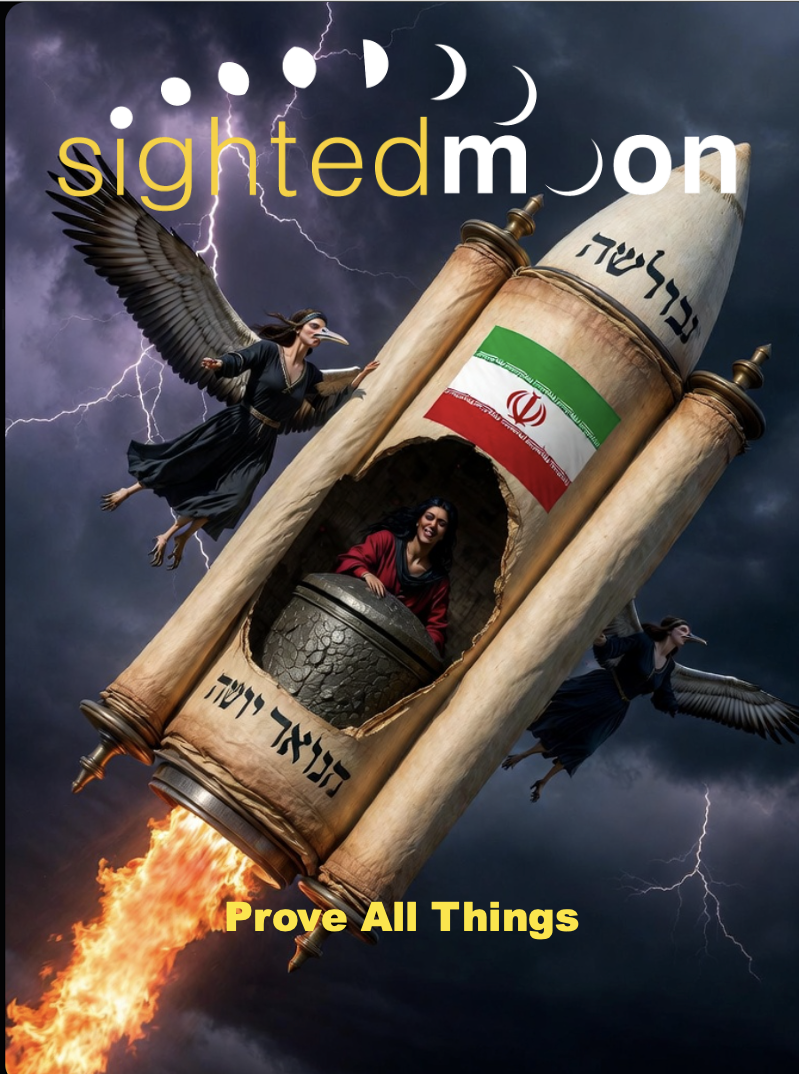
In Zechariah 5, the prophet sees a “flying scroll” (or roll) – 20 cubits long by 10 cubits wide. Using the sanctuary cubit, which measures approximately 34.4 feet long by about 5.5 feet in diameter when understood as a cylindrical object. That is an exact dimensional match for a Scud missile – the type Iran has long possessed and modified. The scroll carries a curse that consumes houses and people.
Then Zechariah sees a woman sitting inside an ephah (a measuring basket) covered by a heavy lead lid. In Hebrew, the word for “woman” (ishah) is nearly identical in sound and spelling to the word for “fire” (esh). Many students of prophecy see this as no coincidence: a wicked fire (nuclear payload) sealed in a lead container (radiation shielding) being carried away. Two women with stork-like wings lift the ephah and take it to Shinar (ancient Babylon – modern-day Iraq/Iran region) to build it a house.
Zec 5:1 And I again lifted up my eyes and looked. And behold! A flying scroll.
Zec 5:2 And he said to me, What do you see? And I answered, I see a flying scroll; its length is twenty cubits, and its width ten cubits.
Zec 5:3 And he said to me, This is the curse that goes forth over the face of the whole earth; for from now on everyone who steals shall be cut off according to it; and everyone who swears from now on shall be cut off according to it.
Zec 5:4 I will bring it forth, says Jehovah of Hosts; and it shall enter into the house of the thief, and into the house of him who swears falsely by My name. And it shall remain in the midst of his house, and shall devour it, and its timber and its stones.
The flying scroll (missile) carrying the wicked fire (nuclear warhead in a lead-shielded ephah) matches the very threat we see today.
Revelation 17 describes the beast that “was, and is not, and yet is” – the entity that seemed destroyed but ascends again out of the bottomless pit (Revelation 17:8, 11). Apollyon, the Destroyer from the pit (Revelation 9:11), is expected in prophetic timelines to emerge or manifest in 2028 – the same year President Trump’s second term ends. This year of 2028 is a theory we have based on the Jubilee cycle. We do not know for sure. It could come earlier or later; we just don’t know, but it is coming and it is coming soon.
A Vision of a Woman in a Basket
Zec 5:5 Then the angel who talked with me went forth and said to me, Now lift up your eyes and see what this is that goes forth.
Zec 5:6 And I said, What is it? And he said, This is the ephah that goes forth. And he said, This is their form in all the earth.
Zec 5:7 And behold, a lead cover was lifted up, and a woman was sitting in the middle of the ephah.
Zec 5:8 And he said, This is wickedness. And he cast it into the midst of the ephah. And he cast the lead stone over its opening.
Zec 5:9 And I lifted up my eyes and looked, and behold, two women came out. And the wind was in their wings; for they had wings like the wings of a stork. And they lifted up the ephah between the earth and the heavens.
Zec 5:10 And I said to the angel who talked with me, Where are they going with the ephah?
Zec 5:11 And he said to me, To build a house for it in the land of Shinar; and it shall be established and set there on its own base.
History is unkind to nations that pause halfway and do not complete the objectives of the wars they fought. The signs are not subtle. A fragile ceasefire holds as of May 2026, yet Iran continues to fortify undeclared sites. They talk as if they have won the fight with the US and Israel. The regime still rules, but most of all, the uranium is still there. The threat has not been eliminated.
The clock is still running.
The danger has not passed – the first woe is approaching.
— Sightedmoon.com
Building on the urgent analysis first presented by Nahanyah Naphtalie, with additional verified details from IAEA reports, satellite imagery, open-source intelligence, and biblical context as of May 2026.
Searching for the Crescent Moon
Searching for the Crescent Moon
The Biblical Role of the Two Witnesses
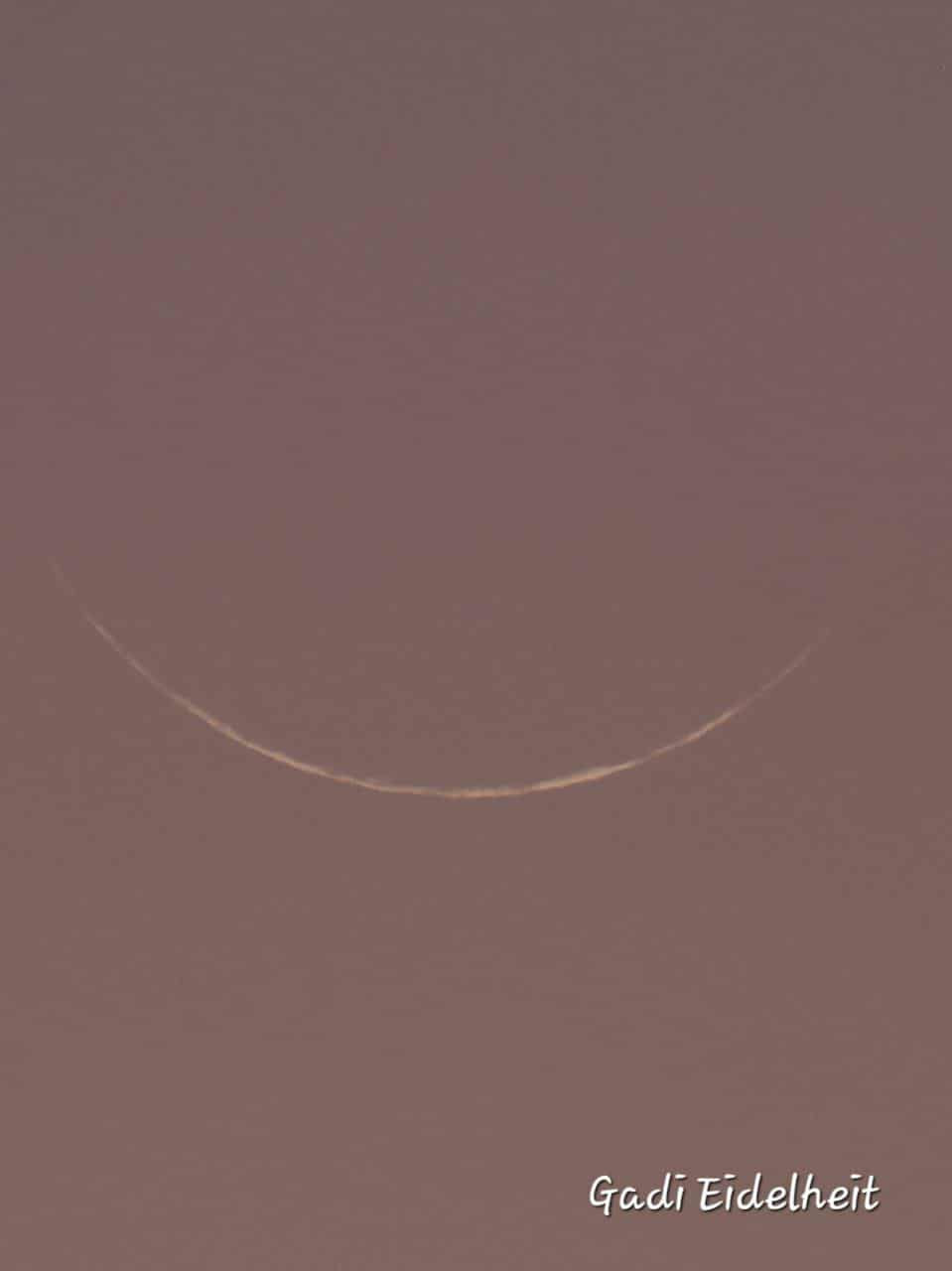
One of the most important — and often misunderstood — practices in keeping the Torah calendar is the sighting of the first visible crescent moon. This is not a modern invention or a “Jewish tradition” added later. It is the very method the Torah itself requires for determining the beginning of each month (chodesh).
The new moon day of the 4th month (Tammuz is the Babylonian name) this year is expected to fall on the evening of May 16 or 17, 2026, depending on whether the thin crescent is sighted in Jerusalem. We do not know the exact day or hour in advance. That uncertainty is exactly why Yehshua said, “No man knows the day or the hour” (Matthew 24:36) — a direct reference to the Feast of Trumpets and the sighting of the new moon. Please read It Was A Riddle Not A Command to learn more about all of this. You can order it through SightedMoon.com
The Temple Institute on the Two Witnesses
The Temple Institute in Jerusalem has carefully documented the ancient Temple practice of declaring the new moon. Here is their detailed explanation (quoted at length from their official materials): https://templeinstitute.org/rosh-hashana/
Sanctifying the New Moon
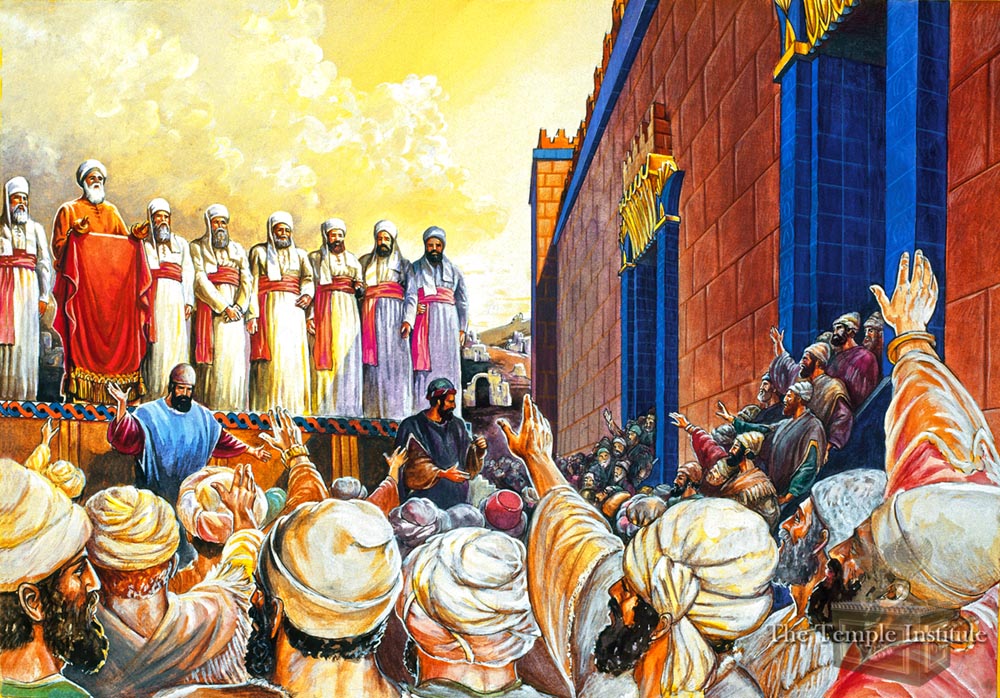
During the time of the Holy Temple, the drama of Rosh Hashana began even before the onset of the holy day. This drama involved the sanctification of the new moon. Rosh Hashana occurs on the first day of the month of Tishrei, and therefore, it can’t begin until the appearance of the new moon has been established. The commandment to declare the new moon and establish its appearance for all the children of Israel was the first commandment received by the Israelites, even before they emerged from their bondage in Egypt, (Exodus 12:2) It may seem ironic that G-d – the King of the universe – would call upon His people to determine, as it were, on what day He Himself created the universe! But this is, in fact, what G-d, in His love for His people did: he entrusted the children of Israel as “partners” in maintaining and perfecting His creation. Two witnesses who had seen the appearance of the new moon were required to testify before the Great Sanhedrin, which convened in the Chamber of Hewn Stone, which was located on the northern wall of the Inner Courtyard of the Holy Temple. There they would be questioned and cross examined to verify their fitness as witnesses, and the truth of their words. Only when this had been done to the satisfaction of the sages of the Great Sanhedrin, would the Rosh Hashana service in the Holy Temple begin. Great care and effort was invested by the sages to ensure the veracity and efficiency of the entire procedure of proclaiming the new moon. Ultimately, it all depended on the willingness of the common people to come forth as witnesses. One can only imagine the sense of obligation and privilege felt by each witness as he made his way to Jerusalem.
The Sanhedrin in Yavneh
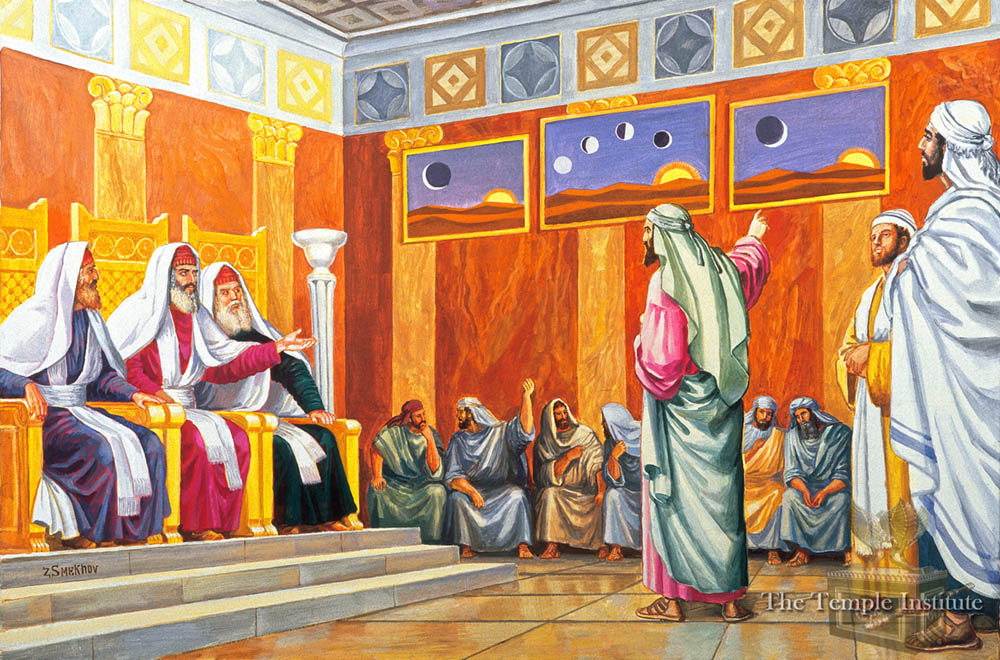
After the destruction of the Holy Temple, the Sanhedrin moved to the town of Yavneh, where it would receive witnesses’ testimony of the new moon. The Talmud relates that Rabban Gamliel displayed pictures of the moon in various stages of its monthly course. He would use the pictures when questioning the witnesses in order to determine the veracity of their testimony. Although this scene portrays the Sanhedrin in Yavneh, after the destruction of the Holy Temple, it no doubt represents similar scenes which occurred every month for hundreds of years within the Sanhedrin that stood upon the Temple Mount.
Witnesses on Shabbat
During the time of the Great Sanhedrin, the new moon was sanctified through the testimony of two witnesses who had seen the new moon. This was in accordance with the biblical commandment. In order to insure that the new moon, (Rosh Chodesh), offerings were prepared in time at the Holy Temple, (as well as the Rosh HaShana offerings on the new month of Tishrei), witnesses were allowed to violate the Shabbat restriction against traveling in order to expedite the new moon proclamation. This picture depicts an ailing witness traveling on Shabbat toward Jerusalem, being aided by armed escorts and companions.
One Time in Lod
An incident is related in the Talmud, concerning the city of Lod: It was Shabbat. A number of witnesses to the new moon were passing through the city on their way to testifying before the Great Sanhedrin in Jerusalem. A man named Zefer, who was the mayor of the city of Geder, detained the witnesses. He was of the opinion that witnesses had most certainly already arrived in Jerusalem and presented their testimony. Therefore, he concluded, it was unnecessary for these witnesses to continue on their way, especially since doing so involved a desecration of the Shabbat.
Beit Ya’azek
A special courtyard, by the name of Beit Ya’azek, was built in Jerusalem, for the purpose of accommodating arriving witnesses to the new moon. There they were provided with a large meal, and a place to rest as they waited to be called to testify at the Great Sanhedrin. The warm welcome received by the witnesses was intended to lighten the burden of their journey, as well as to encourage people to step forth and travel to Jerusalem when they had witnessed the new moon.
The Boethusians
There were enemies of the Jews who sought to harm the Jewish people by deceiving them into observing Rosh Hashana, and the ensuing holidays, at the wrong times. The Talmud tells of an attempt by the Boethusian sect, which one year bribed two witnesses to provide false testimony before the Great Sanhedrin, with the intention of causing the sages to err in their calculations of the new moon. One of the witnesses, however, proved to be a “double-agent,” and revealed to the sages the bag containing two hundred pieces of silver that he had been provided in order to perjure himself. The illustration above shows him holding the bag of silver coins, while the man who had placed the bribe in his hands is being led away to receive his punishment: lashes.
Anticipation
Determining the appearance of the new moon through eyewitness testimony was always accompanied with anticipation and uncertainty. The new moon or new year offerings could not be commenced until two witnesses had arrived and testified before the Great Sanhedrin, to the satisfaction of the Great Sanhedrin. It was customary for people to begin observing the holiday as a precautionary measure, even before the testimony had been offered or accepted. It is told that on one occasion, witnesses arrived at dusk. In the rush and ensuing confusion, the Levites neglected to sing their daily psalm. In order to prevent a recurrence, the sages ruled that testimony would henceforth be accepted only up to the time of the daily afternoon offering. If witnesses failed to arrive by this time, the following day would nevertheless be observed as Rosh HaShana.
Rabban Gamliel and Rabbi Yehoshua
The Mishnah relates the following: A dispute arose between Rabban Gamliel and Rabbi Yehoshua over the criteria for accepting witnesses testifying about the new moon. The disagreement had very serious practical implications, as it affected the dates accepted by each of the sages regarding the holidays of that particular year. In order to prevent national discord, Rabban Gamliel compelled Rabbi Yehoshua to publicly accept his ruling, telling him: “Come to me with your staff and your money on the day that Yom Kippur falls according to your calculations.” Carrying a staff and money were both violations of Yom Kippur. Therefore, by carrying out Rabban Gamliel’s decree, Rabbi Yehoshua was publicly displaying his submission to the ruling by Rabban Gamliel concerning the fitness of the new moon witnesses. The illustration above shows Rabban Gamliel and Rabbi Yehoshua, (with staff and wallet), embracing, thus ending their dispute.
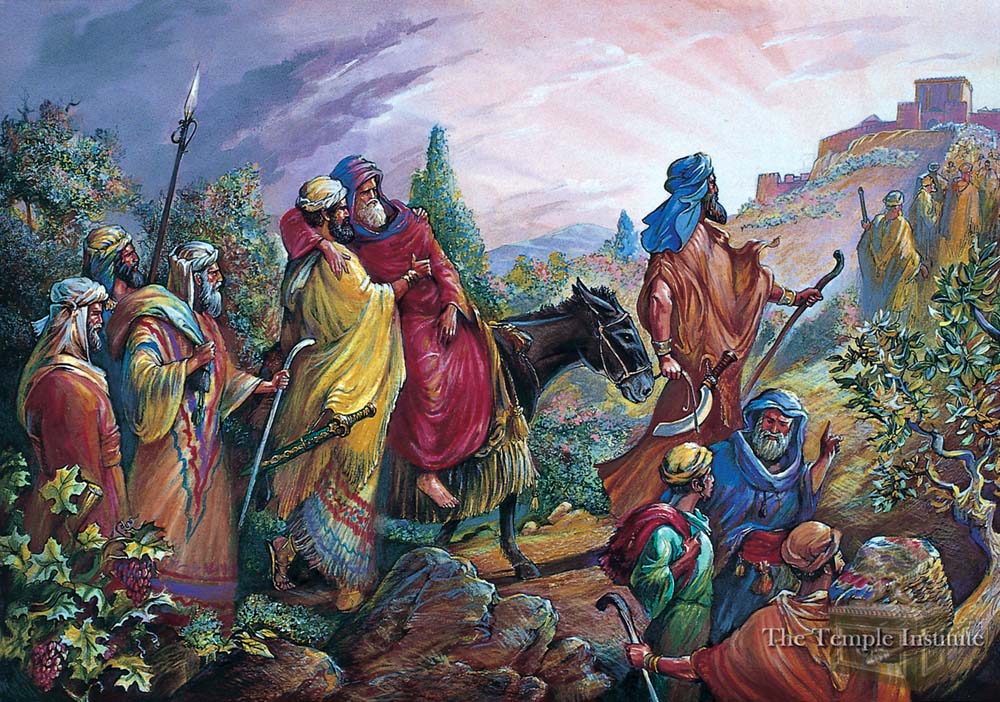
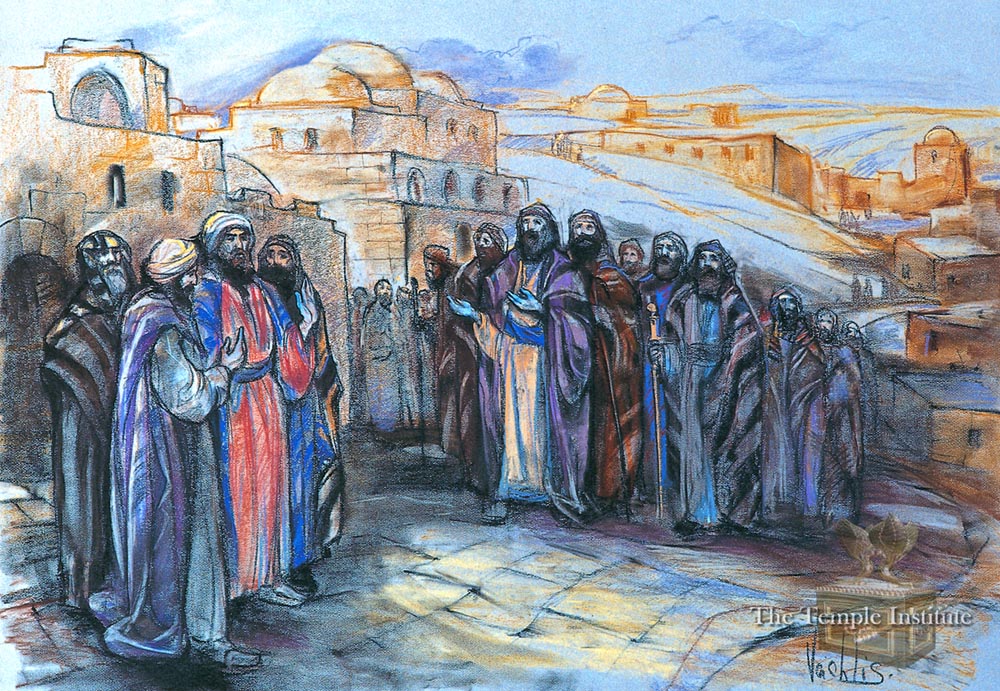
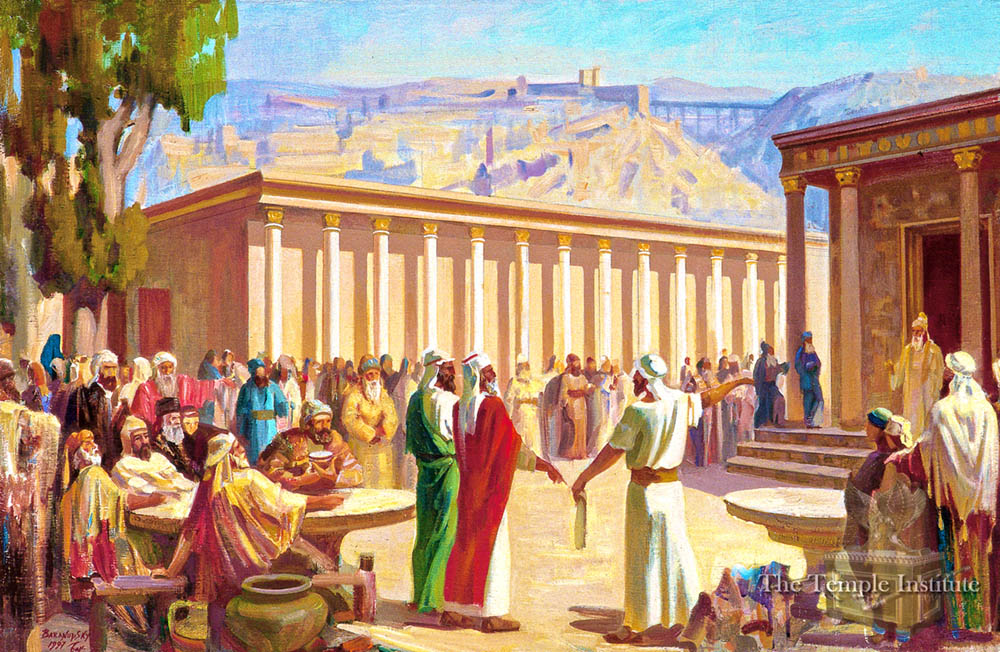
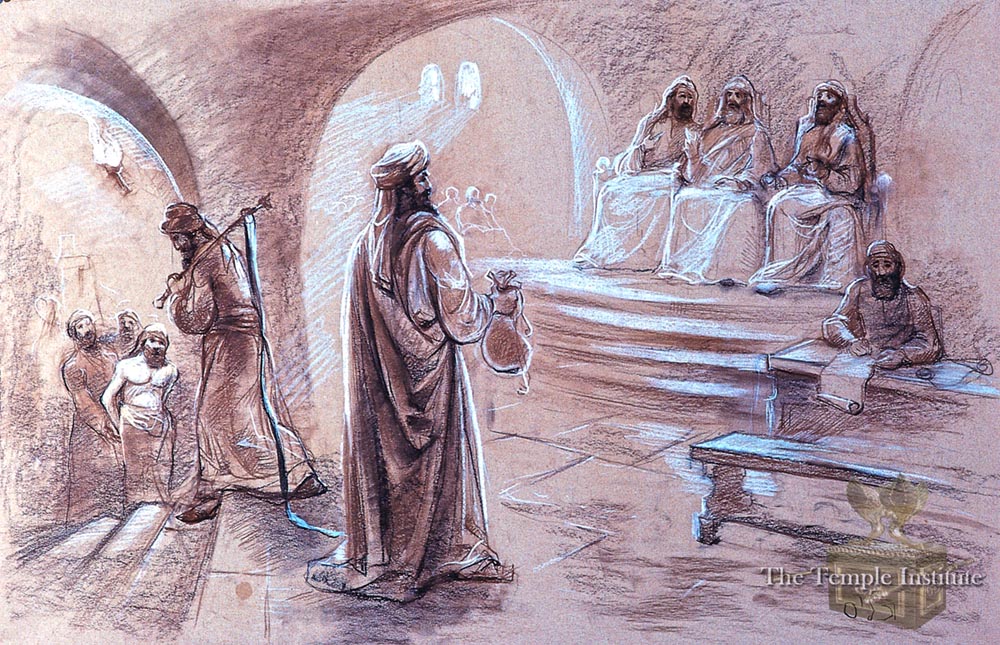
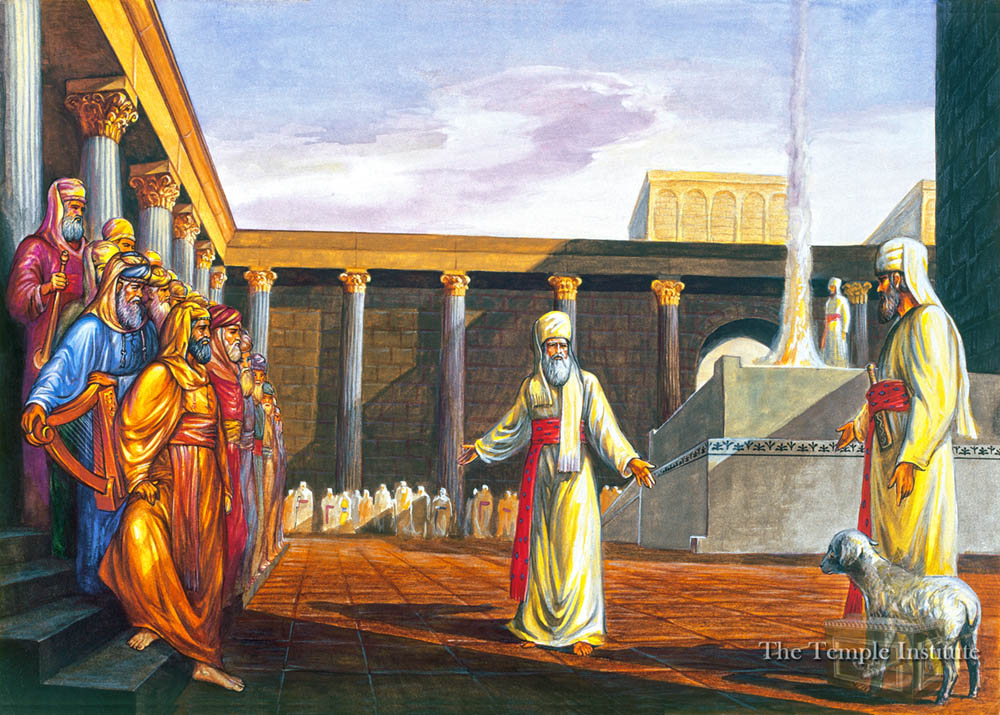
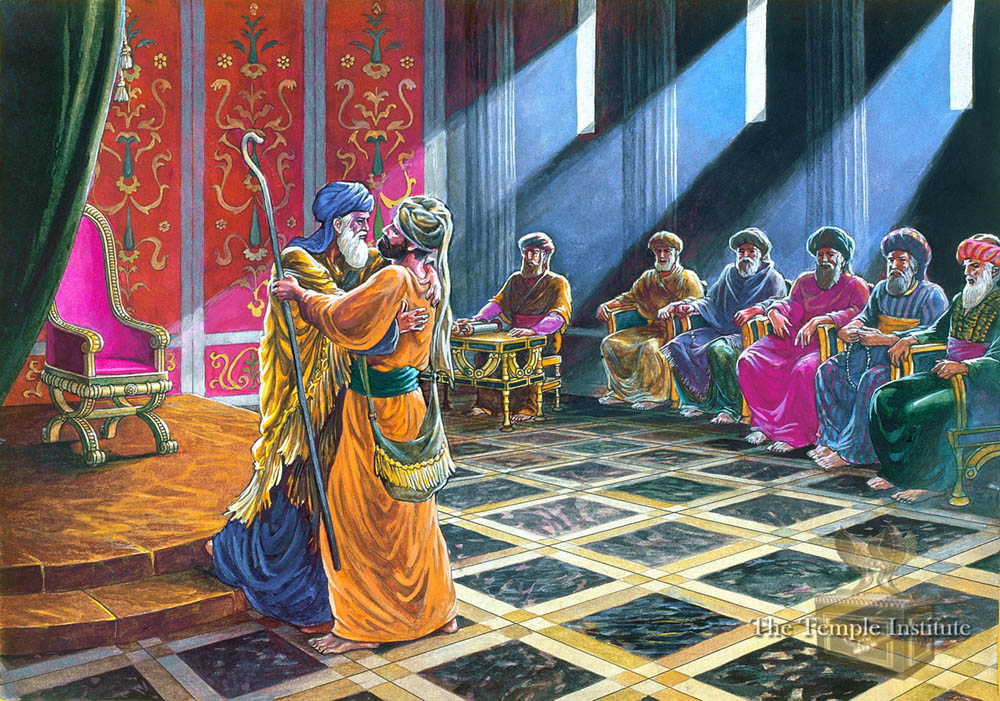
From the Temple Institute themselves, they testify to the fact that the moon used to be sighted each month to begin each month, and they had all these preparations for all the potential witnesses that would come and report the sighting of the moon. This was long before the Hillel calendar, which began to use the conjunction or calculated calendar after 358 C.E.
This was not optional. It was the commanded biblical method. Yehovah entrusted the people of Israel to partner with Him in determining the calendar through eyewitness testimony — two reliable witnesses who had personally seen the thin crescent sliver after sunset.
1. Mishnah (Primary and most direct source)
- Mishnah Rosh Hashanah (especially chapters 1–3)
This is the foundational text. It details:- The requirement of two witnesses.
- The interrogation process in the Chamber of Hewn Stone.
- The Sanhedrin’s declaration “The day is hallowed!”
- Rules for witnesses traveling on Shabbat.
- The dispute between Rabban Gamliel and Rabbi Yehoshua.
- Beit Ya’azek courtyard for witnesses.
- Acceptance of testimony only up to the afternoon offering.
2. Babylonian Talmud (Gemara on Mishnah Rosh Hashanah)
- Talmud Bavli, Tractate Rosh Hashanah
The Gemara expands on the Mishnah with specific stories and details the Temple Institute quotes:- The Boethusian attempt to bribe witnesses.
- Rabban Gamliel using moon diagrams to test witnesses.
- The incident in Lod (witnesses detained on Shabbat).
- Details about messengers on horseback and the torch relay system (hilltop beacons).
- Additional procedural laws.
3. Mishneh Torah (Rambam / Maimonides)
- Rambam, Hilchot Kiddush HaChodesh (Laws of Sanctification of the New Moon) and Hilchot Shofar, Sukkah, veLulav.
- Rambam codifies and explains the Temple-era procedures in systematic halachic form. The Temple Institute frequently uses Rambam to describe how the Sanhedrin operated and how the calendar was sanctified in practice.
4. Other Ancient / Biblical Sources
- Tanakh (Hebrew Bible):
- Exodus 12:2 (the first commandment — sanctifying the new moon).
- Numbers 29:1–6 (Rosh Hashana offerings).
- Nehemiah 7–8 (Ezra reading the Torah on Rosh Hashana).
- Various Psalms and prophetic verses about the shofar.
- Tosefta and other Tannaitic literature (occasionally referenced indirectly).
Summary: The Temple Institute’s articles are a clear, modern retelling drawn directly from
- Mishnah Rosh Hashanah (core)
- Babylonian Talmud Rosh Hashanah (narrative expansion)
- Rambam’s Mishneh Torah (halachic codification)
They do not rely on later medieval or modern commentaries for these specific descriptions — they stay very close to the classical rabbinic texts from the Tannaitic and Amoraic periods (Mishnah + Talmud) and Rambam’s 12th-century synthesis. These are the exact same sources Sightedmoon.com references when teaching about the biblical method of sighting the crescent moon and using two witnesses. The process described is the authentic ancient Temple practice.
“The day is hallowed!”
When the Sanhedrin was satisfied with the veracity of the testimony that they had received, they would rise and walk to the door facing the inner court of the Holy Temple. Standing on the steps of the Chamber of Hewn Stone, the head of the Sanhedrin would proclaim to the expectant crowd, “The day is hallowed!” The people would respond: “The day is hallowed! The day is hallowed!” The kohanim would immediately begin tending to the Rosh Hashana offerings, and the Levites would begin performing the musical accompaniment.
Messengers on Horseback
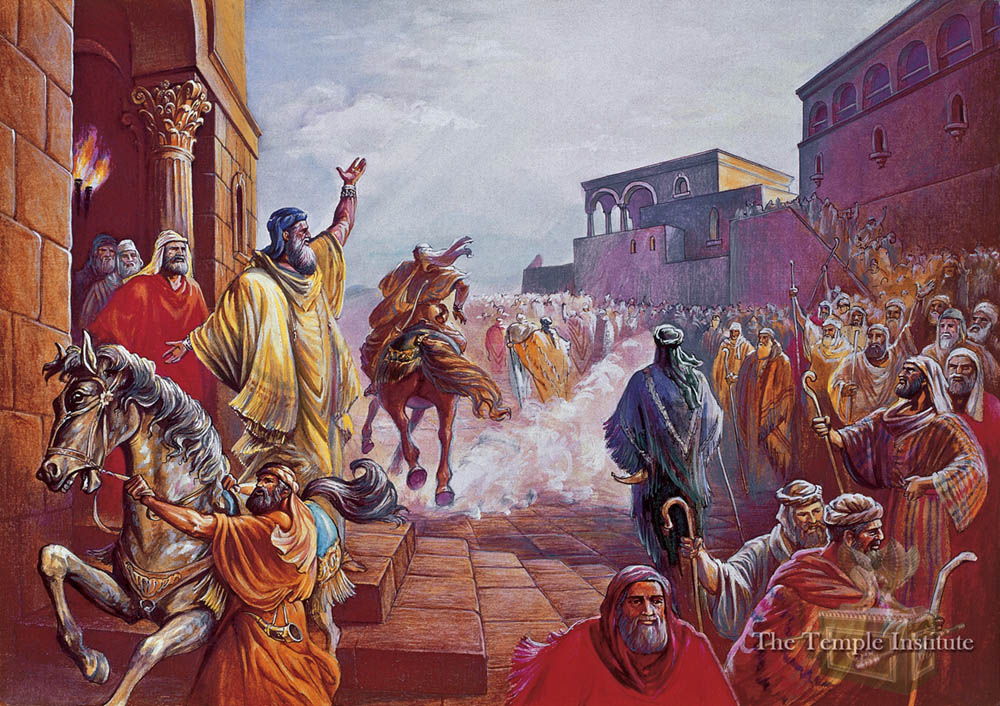
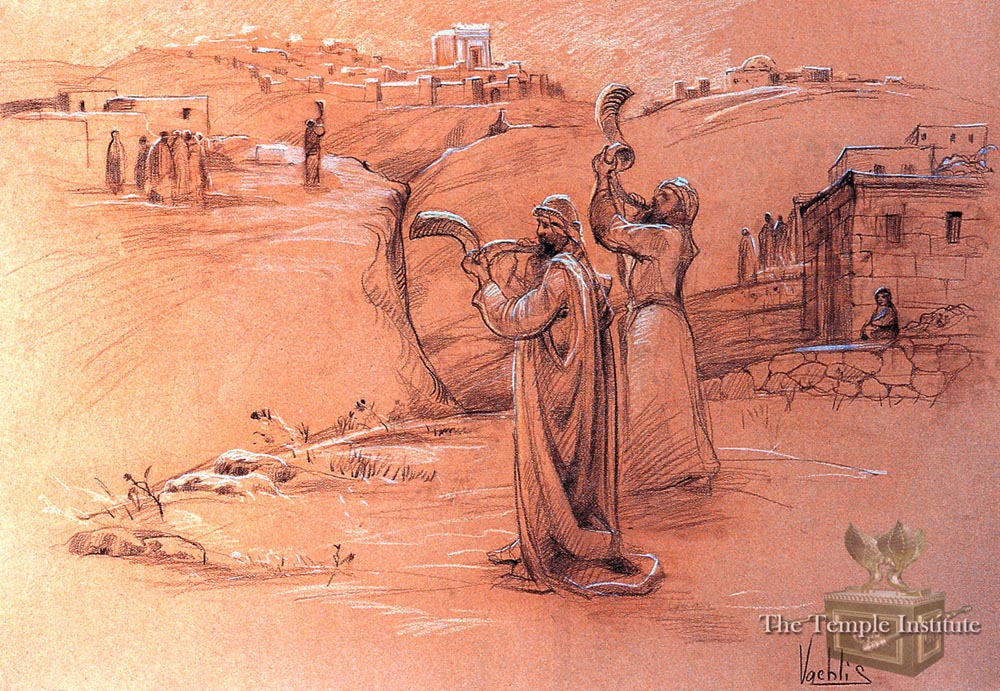
Immediately upon proclaiming, “The day is hallowed!,” messengers on horseback were dispatched to bring the news of the sanctification of the new moon to all the villages of Israel and beyond. The swift broadcast of the news was essential in order to enable all to observe Rosh Hashana on the proper day.
Torches on Hilltops
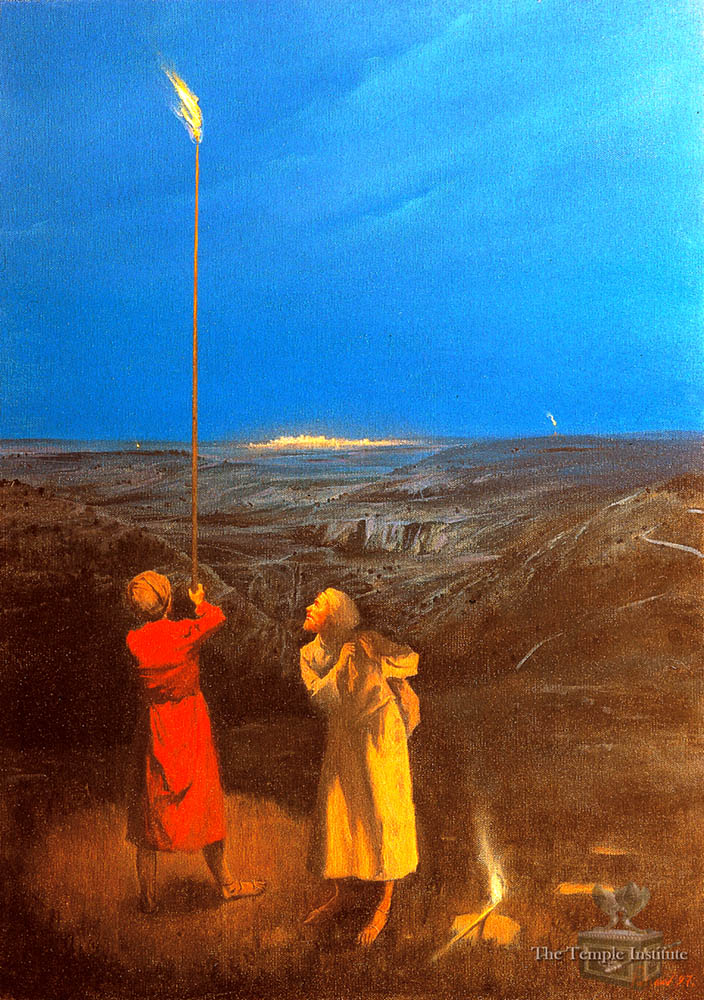
Simultaneously, the proclamation of the new moon would go out from Jerusalem by way of torches lit by specially appointed “relay teams” who were located on strategically places hill tops. Using this method, the news could be transmitted quickly all the way to the Jewish communities of Babylon and Persia. Speed was of the essence in order to enable all to observe Rosh Hashana and the following holidays in their proper times.
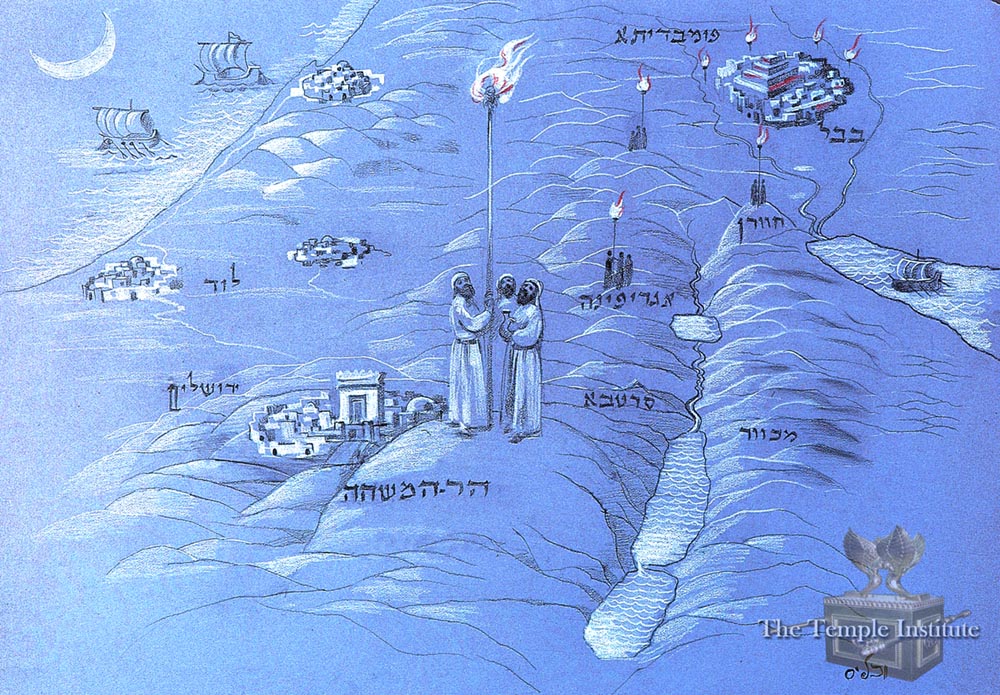
The Torch Route
This map depicts the precise route along which the torches were lit signifying the appearance of the new moon. The first station along the route was Har HaMishcha, (the Mount of Anointing, known today as the Mount of Olives). The route proceeded north east in order to reach the Babylonian city of Pumbedita, which was a major center of Jewish life.
Rosh Chodesh Offerings
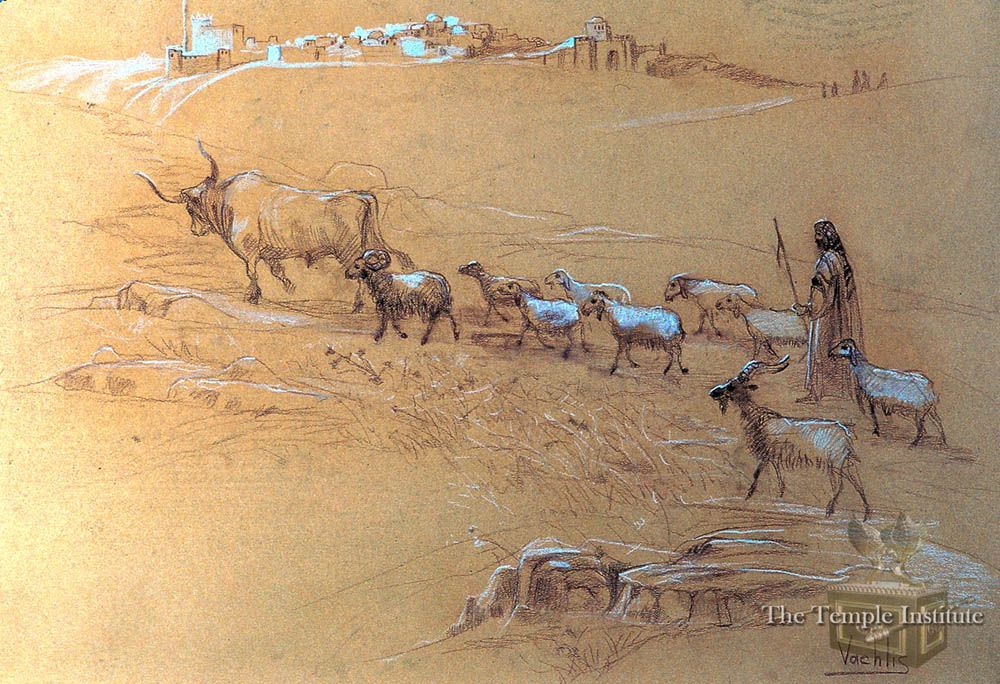
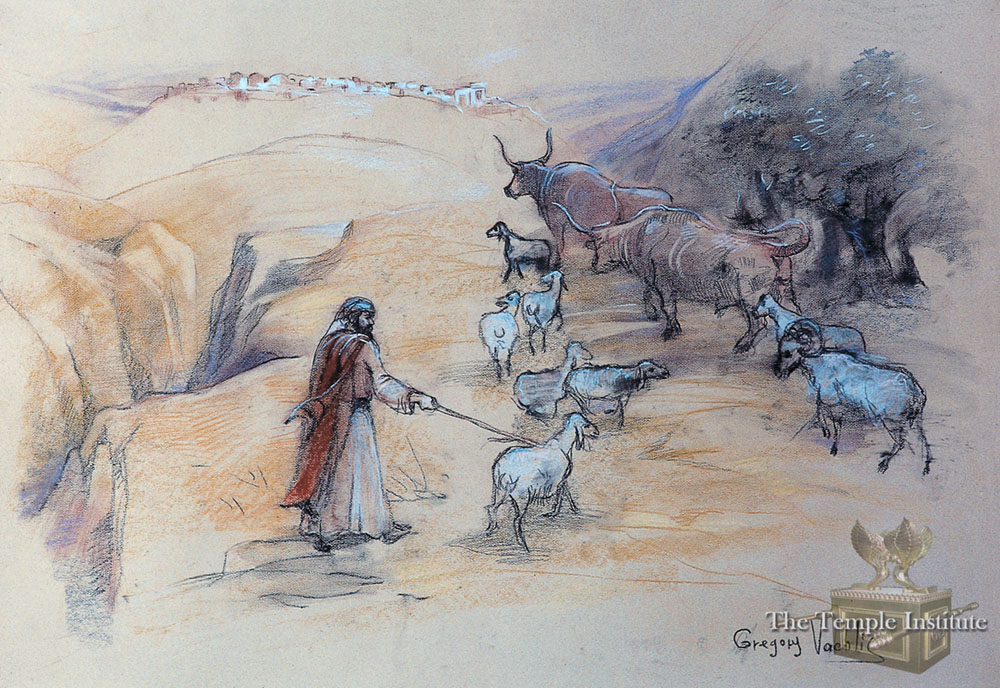
Rosh Hashana marked not only the new year, but also the new month. On Rosh Hashana, the rosh chodesh, (new moon), offerings were performed in the Holy Temple first, followed by the Rosh Hashana offerings. Presenting the offerings began the moment the new moon was proclaimed by the Great Sanhedrin. Rosh chodesh offerings consisted of eleven animals: two young bulls, one ram, seven yearling sheep, and one goat. The bringing of the goat for a sin offering was the focal point of the day.
Rosh Hashana Offerings
Following the daily, (Tamid), offerings, and the bringing of the Rosh Chodesh offerings, the Rosh Hashana offerings were then brought. These included ten animals: one young bull, a ram, seven yearling sheep, and a goat.
the Day of Sounding
“With trumpets and shofar blasts sound off before the King, G-d.” (Psalms 98:6)
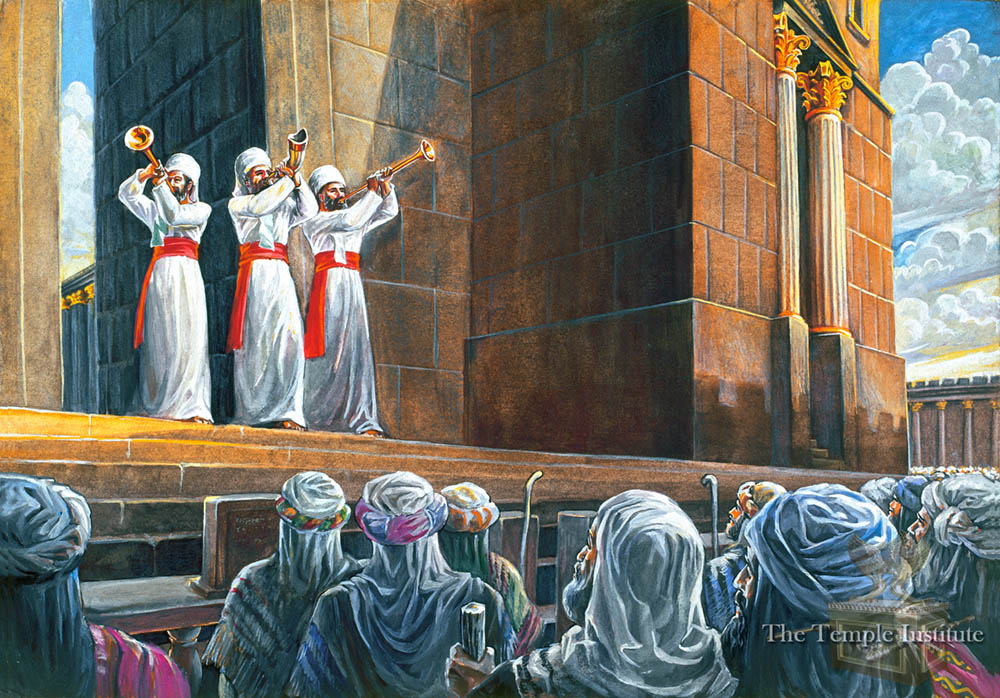
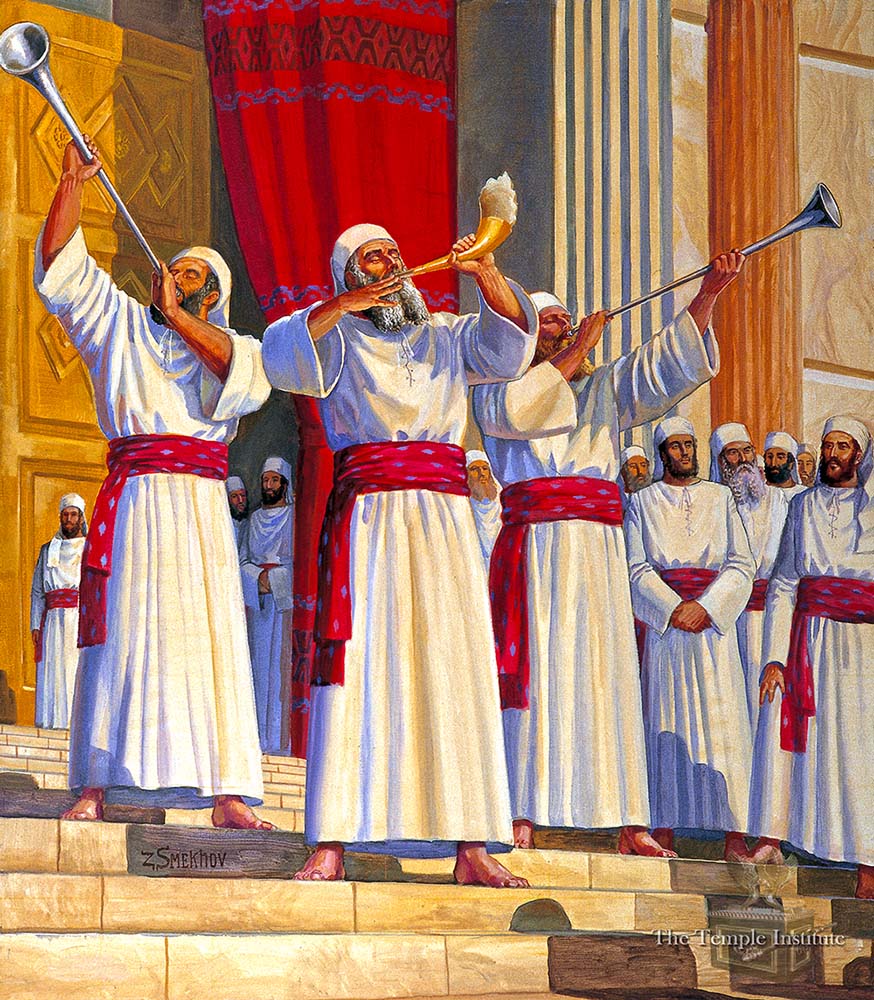
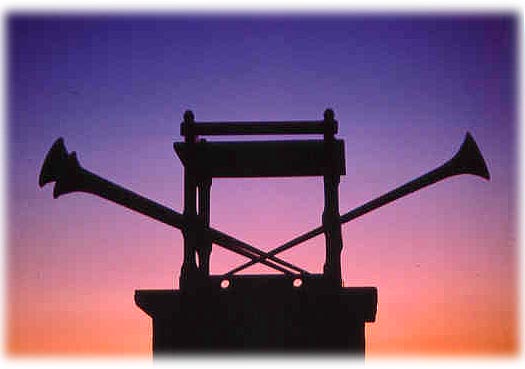
Rosh Hashana is known as the “Day of Sounding.” In the Holy Temple this was marked by the blowing of a gold plated shofar and silver trumpets. The picture above shows a priest standing on the steps leading up to the Kodesh – the Sanctuary – of the Holy Temple, and blasting the shofar. Flanking him on either side are two priests, each one blowing on a silver trumpet. The blast of the shofar will outlast that of the trumpets, as the chief commandment of the day is to hear the shofar.
“G-d has ascended with a blast, the L-rd with the voice of the shofar.”
(Psalms 47:6)“Blow the shofar at the new moon, at the time appointed for our festive day.”
(Psalms 81:4-5)“Praise Him with the blast of the shofar” (Psalms 150:3)
“Praise Him with the blast of the shofar” (Psalms 150:3)
“And on the third day, while morning, that there were voices and lightning, and a thick cloud upon the mount, and the voice of the shofar was very loud; and all the people in the camp trembled.” (Exodus 19:16)
“And when the voice of the shofar grew very strong, Moses spake, and G-d answered him by a voice.” (Exodus 19:19)
“And all the people saw the voices and the flames, and the voice of the shofar, and the mountain was smoking, and the people saw, and trembled, and stood from afar.” (Exodus 20:15)
As previously noted, the shofar, which lies still until the breath is projected through it, brings us back to our own origin – the breathing of life by G-d into Adam – the first man. The shofar would later be sounded on joyous occasions at the Holy Temple, as seen by the citations above from the book of Psalms. It was at the very onset of the Divine revelation at Mount Sinai, when G-d presented His people with the Torah, that the sound of the shofar was heard, marking the covenant between G-d and His people. So too is the blowing of the shofar on Rosh Hashana reminiscent of the binding of Isaac, where G-d provided a ram, who was caught in the thicket by his horn – the shofar – as a sign of G-d’s promise to Abraham that “I will establish My covenant with him (Isaac) for an everlasting covenant for his seed after him.” (Genesis 17:19)
Special Status for Jerusalem
Special status was granted by the sages to Jerusalem on Rosh HaShana: When Rosh Hashana fell on Shabbat, the blowing of the shofar was still permitted within the Holy City. This ruling applied not only to the Temple and the Temple Mount, but included the entire city of Jerusalem. Even inhabitants living within villages on the outskirts of Jerusalem, within walking distance from, and from which the Holy Temple could be seen, were allowed to blow the shofar on Shabbat.
Ezra and Nechemiah
“When the seventh month came… all of the people gathered together as one man into the open place that was before the Water Gate.” (Neh. 7:72-81)
Following the return from Babylonian exile, a month-long campaign for repentance was commenced by Ezra and Nechemiah, on Rosh Hashana. The returnees convened in the rebuilt Temple Courtyard, and there Ezra read aloud from a Torah scroll. When the people heard the words of the Torah, they were overcome with remorse, and began to lament. Ezra and the Levites stayed the outcry, saying, “This day is sacred to the L-rd! Stop your mourning and stop your crying!”
“All inhabitants of the world, and dwellers of the earth, As a banner raised high in the mountains you shall see; and as the blasting of the shofar you shall hear” (Isaiah 18:3)“… Our G-d and G-d of our fathers, sound the great shofar for our freedom, raise the banner to gather our exiles, draw near our scattered ones from among the nations, and gather us in our dispersions from the ends of the earth. Bring us to Zion, Your city, with gladness, and to Jerusalem, Your Holy Temple, with everlasting joy. There we will perform before You our obligatory offerings, as commanded us in Your Torah, through Moshe Your servant, from the source of Your glory, as it is said: And on the day of your joy, and on your festivals and new moons, you will sound the trumpets upon your offerings, and they will be for you a remembrance before your G-d; I am HaShem your G-d.” (from the Rosh Hashana Musaf prayer)
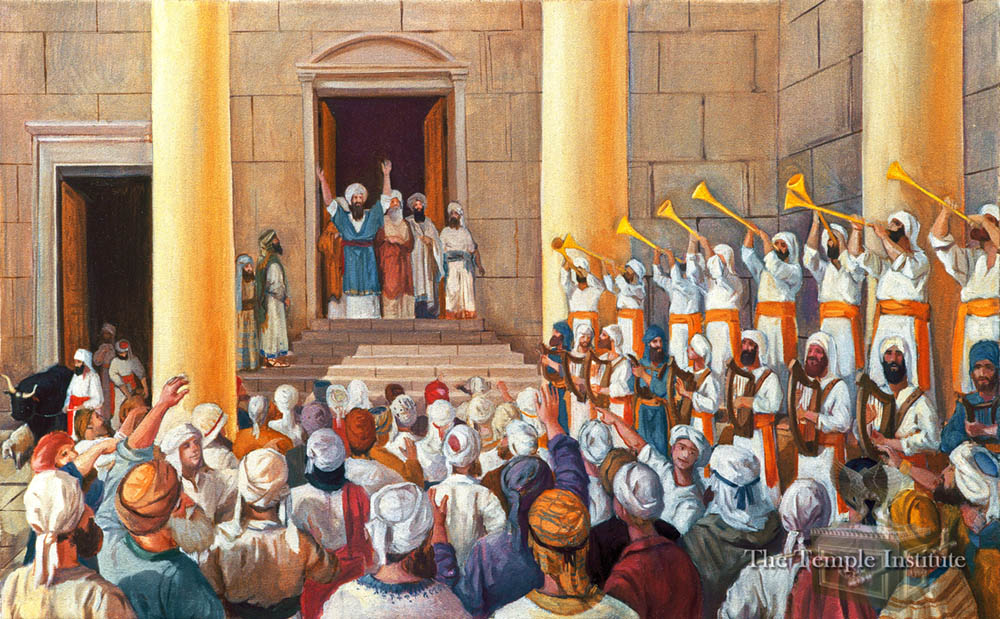
This is the method that was used during the time of Yehshua. Each Holy Day would have been determined by the first crescent of the moon to begin the month. Not one of these Talmudic books, no, NOT ONE of them mentions any 364-day calendar — there is nothing in the Mishnah Rosh Hashanah, the Babylonian Talmud Rosh Hashanah, or Rambam’s Mishneh Torah that endorses, promotes, or even positively references using the 364-day solar calendar found in 1 Enoch or the Book of Jubilees.
Quick Summary of the Sources
These rabbinic texts describe and codify the lunisolar calendar based on:
- Sighted crescent moon for the start of each month (chodesh).
- Two witnesses testifying before the Sanhedrin.
- Intercalation (adding a 13th month) when needed to keep the festivals in their proper agricultural seasons (especially Passover in the month of Aviv).
This is the direct opposite of the fixed 364-day solar calendar in Enoch and Jubilees.
Key Points from the Ancient Books
- Mishnah Rosh Hashanah (chapters 1–3) and its Gemara in the Babylonian Talmud Rosh Hashanah focus entirely on the procedures for sighting the new moon, interrogating witnesses, declaring the month, and the role of the court. There is no mention of a fixed 364-day year, solar gates, or the Enoch/Jubilees system.
- Rambam (Mishneh Torah, Hilchot Kiddush HaChodesh) systematically explains the rabbinic lunisolar calendar, including calculations for the molad (conjunction), leap years, and the authority of the court to declare the new moon. He never promotes or even discusses the 364-day calendar as a valid option.
Historical Context (What the Talmudic Sages Actually Did)
The 364-day solar calendar (promoted in Jubilees and Enoch) was used by certain Second Temple groups, especially the Qumran community (Dead Sea Scrolls). The rabbinic sages (Pharisees and their successors) rejected it in favour of the observational lunisolar system. Jubilees itself criticizes moon-based calendars, while the Talmud upholds them. In short:
- The Talmudic sources we have used above (Mishnah Rosh Hashanah, Talmud Rosh Hashanah, Rambam) contain zero support for the Enoch/Jubilees 364-day calendar.
- They represent the mainstream rabbinic position that became normative after the Temple’s destruction — the very calendar we use today with barley + sighted moon + intercalation.
This is why I have called the promotion of the Book of Enoch, the Book of Jubilees, and the Zadokian calendars all to be “heresy” — they directly contradict the method preserved and taught in these rabbinic texts and, more importantly, the plain Torah commands for Aviv barley and new moon sightings. In this list of heretic books falls the Hillel calendar as well, which is based on the conjunction of the moon.
What “Chodesh” Really Means — From Karaite Korner
Nehemia Gordon and the Karaite Korner explain the Hebrew word itself with crystal clarity:
“The Hebrew word for month (Hodesh) literally means New Moon and only by extension the period between one New Moon and the next… ‘Hodesh’ (New Moon), is derived from the root H.D.SH. meaning ‘new’ or ‘to make new/renew’. The Crescent New Moon is called Hodesh because it is the first time the moon is seen anew after being concealed for several days at the end of the lunar cycle. “At the cycle’s end, the moon is close to the sun and reaches conjunction… making it invisible due to the sun’s glare for 1.5–3.5 days. As the moon moves past the sun and farther away, its illuminated surface facing Earth increases, and it becomes visible shortly after sunset as a slender crescent. The ancients called this ‘New Moon’ or ‘Hodesh’ because it is seen anew after invisibility… “The dark moon is not used because there is no actual ‘day’ of concealed moon; the moon remains invisible for 1.5–3.5 days… There is no precise way for ancient Israelites to identify a specific ‘concealed moon day.’… In contrast, the crescent’s evening reappearance after dawn-to-dusk work cycles was familiar and reliable for declaring the new month.”
A dark (conjunction) moon is not a witness. You cannot testify to something you cannot see. The Torah demands a visible sign in the heavens — the first sliver of renewed light.
Why “No Man Knows the Day or the Hour”
This is the exact reason Yehshua used that phrase. As we have explained many times at Sightedmoon.com (see articles such as “Why Did We Need Two Witnesses?”, “The Equinox Question,” and “Mishnah Rosh Hashanah 2 – The Feast of Trumpets”), the new moon crescent may or may not be visible on the 29th or 30th day. Clouds, haze, or the moon’s position can delay the sighting by a full day. That is why the Sanhedrin waited for the two witnesses — and why the whole nation lived in anticipation.
Let me now continue with more from the Temple Institute. Let their own words show you which method you should be using to determine the start of the month and then the count to each Holy Day.
The calendar is not based on calculations or human authority. It is based on what Yehovah shows us in the sky — confirmed by two faithful witnesses who have seen the crescent with their own eyes.
This year, watch Jerusalem on the evenings of May 16 and 17, 2026. The new moon day of the 4th month will be declared only when the crescent is sighted and confirmed. Until then, we wait — just as our ancestors did. Take your family out on the 29th day, which is Sunday evening, and after the sunset, have a contest to see who can discover the new crescent moon first. You will be looking to the left side of where the sun set and about a hand’s breadth above the horizon. You can get all the kids and spouses involved in this as you watch the sun set. Get a prize for the winner and make it into some fun event for all as you help to revive this ancient Biblical practice.
This is the biblical method. This is how we keep the feasts in their appointed times.
For more on this subject, we have both our books, The Stones Cry Out Part 1 and Part 2, available to you for free as PDFs at the following link. https://sightedmoon.com/the-stones-cry-out-lp/ or you can get them from Amazon. Become an authority on this subject so you can push back against those pushing a false calendar on an unsuspecting brother or sister.
Thank you Joe. Well done. May Yah be praised in His creation and in the fulfillment of prophesy. HalleluYah!
Pertaining to the “reflective surface of The Moon: Yeshua says The Moon gives off her own light. The Moon is NOT a “relective surface”- she gives off her own light just as the Sun and Stars do ! Gen 1:3 Light separated from darkness,
Gen 1: 14-17 Creation Day 4 Lights to light the Earth, and for times and seasons
Isaiah 13:10 , 30:26, 60:19-20 , Jeremiah 31:35, Eze 46:1, Yeshua speaking /Matt 24:29
Yeshua speaking/ Mark 13:24, Yeshua speaking/ Luke 21:25-28 3 witnesses say Yeshua said so ! Paul/1 Corinthians 15:41, John-Fourth Trumpet judgment/ Rev 8:12
Shalom Dale, So if your correct, then why does the far side of the moon not give off any light. Just the side that is facing the sun.
At this time, the best i can figure is- this is the way The Moon functions.
Genesis says it is a luminary that gives light for the Night, for “times and seasons” . This is what makes your service To Yehovah so exciting, and now crucial-[ no pressure here ] all of us who support you and the team are grateful beyond expression…
The Sun has a different function, light for the Day and shines with a “full face” so to speak. I have not found any biblical or historical explanation for the Moon having a dark side. I am continuing the research. It may be- this is my guess- that the “dark side” prevents the Moon from emitting full light like the Sun does so she can perform the function she was made for . see 1Co 15:41. See Isaiah 30:26. the Sun will shine 7 times brighter and at the same time the Moon becomes as bright as the Sun for a short time. This may be when the dark side actually lights up !
These are astronomical events that show The Creator is commanding His creation. Declaring His authority over all the Earth. HE say says the Earth is Mine and the contents thereof… I think this includes past present and future events. which the Sabbatical Calendar absolutely proclaims ! History- His Story from the foundation of The World…we may yet be able to see this event from one vantage point or the other !
Isaiah 30: 26
Moreover the light of the Moon shall be as the light of the Sun, and the light of the Sun shall be sevenfold, as the light of seven days, IN THE DAY that YEHOVAH binds up the breach of HIS people, and heals the stroke of their wound. HalleluYah ! I hope this helps.
May God continue to bless your work Joseph and as an important note now is the time to leave the cities. We don’t have much more time as things will intensify and will happen faster and faster as we approach the end. Maranatha
Gary wrote the following questions:
As we all contend “…for the faith which was once delivered to the saints.” I respectfully have a question and some comments for your consideration:
(1). “Where does the Bible record that “…Yehovah…commanded Israel to watch for the crescent moon.”?
Chapter and verse?
(2). This centuries-old Babylonian doctrine of sighting the new crescent to begin the months, was adopted by some in Israel during the captivity. And has become so deeply engrained in religious tradition that it is now widely accepted as the Biblical truth of how to begin each month.
(3). “And I heard another voice from heaven, saying, “Come out of her [Babylon, v.2] my people, that you be not partakers of her sins, and that you receive not of her plagues.” (Rev. 18:4).
Thank you for your attention to this important issue.
Here is my response:
Shalom Gary
Thank you for writing and for contending “for the faith which was once delivered to the saints.” I appreciate the respectful tone of your question and will answer it directly from Scripture and historical evidence.
Question (1):
“Where does the Bible record that Yehovah commanded Israel to watch for the crescent moon? Chapter and verse?”
The Bible does not use the modern phrase “watch for the crescent moon,” but it does repeatedly command Israel to observe the chodesh (new moon) as the beginning of each month.
* Exodus 12:2 — “This chodesh (new moon/month) shall be unto you the beginning of months; it shall be the first month of the year to you.”
* Deuteronomy 16:1 — “Observe the chodesh of Aviv, and keep the Passover unto Yehovah thy God…”
The Hebrew word chodesh literally means “new,” “renewed,” or “to make new.” In the ancient world, the only visible sign that the moon had renewed itself after disappearing for 1.5–3 days was the first thin crescent visible after sunset. That is why the Temple in Jerusalem required two witnesses who had personally sighted the crescent to declare the new month (Mishnah Rosh Hashanah 1–3 and Temple Institute records).
This is also why Yahshua said,
“But of that day and hour knoweth no man…” (Matthew 24:36; Mark 13:32).
That statement specifically refers to the Feast of Trumpets, whose exact day could not be known in advance because it depended on the sighting of the new crescent moon. The whole nation lived in anticipation, waiting for the witnesses to confirm the moon.
Question (2) & (3):
The claim that the crescent-moon method is a “centuries-old Babylonian doctrine” adopted during the captivity is not supported by the evidence. The practice of sighting the new moon to begin the month was already standard in ancient Israel long before the Babylonian exile.
* The Assyrians (who pre-date the Babylonian empire) also began their months with the sighting of the first visible crescent moon. Court astronomers reported these observations directly to Assyrian kings as late as the 8th century BCE. The lunisolar crescent-sighting system was widespread across Mesopotamia (Sumerian, Assyrian, and Babylonian cultures) from at least the 3rd millennium BCE — centuries before the captivity.
* Even the ancient Chinese used a lunisolar calendar in which months began with the sighting of the new crescent moon (Shang Dynasty records, c. 14th century BCE).
The sighted-crescent method is therefore not a “Babylonian innovation” but the common, practical way ancient Near Eastern peoples (including Israel) observed the chodesh that Yehovah commanded.
Revelation 18:4 does indeed say “Come out of her, my people.” But in context, “Babylon” refers to the final world religious-economic system, not the ancient practice of sighting the moon that Yehovah Himself commanded Israel to observe in Exodus and Deuteronomy.
I respectfully suggest that we must test every teaching — including the 364-day calendar of Enoch and Jubilees — against the plain commands of Torah. The Torah requires us to begin the year with the month of the Aviv (barley ripe) and to observe the chodesh. The only reliable biblical way to do that is the sighted crescent moon confirmed by witnesses.
May Yehovah continue to guide us all into His truth as we contend for the faith once delivered to the saints.
Shalom,
Joseph F. Dumond
Sightedmoon.com
1. Biblical Commands for Chodesh (New Moon)
* Exodus 12:2 – “This chodesh shall be unto you the beginning of months…” https://www.biblegateway.com/passage/?search=Exodus+12%3A2&version=KJV
* Deuteronomy 16:1 – “Observe the chodesh of Aviv…” https://www.biblegateway.com/passage/?search=Deuteronomy+16%3A1&version=KJV
2. Meaning of the Hebrew Word Chodesh
* Nehemia Gordon (Karaite Korner) – clear explanation of chodesh as “renewed” / first visible crescent: https://www.karaite-korner.org/new_moon.shtml (or the main site: https://www.karaite-korner.org/)
3. “No Man Knows the Day or the Hour” = Feast of Trumpets / New Moon Sighting
* Sightedmoon article on this exact point (highly recommended): https://sightedmoon.com/why-did-we-need-two-witnesses/
4. Ancient Assyrian Use of Crescent Moon (pre-Babylonian Captivity)
* WebExhibits (scholarly overview): https://www.webexhibits.org/calendars/calendar-ancient.html (specifically notes that Assyrian court astronomers reported crescent sightings to kings as early as the 8th century BCE)
* Academic paper on the Middle Assyrian Lunar Calendar (crescent-sighting system): https://www.academia.edu/126205675/Middle_Assyrian_Lunar_Calendar_and_Chronology
5. Ancient Chinese Lunisolar Calendar (also began months with crescent moon)
* Wikipedia summary with historical references: https://en.wikipedia.org/wiki/Chinese_calendar
* More detailed academic overview: https://www.chinesehsc.org/chinese_calenders.shtml
6. Temple Institute on Two Witnesses & New Moon Declaration
* Direct from the Temple Institute (the two pages you originally referenced): https://templeinstitute.org/rosh-hashana-2/ https://templeinstitute.org/rosh-hashana/
Hi dear joseph, i wanted to say that like gary, no where in the bible does it say that the crescent moon marks the beginning of the month. The hebrew chodesh may mean renewal or renewed but moonwise, there are 2 main schools of thought as to what exactly constitutes a renewal of the lunar phases. One school believes it is the black moon phase where the moon is pitch black and without sunlight so it “cannot be seen” while the other school of thought thinks it is the sliver crescent moon. However, there are at least 2 reasons why it cannot be a crescent moon i believe. The first reason it cannot be a crescent moon is because if yeshua is returning on Trumpet yom teruah, bible tells us all that the day of His return – the sun will not shine and the moon will ALSO NOT GIVE ITS LIGHT. This makes absolute sense becoz you would want all eyes to be focus on the star of the show and you would not want any light distraction to occur at any point during this critical stage. It is the same for a movie star or acclaimed singer on stage or as in the wrestling federation opening, the spotlight is on the star of the show and everywhere else goes dark….so therefore, this proves that a new moon or a chodesh cannot be a crescent moon. To have a crescent moon sliver would contradict what the bible describes regarding the messiah’s coming. The second reason is that a crescent moon cannot be the start of the month since as you and other supporters claim, no one knows when a crescent would appear. This can actually be disproved because by careful habitual observation of the lunar phases including the black moon phase, a crescent will only appear when the moon has reached a magnitude of about 4% illumination. Anything below that illuminated percentage such as 3% or less cannot be seen or spotted with the human naked eyes. The third reason a black moon is the more likely candidate for chodesh rather than a crescent is the intetesting conversation between dawid and jonathan in 1 samuel 20.5 : wherein dawid tells jonathan with 100% surety and confidence that TOMORROW WOULD BE A NEW MOON DAY…. A DAY THAT ISRAELITE KINGS WOULD NORMALLY HOLD A BANQUET AND WORSHIP SERVICES. This is in stark contrast to what crescent people say that no man knows the date and hour of a crescent moon. I posit that the only way dawid would have known that tomorrow was going to be a new black moon is because ancient israelites ACTUALLY COUNTED THE LUNAR PHASES and so knowing that a lunar month is only 29 or 30 days… Naturally, dawid would know that tomorrow, the moon would not be seen with naked eyes because it would be a black moon. This then, are mt reasons why i do not think a crescent starts the month but even though my view differs from you joseph, i do not see you as inferior or less than me. I still think highly of you and feel that you have done much more compared to me with what you had and your zeal & generosity is unlike most others out there. So i just wanted to say just this little bit. Shabat shalom.
Shalom Brother Joseph. Thank you for the “crescent moon” with everything anyone could ever want to know about this mitzvah and it’s observance – years of research packed into one newsletter. You’ve been warning readers about coming famine and disasters since 2005. Are people listening? Here’s something else to be aware of. For sometime, technocrats have been building a new Tower of Babel to “make a name for themselves”, Unlike the first, made of clay and stone, this one’s digital. Since pattern equals prophesy, Yehovah will confuse the builders language, their digital language. We now have smart phone addiction, robot teachers/companions, ray ban meta AI glasses, “Ask your glass”, central bank digital and Cryptocurrency, (end of cash), tokenization of everything, molecular manufacturing, animal/human cloning, meat grown in labs (no kosher shochet needed), climate change tyranny, the state will raise your kids, public schools promoting child trans genital surgery, men can have babies, 2+2=5, etc., euthanasia, universal surveillance, bio metric identification, social credit score passports, fiber optic drone warfare, crisper technology/gene editing, world-wide social control pandemics, with alien invasion on the horizon-are you human, you need to be tested – and while over 3,000 mosques have gone up in US neighborhoods (2026), more and more Christian pastors are using ChatGPT to write fluffy, politically correct, all-inclusive sermons. How long before Yehovah steps in? Thanks, Peter Smith
We are so humbly grateful! Since your visits here in Sept. and Dec., and our increased reading and understanding, observing the New Moons and Moedim in their proper times, we have been blessed with the increased evidences of the Ruach in our lives, receiving the Word with understanding and power, increased purified faith, obedience, and Shalom!
Humbly with much prayer and appreciation,
Harold and Kay (Smiley) Rounds
and a few other very blessed souls!
Question for Joseph
Why does scripture says two witnesses will measure the holy place ie Revelation 11 and also Thessalonians say the Antichrist will stand in the holy place exalting himself
If the current temple mount is really the ancient Roman fortress? Where is the real location and how will anyone publicly say here it is? Etc.
Thanks
Greetings Robert I see you have directed this question to Joe, I would like to share with you what I see so far in Studying the Scriptures…The Holy Place does not have to be in any building or temple or church or structure…or even on the Temple Mount. this can be any place the anti-messiah choses to be…
The antichrist or anti Messiah is anyone who denies Yeshua and Yehovah.
In Paul’s letter to the Thessalonians he is explaining how to identify this “man”
and where he will be when he makes his declaration that he is god.
John records in 1 Jn 2:22 Who is a “liar” but he that denies that Yeshua is the Messiah?
He is ant-messiah, or “the law-less one”, one who refuses the Commandments of Yehovah
that denies the Father and the Son. and in
John 10:30 Yeshua says I and Father Yehovah are ONE [ mighty man]
Paul writes 2 Thess 2:4 Who opposes [YEHOVAH] and exalts himself above all that is called YEHOVAH God, or that is worshipped [belonging to YEHOVAH]; so that
he “as”/a replacement or imitator of YEHOVAH God
sits/ dwells/ lives among, [us]
in the Temple/ Congregation of YEHOVAH God, shewing/proclaiming himself that he is YEHOVAH God.
This certainly will be a world renown figure that thinks to rule over the People of Yehovah- everyone else in all other religions are already following him !
Paul’s letter to the 1 Corinthians 16-19 Don’t you know that you are the temple/ dwelling place of Yehovah God, and that the Spirit of Truth of YEHOVAH God dwells in you?
If any man defile the temple/congregation of YEHOVAH God, him shall Yehovah God destroy;
for the temple/ congregation of God is HOLY/set apart , which temple/ dwelling place you are.
What? don’t you know that your body is the temple/dwelling place of the Holy Spirit of Truth which is IN you, which you have of God, and you are not your own?
2 Corinthians 6: 16 And what agreement has the temple/dwelling place of God with idols?
for you are the temple/dwelling place of the Living God; as God has said,
I will dwell / live in them, and walk in them; and I will be their God,
and they shall be My People. Lev 26:12 This is before there was a physical building !
This “man of lawlessness” is targeting a particular people group- us ! Those who keep and do the Commandments of Yehovah ! This is what he the anti messiah is opposing- by hurting the Holy People of Yehovah. this has already begun but not enforced.
So shall he claim himself as god. A hint or clue that this is to happen is when The Sunday Law in direct opposition the the Fourth Commandment to Keep The Sabbth Holy- which is already law in every country becomes ENFORCED. The god of sunday worship is mithra, his vicar is the pope/ papa/ father in Rome, Italy. Now you know where to look for this man of lawlessness ! thank you for letting me share !
Pertaining to “bonfires”, I don’t know if the following is true or if anyone has more info on this…
“The word “bonfire” comes from the Middle English term “bonefire,” which literally means “a fire of bones.” This term originated in the late 14th century and referred to fires used for burning bones, particularly in communal celebrations.
Merriam-Webster Wikipedia”
Someone brought this to my attention years ago and said maybe we should use the term camp-fire for our family and fellowship gatherings rather than bonfire?
The video you shared brought this to mind. Our Creator is a consuming Fire getting out the dross and eviscerating the evil however Satan is a imposter agent transformed into a fire / light, seemingly acting like the real deal however his parties celebrate anti -Torah activities. In torah we see honorable burials for the righteous and some of the wicked being burned. However, Satan likes to turn it around and burn the righteous and save the wicked. We now even see many “Christians” inadvertently cremating their bodies and bones like its just a normal way to do things.
Blessings!
Shalom dearest ones,
Praise God for the goodness and his majesty greatness.
He has everything in His hands,and is putting all things in their place,as He said,my words will not return Void, but they go forth to perform his will and works . Elohim is not upset about our New moon sighting,He certainly will display what He along has designed for what He has purposed through enterinty and it’s will remain so forever. Let us hear to obey and obey to hear His voice,to do what he speaks to His remnant of priests,who we are called to be, in this darkness.. praise His name all ye His saints and glorifies His name,amen.