

Newsletter 5862-015
The 3rd Year of the 5th Sabbatical Cycle
The 32nd year of the 120th Jubilee Cycle
The 19th day of the 4th month, 5862 years after the creation of Adam
The 5th Sabbatical Cycle after the 119th Jubilee Cycle
The Sabbatical Cycle of the Tithes to the Widows and Orphans
June 6, 2026
Shabbat Shalom to the Royal Family of Yehovah,
This week we hosted Amanda Grace of Ark of Grace Ministries to discuss her compelling new book, Brace for Impact. She has over 1.5 million followers. Ryan and I thought it would be great to get to know her when the opportunity presented itself. So we invited her as a guest on our podcast. I hope you all will watch it and share a nice comment about the interview. So that when Amanda watches it, she will learn and see how nice our followers are. Please do leave a nice comment and share this for us. It is another method we are using to get our message out, and your comments will help us do that. Then get ready and Brace for Impact.
Over the past few weeks we have been warning you about the USA drought, the rapid glacial melt in the Himalayan Mountains that gives water for over 2 billion people, and the major El Niño that is breaking all records developing off the west coast of the USA. We have shown you how Lev 26 warns you first that you will lack enough food and then you will starve. Let me share those verses again with you.
Lev 26:23 And if you will not be reformed by Me by these things, but will still walk contrary to Me,
Lev 26:24 then I will walk contrary to you and will punish you seven times more for your sins.
Lev 26:25 And I will bring a sword on you that shall execute the vengeance of the covenant. And when you are gathered inside your cities, I will send the plague among you. And you shall be delivered into the hand of the enemy.
Lev 26:26 When I have broken the staff of your bread, ten women shall bake your bread in one oven, and they shall deliver you your bread again by weight. And you shall eat and not be satisfied.
Lev 26:27 And if you will not for all of this listen to Me, but will walk contrary to Me,
Lev 26:28 then I will walk contrary to you also in fury. And I, even I, will chastise you seven times for your sins.
Lev 26:29 And you shall eat the flesh of your sons, and the flesh of your daughters you shall eat.
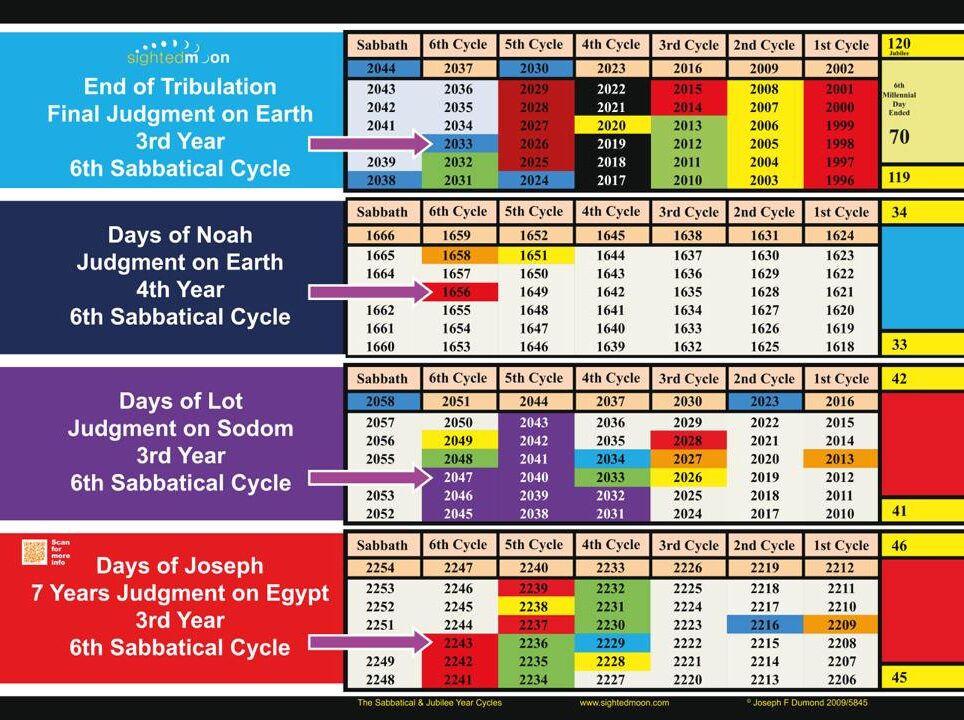
This is what we have been warning you about: that you are now in the 4th and 5th curses of Leviticus 26. The first curse of terror, the second of extreme weather, the third of plague, the fourth of plague, sword, and drought, and the fifth of famine and captivity. Each curse of Leviticus 26 corresponds with a Sabbatical cycle of this 120th Jubilee. So just apply those curses to each Sabbatical cycle going from right to left on the chart below.
The days of Noah and Lot teach us that this final judgment comes in the 6th sabbatical cycle.
We have been saying this to you in our newsletter videos and books since 2005. For the past 21 years we warned you it was coming. I say all of this to you so that you might pay attention to this next story. Watch it. Just watch it and take his warning seriously.
You can read Deuteronomy 28 to again be told what is about to happen when you do not obey Yehovah.
Deu 28:23 And your heavens over your head shall be bronze, and the earth that is under you iron.
Deu 28:24 Jehovah shall make the rain of your land powder and dust. It shall come down from the heavens on you until you are destroyed.
Deu 28:38 You shall carry much seed out into the field, and shall gather little in, for the locust shall eat it.
Deu 28:39 You shall plant vineyards and dress them, but shall neither drink the wine nor gather, for the worm shall eat them.
Deu 28:52 And he shall besiege you in all your gates until your high and fortified walls in which you trusted come down, throughout all the land. And he shall besiege you in all your gates throughout all your land which Jehovah your God has given you.
Deu 28:53 And you shall eat the fruit of your own body, the flesh of your sons and of your daughters, which Jehovah your God has given you, in the siege and in the anguish with which your enemies shall distress you.
Deu 28:54 The man that is tender among you, and very delicate, his eye shall be evil toward his brother and toward the wife of his bosom, and toward the rest of his sons which he has left;
Deu 28:55 so that he will not give to any of them of the flesh of his sons whom he shall eat, because he has nothing left to him in the siege and in the anguish with which your enemies shall distress you in all your gates.
Deu 28:56 The tender and delicate woman among you, who would not have ventured to set the sole of her foot on the ground for delicateness and tenderness, her eye shall be evil toward the husband of her bosom, and toward her son, and toward her daughter,
Deu 28:57 and toward her young one who comes out from between her feet, and toward her sons whom she shall bear. For she shall eat them secretly for lack of all things, in the siege and anguish with which your enemies shall distress you in your gates.
Deu 28:58 If you will not observe to do all the words of this Law that are written in this book, that you may fear this glorious and fearful name, JEHOVAH YOUR GOD,
Deu 28:59 then Jehovah will make your plagues remarkable, and the plagues of your seed great and persistent plagues; with evil and long-lasting sicknesses.
You are being warned of cannibalism that some of you will witness and/or do.
Jer 14:11 Then Jehovah said to me, Do not pray for this people for good.
Jer 14:12 When they fast, I will not hear their cry; and when they offer burnt offering and a grain offering, I will not accept them. But I will consume them by the sword, and by the famine, and by the plague.
Jer 29:17 so says Jehovah of Hosts: Behold, I will send on them the sword, the famine, and the plague, and will make them like worthless figs which cannot be eaten from badness.
Jer 29:18 And I will pursue them with the sword, with the famine, and with the plague, and will make them a horror to all the kingdoms of the earth, to be a curse, and a waste, and a hissing, and a reproach, among all the nations where I have driven them,
Jer 29:19 because they have not listened to My Words, says Jehovah, which I sent to them by My servants the prophets, rising up early and sending; but you would not hear, says Jehovah.\\
Ezk 5:16 When I shall send on them the evil arrows of famine, which shall be for their ruin, which I will send to destroy you; even I will increase the famine on you, and break your staff of bread;
Ezk 5:17 yea, I will send on you famine and evil beasts, and you will be bereaved. And pestilence and blood shall pass among you; and I shall bring a sword on you. I Jehovah have spoken.
Ezk 14:13 Son of man, when a land sins against Me by traitorous betraying, then I will stretch out My hand on it, and will break the staff of its bread, and will send famine on it, and will cut off man and beast from it.
Ezk 14:14 And though these three men, Noah, Daniel, and Job, were in it, they should deliver only their own souls by their righteousness, says the Lord Jehovah.
Ezk 14:15 If I cause destroying beasts to come through the land, and they spoil it so that it is deserted, so that no one may pass through because of the beasts,
Ezk 14:16 though these three men were in its midst, asI live, says the Lord Jehovah, they shall deliver neither sons nor daughters. They only shall be delivered, but the land shall be deserted.
Ezk 14:17 Or if I bring a sword on that land, and say, Sword, go through the land; so that I cut off man and beast from it;
Ezk 14:18 though these three men were in it, as I live, says the Lord Jehovah, they shall deliver neither sons nor daughters, but they only shall be delivered themselves.
Ezk 14:19 Or if I send a plague into that land, and pour out My fury on it in blood, to cut off man and beast from it;
Ezk 14:20 though Noah, Daniel, and Job were in it, as I live, says the Lord Jehovah, they shall deliver neither son nor daughter. They shall only deliver their own souls by their righteousness.
Ezk 14:21 For so says the Lord Jehovah: How much more when I send My four evil judgments on Jerusalem, the sword, and the famine, and the destroying beast, and the plague, to cut off man and beast from it.
Ezk 14:22 Yet, behold, there shall be left a remnant in it that shall be brought out, sons and daughters. Behold, they shall come out to you, and you shall see their way and their doings. And you shall be comforted concerning the evil that I brought on Jerusalem, for all that I have brought on it.
There is coming a time when all these things are going to come upon this land that we are in now, and then, AND THEN they will begin to seek the Word of Yehovah but it will not be found.
Amo 8:11 Behold, the days come, says the Lord Jehovah, that I will send a famine in the land; not a famine of bread nor a thirst for water, but of hearing the Words of Jehovah.
Amo 8:12 And they shall wander from sea to sea, and from the north even to the east; they shall run to and fro to seek the Word of Jehovah, and shall not find it.
Amo 8:13 In that day the beautiful virgins and the young men shall faint for thirst.
The God who is sending these plagues right now is the one I want to talk to you about this week. We are told to call upon His name. The remedy is to know and call upon His Name before that famine fully hits.
Jer 29:11 For I know the purposes which I am purposing for you, says Jehovah; purposes of peace and not of evil, to give you a future and a hope.
Jer 29:12 Then you shall call on Me, and you shall go and pray to Me, and I will listen to you.
Jer 29:13 And you shall seek Me and find Me, when you search for Me with all your heart.
Jer 29:14 And I will be found by you, says Jehovah; and I will turn away your captivity, and I will gather you from all the nations, and from all the places where I have driven you, says Jehovah. And I will bring you again into the place from where I caused you to be exiled.
Yehovah commands us to call upon Him in our time of trouble, and He will hear us. We are not to throw HIs word away as not relevant. It is life.
Psa 50:14 Offer to God thanksgiving; and pay your vows to the Most High;
Psa 50:15 and call on Me in the day of trouble; and I will deliver you, and you shall glorify Me.
Psa 50:16 But to the wicked, God says, What is it to you, to declare My Precepts, and to take up My covenant in your mouth?
Psa 50:17 Yea, you hate to be taught, and you toss My Words behind you.
We know He is coming, and it will be very hard in those days, but….
Jol 2:31 The sun shall be turned into darkness, and the moon into blood, before the coming of the great and awesome day of Jehovah.
Jol 2:32 And it shall be, whoever shall call on the name of Jehovah shall be saved; for salvation shall be in Mount Zion and in Jerusalem, as Jehovah has said, and in the remnant whom Jehovah shall call.
And it shall come to pass that everyone who calls on the name of Yehovah shall be saved / delivered.”
Act 2:21 And it shall be that everyone who shall call upon the name of the Lord shall be saved.
Rom 10:13 For everyone, “whoever shall call on the name of the Lord will be saved.”
Rom 10:14 How then shall they call on Him in whom they have not believed? And how shall they believe in Him of whom they have not heard? And how shall they hear without preaching?
Rom 10:15 And how shall they preach unless they are sent? As it is written, “How beautiful are the feet of those who preach the gospel of peace and bring glad tidings of good things!”
Rom 10:16 But they have not all obeyed the gospel. For Isaiah says, “Lord, who has believed our report?”
It is Yehovah who is sending this famine upon the land and the world at the end of this age. Many will find fault in other things and not look at what they themselves have done to cause this. They have not obeyed Yehovah. With what is coming, I felt it was important to share with you this week how to know what Yehovah’s name is and how to pronounce it and prove beyond all doubt how to say it.
Join Our Sabbath Meetings
Join Our Sabbath Meetings
There are many people in need of fellowship and who are sitting at home on the Sabbath with no one to talk to or debate with. I want to encourage all of you to join us on Shabbat, and to invite others to come and join us as well. If the time is not convenient then you can listen to the teaching and the midrash after on our YouTube channel.
What are we doing and why do we teach this way?
We are going to discuss both sides of an issue and then let you choose. It is the work of the Ruach (Spirit) to direct and to teach you.
The medieval commentator Rashi wrote that the Hebrew word for wrestle (avek) implies that Jacob was “tied”, for the same word is used to describe knotted fringes in a Jewish prayer shawl, the tzitzityot. Rashi says, “thus is the manner of two people who struggle to overthrow each other, that one embraces the other and knots him with his arms”.
Our intellectual wrestling has been replaced by a different kind of struggle. We are wrestling with Yehovah as we grapple with His Word. It is an intimate act, symbolizing a relationship in which Yehovah and you and I are bound together. My wrestling is a struggle to discover what Yehovah expects of us, and we are “tied” to the One who assists us in that struggle.
Today, many say Israel means “Champion of God”, or better — the “Wrestler of God”.
Our Torah sessions each Shabbat teaches you and encourages you to constantly challenge, question, argue against, as well as view alternative views and explanations of the Word. In other words, we are to “wrestle with the Word” to get to the truth. Jews worldwide believe that you need to wrestle with the Word and constantly challenge Dogma, Theology, and views or else you will never get to the Truth.
We are not like most churches where “The preacher talks and everyone listens.” We encourage everyone to participate, to question and to contribute what they know on the subject being discussed. We want you to be a champion wrestler of the Word of Yehovah. We want you to wear the title of Israel, knowing that you not only know but are capable of explaining why you know the Torah to be true with logic and facts.
We have a few rules though. Let others talk and listen. There is no discussion about UFO’s, Nephilim, Vaccines or conspiracy-type subjects. We have people from around the world with different world views. Not everyone cares who is the President of any particular country. Treat each other with respect as fellow wrestlers of the word. Some of our subjects are hard to understand and require you to be mature and if you do not know, then listen to gain knowledge and understanding and hopefully wisdom. The very things you are commanded to ask Yehovah for and He gives to those who ask.
Jas 1:5 But if any of you lacks wisdom, let him ask of God, who gives to all liberally and with no reproach, and it shall be given to him.
We hope you can invite those who want to keep Torah to come and join us by hitting the link below. It is almost like a Torah teaching fellowship talk show with people from around the world taking part and sharing their insights and understandings.
We start off with some music and then some prayers and it’s as though you were sitting around the kitchen back in Newfoundland having a cup of coffee and all of us enjoying each other’s company. I hope you will grace us with your company someday.
Sabbath services begin at 12:30 PM EDT where we will be doing prayers, songs and teaching from this hour.
Shabbat midrash will begin at about 1:15 pm Eastern.
We look forward to you joining our family and getting to know us as we get to know you.
Joseph Dumond is inviting you to a scheduled Zoom meeting.
Topic: Joseph Dumond’s Personal Meeting Room
Join Zoom Meeting
https://us02web.zoom.us/j/3505855877
Meeting ID: 350 585 5877
One tap mobile
+13017158592,,3505855877# US (Germantown)
+13126266799,,3505855877# US (Chicago)
Dial by your location
+1 301 715 8592 US (Germantown)
+1 312 626 6799 US (Chicago)
+1 346 248 7799 US (Houston)
+1 669 900 6833 US (San Jose)
+1 929 436 2866 US (New York)
+1 253 215 8782 US (Tacoma)
Meeting ID: 350 585 5877
Find your local number: https://us02web.zoom.us/u/kctjNqPYv0
Torah Portion
Torah Portions
We read through the entire Torah along with the Prophets and the New Testament once over the course of 3 1/2 years. Or according to the Sabbatical Cycle which means we read it all twice over a 7-year period. This allows us to cover more in-depth rather than being rushed to cover as much as is covered on an annual basis. We allow all to comment and take part in the discussions.
Septennial Torah Portion
If you go to Torah Portion in our archived section, you can then go to the 1st year, which is the 1st year of the Sabbatical Cycle, the one we are in now, as we state at the top of every Newsletter. There, you can scroll down to the proper date and see that this Shabbat, we could very well be midrashing about:
Numbers 9
Job 22-25
Hebrews 10
We are in the 3rd Sabbatical Cycle in 2026-2027. We go through the entire Bible twice in a 7 year cycle. This means we cover the entire Bible once every 3 1/2 years. It gives us more time to debate and discuss each portion we read.
If you missed last week’s exciting discoveries as we studied that section, you can go and watch past Shabbats on our media section.
2026 Is a Third Tithe Year
2026 Is a Third Tithe Year
I want to begin by apologizing for not being more faithful in reminding us all of our duties in this third tithe year.
We are in the third year of the current 5th Sabbatical Cycle (2024–2030). According to the biblical pattern given in Deuteronomy 14:28-29 and 26:12-15, every third year is designated as the Third Tithe Year — the year set aside specifically for the widows, the fatherless (orphans), the Levites, and the stranger in your gates.
This is not the regular first and second tithe used for the feasts and supporting the work of the ministry. The Third Tithe is an additional tithe (10% of your increase) given directly to care for those who cannot care for themselves.
Sightedmoon.com has taught this consistently for many years: 2026 is a Third Tithe Year (Aviv 2026 to Aviv 2027).
If you have widows or orphans in your own family or immediate circle, this is the year to support them intentionally. The command is clear — do not neglect them.
If you do not have family members in need, or if you want to do more, you can support the widows and orphans who reach out to Sightedmoon.com. Many are struggling in this time of rising costs and uncertainty. Your Third Tithe gift this year will be used directly to help those in genuine need.
Deuteronomy 14:29 tells us that when we obey this command, “the Lord your God may bless you in all the work of your hand which you do.”
This is not optional. It is one of the specific ways Yehovah tests and blesses His people — especially in a year like 2026, when the signs of scarcity are increasing.
Let us be faithful in the Third Tithe this year.
If you would like to support the widows and orphans through Sightedmoon.com, you can do so here:
https://sightedmoon.com/donate/
May Yehovah bless you as you obey Him in this important command.
AI, Fear, and Idolatry, Are We Using a Tool or Bowing to It?
AI, Fear, and Idolatry, Are We Using a Tool or Bowing to It?

Last week I announced that Sightedmoon.com now has its own AI, trained to answer questions according to the understanding we have gained from the Sabbatical and Jubilee cycles.
Almost immediately, some people rejoiced, some were curious, and others were deeply troubled.
A few even suggested that by using AI we are now following Satan, creating a god in our own image, or crossing a line from which there may be no repentance.
These are serious concerns, and sincere believers deserve a serious answer.
Let me say this plainly from the beginning: AI is not our god. AI is not our teacher. AI is not our source of truth. AI is not our shepherd. Yehovah alone is God.
Isaiah 45:5 says,
“I am Yehovah, and there is none else, there is no God besides Me.”
And Deuteronomy 6:4 says,
“Hear, O Israel, Yehovah our God is one Yehovah.”
And again, Psalm 20:7 says,
“Some trust in chariots, and some in horses; but we will remember the name of Yehovah our God.”
That is where we stand. We are not trusting in AI. We are trusting in Yehovah. We are not praying to AI. We are not bowing to AI. We are not asking AI to reveal truth apart from Scripture. We are using a tool to help organize, retrieve, and explain teachings that are already on our website and already taught from the Bible.
That is very different.
The real issue is never merely the existence of a tool. The issue is always whether we put the creation before the Creator.
Romans 1:25 warns of those
“who changed the truth of God into a lie, and worshiped and served the created thing more than the Creator.”
That is idolatry. But the tool itself is not the idol unless the heart exalts it. The hammer is not evil because a wicked man may use it for violence. The printing press was not evil because heretics used it to spread lies. The internet is not evil because men use it for sin. The phone is not evil because people gossip through it. A gun is not evil because it is used to kill someone.
The tool is not the sin. The heart using it is where the sin begins.
Yehovah gave men skill, intelligence, and craftsmanship from the beginning.
Exodus 31:2-5 says of Bezalel,
“I have filled him with the Spirit of God, in wisdom, and in understanding, and in knowledge, and in all workmanship, to devise skillful works…”
Skillful works are not evil simply because men make them. The question is how they are used and to whose glory they are used.
Throughout history, people have feared every major advance. When writing spread, some feared it would weaken memory. When books were printed, many feared heresy would multiply. When trains appeared, people warned that speed itself would damage the human body. When automobiles came, they were considered dangerous, unnatural, and disruptive to society. When telephones arrived, some believed voices traveling through wires were unnatural and troubling. When computers first spread, many believed they would destroy human thought and relationships.
And now it is AI.
Every generation imagines that its fear is unique. It rarely is. Fear alone is not discernment.
2 Timothy 1:7 says,
“For God has not given us the spirit of fear, but of power and of love and of a sound mind.”
And 1 Thessalonians 5:21 says,
“Prove all things. Hold fast that which is good.”
That is the command, not panic, not blind acceptance, but testing. Discernment asks: Does this tool lead us into sin? Does it replace prayer? Does it replace the Scriptures? Does it become an idol? Does it lead people away from Yehovah?
If the answer is yes, then it must be rejected. But if a tool is being used lawfully and carefully to help teach, explain, organize, or communicate truth, then the tool itself is not the problem.
Some have asked whether this is like eating meat offered to idols. That is a thoughtful question. Shaul taught us to care about the conscience of weaker brethren.
1 Corinthians 8:4 says,
“As concerning therefore the eating of those things that are offered in sacrifice to idols, we know that an idol is nothing in the world, and that there is no other God except one.”
And yet we are still commanded to walk in love toward those whose conscience is troubled. So yes, we should be careful. Yes, we should be humble. Yes, we should avoid arrogance. But that does not mean the thing itself has spiritual power over us.
In the same way, AI is not a god. It is not a rival spirit. It is not an object of worship. It is a man-made system that can be used for good or for evil, just like a camera, a printing press, a microphone, a map, a website, or a translation tool.
Right now we are using it for one purpose, to help people search and understand the teachings already available through Sightedmoon.com more quickly. It can help answer questions. It can point people to articles. It can help organize a large body of material.
That is all. We are not replacing study.
Acts 17:11 praises those
“in that they received the word with all readiness of mind and searched the Scriptures daily, whether those things were so.”
The Bereans did not take a teacher’s word blindly, and neither should you take an AI’s word blindly. Search the Scriptures. Test everything. Hold fast what is true. That is the standard.
And let me say this clearly. Many of the same people who are condemning AI without distinction are already using technologies shaped by similar machine logic every day. Search engines use it. Phones use it. Voice transcription uses it. Translation systems use it. Recommendation engines use it. Spam filters use it. Maps use it.
So the matter is not nearly as simple as some want to make it. The issue is not whether a tool exists. The issue is whether we remain under the authority of Yehovah.
Proverbs 3:5-6 says,
“Trust in Yehovah with all your heart, and lean not to your own understanding. In all your ways acknowledge Him, and He shall direct your paths.”
That is still true whether a man uses a plow, a scroll, a printing press, a radio, or a computer.
Could AI be used for deception? Yes. Could it spread error? Yes. Could it be used by wicked men? Certainly. But so can books. So can pulpits. So can radio. So can television. So can websites. So can teachers. That is why the answer is not fear. The answer is discernment.
1 John 4:1 says,
“Beloved, do not believe every spirit, but test the spirits, whether they are of God.”
And 1 Corinthians 10:31 says,
“Therefore whether you eat or drink, or whatever you do, do all to the glory of God.”
At Sightedmoon.com we are not replacing prayer with technology. We are not replacing Scripture with automation. We are not replacing the leading of Yehovah with a machine. We are using a tool to help point people back to the teachings, the articles, the books, and above all the Scriptures that have already shaped this ministry for years. And if at any point a tool begins to corrupt the message, then we correct it or cast it aside. That is how tools are meant to be treated, as servants, not masters.
Luke 16:13 says,
“No servant can serve two masters.”
And we do not serve AI. We serve Yehovah. Some of you are concerned because you love Yehovah and do not want to see His people deceived. I respect that. We need watchmen. We need caution. We need humility. But we also need sobriety. Fear by itself is not wisdom. Suspicion by itself is not holiness. Rejecting every new tool simply because it is new has never been the mark of faithfulness. The real test is always the same: Does this lead us to greater obedience? Greater understanding? Greater faithfulness? Greater dependence on Yehovah?
Or does it lead us away?
That is the question to ask of AI. That is the question to ask of books. That is the question to ask of teachers. That is the question to ask of every ministry, including this one.
James 1:5 says,
“If any of you lacks wisdom, let him ask of God…”
So ask Yehovah for wisdom. Test what we are doing. Watch carefully. Search the Scriptures. But do not confuse the use of a tool with the worship of an idol. No, we have not created a god in our own image. We are using a tool. And like every tool, it must remain under authority, under testing, under correction, and under the fear of Yehovah. We trust in Yehovah alone. Everything else is only a servant.
The Divine Name in Hebrew Theophoric Names
The Divine Name in Hebrew Theophoric Names
Yeh at the Beginning
Yah at the End
In proper biblical Hebrew, when the divine name is incorporated into personal names (theophoric names), it follows a consistent grammatical pattern rooted in the pronunciation and structure of Yehovah (יְהֹוָה).
- When the divine element appears at the beginning of a name, it takes the form Yeh- or Yeho- (יְהוֹ).
- When it appears at the end of a name, it takes the form -yah (יָה) or the fuller -yahu (יָהוּ).
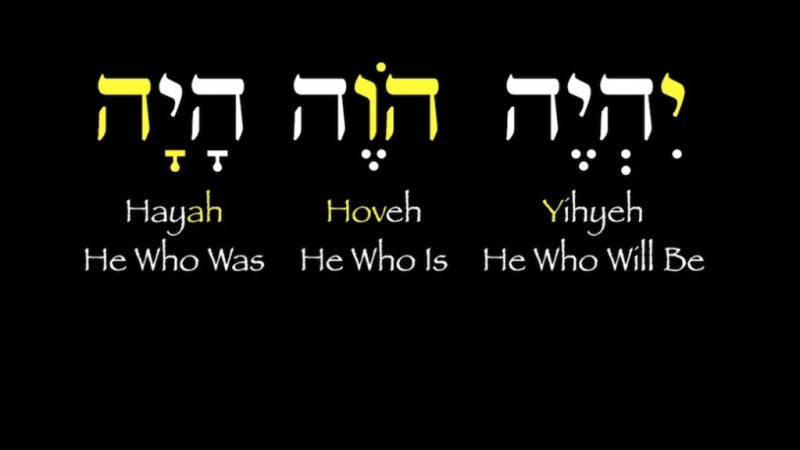
This pattern is not arbitrary. It aligns with Hebrew grammar, accent rules, and the way the eternal Name — revealed as Ehyeh Asher Ehyeh (“I AM WHO I AM / I Will Be Who I Will Be”) in Exodus 3:14 — is embedded in compound names. The three tenses of the root hayah (“to be”) — Yihyeh (He will be), Hoveh (He is), and Hayah (He was) — combine to express the full meaning of Yehovah: “He Was, He Is, He Will Be.”
Why the Pattern Exists
Hebrew favors certain vowel sounds and syllable stress. When the divine name is prefixed, the natural form is Yeh- / Yeho- to carry the full weight of the Name at the start. When suffixed, the emphasis shifts to the end of the word, producing -yah or -yahu. This is seen uniformly across the Hebrew Scriptures and reflects the original pronunciation preserved in the Masoretic text.
Examples of Names Beginning with Yeh- / Yeho-
Here are many clear biblical examples (using standard English spellings followed by Hebrew transliteration):
-
- Yehoshua (Joshua) – יהושע – “Yehovah is salvation” (most famous: successor of Moses)
- Yehonatan (Jonathan) – יהונתן – “Yehovah has given” (son of Saul, friend of David; also others)
- Yehoyada (Jehoiada) – יהוידע – “Yehovah knows” (high priest who overthrew Athaliah; father of Benaiah)
- Yehoyakim (Jehoiakim) – יהויקים – “Yehovah will raise up / Yehovah establishes”
- Yehoyachin (Jehoiachin) – יהויכין – “Yehovah will establish / Yehovah prepares”
- Yehoahaz (Jehoahaz) – יהואחז – “Yehovah has grasped / Yehovah holds”
- Yehoash (Jehoash / Joash) – יהואש – “Yehovah has given / Yehovah is strong” (kings of Judah and Israel)
- Yehonadav (Jehonadab) – יהונדב – “Yehovah is willing / Yehovah impels”
- Yehoshaphat (Jehoshaphat) – יהושפט – “Yehovah has judged” (king of Judah)
- Yehoram (Jehoram / Joram) – יהורם – “Yehovah is exalted / Yehovah is high” (kings of Israel and Judah)
- Yehosef (Joseph, full form) – יהוסף – “Yehovah will add / Yehovah increases” (Psalm 81:6)
- Yehochanan (Jehohanan) – יהוחנן – “Yehovah is gracious / Yehovah has shown favor” (multiple in Chronicles, Ezra)
- Yehiel (Jehiel) – יהיאל – “Yehovah is God / God lives” (multiple leaders and Levites)
- Yehizkiyah (Hezekiah, longer form) – יהזקיה – “Yehovah strengthens”
- Yehotzadak (Jehozadak) – “Yehovah is righteous”
- Yehoaddah – “Yehovah has adorned”
- Yehoram (already listed)
- Yehoiada (already listed)
- Yehoshabeath (Jehosheba) – “Yehovah is an oath / swearing”
There are over 20 clear examples of the Yeho- / Yeh- prefix in the Hebrew Bible, all consistently following this rule with no standard exceptions among Israelite names.
Examples of Names Ending with -yah or -yahu
The suffix form is even more common:
-
- Yirmeyahu (Jeremiah) – יִרְמְיָהוּ – “Yehovah will exalt / Yehovah lifts up”
- Yeshayahu (Isaiah) – יְשַׁעְיָהוּ – “Yehovah is salvation”
- Eliyahu (Elijah) – אֵלִיָּהוּ – “My God is Yehovah”
- Zekaryahu (Zechariah) – זְכַרְיָהוּ – “Yehovah remembers”
- Chizkiyahu (Hezekiah) – חִזְקִיָּהוּ – “Yehovah strengthens”
- Yoshiyahu (Josiah) – יֹאשִׁיָּהוּ – “Yehovah heals / supports”
- Mattanyahu (Mattaniah) – מַתַּנְיָהוּ – “Gift of Yehovah”
- Shefatyahu (Shephatiah) – שְׁפַטְיָהוּ – “Yehovah has judged”
- Azaryahu (Azariah) – עֲזַרְיָהוּ – “Yehovah has helped”
- Uziyahu (Uzziah) – עֻזִּיָּהוּ – “Yehovah is my strength”
- Abiyah (Abijah) – אֲבִיָּה – “My father is Yehovah”
- Adoniyah (Adonijah) – אֲדֹנִיָּה – “My lord is Yehovah”
- Amasyah (Amasiah) – עֲמַשְׁיָה – “Yehovah has borne / carried”
- Amaryah (Amariah) – אֲמַרְיָה – “Yehovah has promised / said”
- Hizkiyahu (Hezekiah, variant) – same as above
- Nethanyahu (Nethaniah) – נְתַנְיָהוּ – “Yehovah has given”
- Yedidyah (Jedidiah) – יְדִידְיָה – “Beloved of Yehovah” (Solomon’s other name)
- Malkiyah (Malchiah) – מַלְכִּיָּה – “Yehovah is king”
- Uriyah (Uriah) – אוּרִיָּה – “Yehovah is my light / flame”
- Toviyah (Tobiah) – “Yehovah is good”
- Berekyahu (Berechiah) – “Yehovah blesses”
- Gemaryahu (Gemariah) – “Yehovah has completed”
- Nedabyah – “Yehovah is willing”
- Pedaiah – “Yehovah has redeemed”
- Rephayah – “Yehovah has healed”
- Shemayah (Shemaiah) – “Yehovah has heard”
- Tsidqiyahu (Zedekiah) – “Yehovah is righteous” (last king of Judah)
- Obadyahu (Obadiah) – “Servant of Yehovah”
There are dozens of names ending in -yahu (full form) and even more in the shortened -yah. This pattern holds throughout the Tanakh.
The Consistency of Proper Hebrew
This is not a random custom but a reflection of proper Hebrew grammar and phonology. The prefix Yeh- and suffix -yah / -yahu both point back to the same divine Name revealed to Moses. No biblical Israelite name begins with “Yah-” as a prefix in the way “Yeh-” appears, nor does the suffix appear as “Yeh-” at the end. The pattern is uniform and testifies to the pronunciation Yehovah as preserved in the Hebrew text.
This beautiful feature of the Hebrew language shows how the eternal Name — “He Was, He Is, He Will Be” — was woven into the very identities of God’s people, reminding them constantly of the One who called them by name.
In the Masoretic Hebrew text of the Tanakh, when the divine Name is incorporated into personal names, proper Hebrew grammar follows a clear and consistent rule:
- When the divine element appears at the beginning of a name, it is always spelled and pronounced Yeh- or Yeho- (יְהוֹ־).
- When it appears at the end of a name, it is spelled -yah or -yahu (יָה / יָהוּ).
There are virtually no standard Israelite theophoric names in the Hebrew Bible that begin with “Yah-” (יַה־) as the divine prefix in the same consistent way that the Yeh-/Yeho- prefix appears.
The short form Yah (יה) is frequently used as:
- A standalone poetic expression (e.g., Hallelu-Yah),
- A suffix at the end of names (-yah / -yahu).
Yehudah (Judah / יְהוּדָה), one of the earliest names, begins with Yeh-, not “Yah-”. Claims that place a “Yah-” prefix at the front of names are mostly made by modern non-scholars and do not reflect proper Hebrew grammar or the Masoretic text.
The few rare candidates sometimes mentioned (such as Yahdai in 1 Chronicles 2:47 or Yahzeel in Genesis 46:24) are exceptional, minor names and not part of the abundant, consistent pattern seen with Yeh-. No major prophets, kings, or central figures in Israel have names that reliably begin with a clear “Yah-” divine prefix.
This uniform pattern — Yeh- at the beginning and Yah / Yahu at the end — is preserved throughout the Tanakh. It testifies to the pronunciation Yehovah as embedded in the Hebrew Scriptures according to proper Hebrew rules.
The Name of God Revealed in Exodus 3:14
The Name of God Revealed in Exodus 3:14
In Exodus 3:14, when Moses asked for the name of the God of the fathers to tell the children of Israel, God answered directly in the first person:
אֶהְיֶה אֲשֶׁר אֶהְיֶה
Ehyeh Asher Ehyeh
This is the foundational self-revelation of the divine Name, spoken in proper biblical Hebrew.
The Root and Grammar
The word Ehyeh (אֶהְיֶה) comes from the Hebrew verb root הָיָה (hayah) — “to be,” “to exist,” or “to become.”
- Ehyeh is the first person singular imperfect form (גוף ראשון יחיד).
- In biblical Hebrew, the imperfect aspect expresses incomplete or ongoing action, which can carry the sense of present or future depending on context.
- God therefore declares: “I Am / I Will Be who I Am / I Will Be.”
Immediately after this, God instructs Moses:
“Thus you shall say to the children of Israel, Ehyeh has sent me to you” (Exodus 3:14).
Then, in verse 15, God connects this first-person revelation to the third-person Name:
Exo 3:15 And God said to Moses again, You shall say this to the sons of Israel, Jehovah the God of your fathers, the God of Abraham, the God of Isaac, and the God of Jacob, has sent me to you. This is My name forever, and this is My title from generation to generation.
יְהֹוָה — Yehovah, the God of Abraham, Isaac, and Jacob.
The Three Tenses of Hayah Forming Yehovah
Proper Hebrew grammar shows that the Name Yehovah (יהוה) is built from the same root hayah. It combines three forms of the verb “to be,” expressing God’s eternal nature across all time:
- Yihyeh (יִהְיֶה) — He will be (future / imperfect, third person) → supplies the Yeh- prefix.
- Hoveh (הֹוֶה) — He is (present / participle) → supplies the Hov / Hovah core.
- Hayah (הָיָה) — He was (past / perfect) → supplies the Yah element.
Together they form Yehovah — “He Was, He Is, He Will Be.” This is the third-person counterpart to God’s first-person declaration Ehyeh Asher Ehyeh (“I Am / I Will Be who I Am / I Will Be”).
The Consistent Pattern in Hebrew Names
This grammar is confirmed throughout the Tanakh in theophoric (God-bearing) names:
- When the divine element is at the beginning of a name, proper Hebrew always uses Yeh- or Yeho- (e.g., Yehoshua, Yehonatan, Yehoshaphat, Yehoyada, Yehoram, Yehosef, etc.).
- When it is at the end of a name, it consistently appears as -yah or -yahu (e.g., Yirmeyahu, Yeshayahu, Eliyahu, Chizkiyahu, Zekaryahu, etc.).
There are no standard exceptions to this rule in the Masoretic Hebrew text for major Israelite names. Yehudah (Judah) itself begins with Yeh-, not “Yah-”.
This pattern is not accidental. It reflects proper Hebrew phonology and grammar when embedding the full name Yehovah into personal names.
Summary
In Exodus 3:14, God reveals Himself in the first person as Ehyeh Asher Ehyeh — the Eternal One who simply is, encompassing past, present, and future. The name Yehovah is the third-person form of the same revelation: “He Was, He Is, He Will Be.”
This understanding flows directly from the Hebrew text and standard biblical grammar, without reliance on later interpretations. It shows that the God of Israel is the Self-Existent One whose Name declares His unchanging presence through all time.
The children of Israel were to know and remember this Name forever — the name revealed at the burning bush according to the plain words and grammar of the Hebrew Scriptures.
From Yehovah to Yahweh
From Yehovah to Yahweh
The Historical Development of the Pronunciations “Yehovah/Jehovah” and “Yahweh”
The Tetragrammaton יהוה (YHWH) appears more than 6,800 times in the Hebrew Bible. Ancient evidence, such as Egyptian inscriptions from the 14th century BCE mentioning “Yhwꜣ” among the Shasu nomads and later Northwest Semitic texts, points to early forms close to Yahwa, Yahu, or similar pronunciations.
By the late Second Temple period (roughly 3rd–1st centuries BCE), Jewish tradition largely stopped pronouncing the Name aloud out of deep reverence, to avoid any misuse of the Third Commandment. Readers substituted Adonai (“My Lord”) whenever they encountered YHWH in the text.
In the early Middle Ages, the Masoretes (Jewish scribes working roughly from the 7th to 10th centuries CE) added vowel points to the consonantal Hebrew text to preserve pronunciation. For YHWH, they inserted the vowels of Adonai (creating an a-o-a pattern) as a perpetual reminder to say “Adonai” instead. Reading those vowels literally on the consonants YHWH produces Yəhōwāh (commonly rendered in English as Yehovah). This hybrid form was never meant to be the actual pronunciation of the Name.
Medieval Christian scholars, reading the pointed Hebrew text without fully grasping the Jewish qere-ketiv (what is written vs. what is to be read) system, combined the consonants YHWH with the vowels of Adonai. The Latinized form Jehovah first appeared around 1270–1520 CE in works such as those by the Spanish Dominican monk Raymundus Martini (c. 1270) and later Petrus Galatinus. It spread through printed Bibles and Protestant scholarship. This remains a hybrid with the consonants of YHWH but the vowels of Adonai, with no direct ancient attestation as the original pronunciation.
During the Renaissance and Reformation, growing study of Hebrew, comparative Semitics, and ancient inscriptions led scholars to question the form “Jehovah.” Early proposals resembling Yahweh emerged from Christian Hebraists in the 16th century (e.g., Gilbert Genebrard in 1599). Supporting evidence included:
- Ancient Greek transcriptions by Church Fathers, such as Clement of Alexandria (c. 180–200 CE) rendering it as Iaoue or Iaouai, and Theodoret (5th century) as Iabe.
- Biblical theophoric names (Yehoshua, Eliyahu, etc.) and short forms such as “Yah” (in Hallelu-Yah) and “Yahu.”
- Comparative linguistics showing the root hwy/hwh (“to be”) and its causative sense (“He causes to be” or “He is/will be”).
The decisive shift came with the German Hebrew scholar Wilhelm Gesenius (1786–1842), whose influential lexicon and grammar strongly championed Yahweh. By the mid-to-late 19th century, this reconstruction had become dominant in academic circles.
In the 20th century, devotional use of “Jehovah” gained massive popular traction through two movements. The Jehovah’s Witnesses, originally known as Bible Students under Charles Taze Russell, increasingly emphasized the divine name in the 1920s under Joseph Franklin Rutherford. In 1931, at a convention in Columbus, Ohio, they officially adopted the name “Jehovah’s Witnesses” based on Isaiah 43:10–12. Their New World Translation (1950/1961) consistently uses “Jehovah” throughout the Old Testament and inserts it in 237 places in the New Testament, making the form widely recognized worldwide.
Around the same time, the Sacred Name Movement (SNM) arose in the late 1930s, primarily from within the Church of God (Seventh Day). Key pioneer Clarence Orvil Dodd began publishing The Faith magazine in 1937 to promote the Hebrew names along with biblical feasts and Sabbath observance. Influenced in part by the growing emphasis on the Name, the movement generally rejected “Jehovah” as a hybrid and advocated forms such as Yahweh (or Yahvah) for the Father and Yahshua for the Son. The first major organization was the Assembly of Yahweh in Holt, Michigan (chartered 1939). Though smaller and more decentralized, it influenced later Hebrew Roots and Sacred Name groups.
Today, “Yahweh” remains the near-universal scholarly reconstruction among biblical linguists and Semitists, as it best aligns with ancient inscriptions, Greek transcriptions, grammar, and theophoric patterns. “Yehovah/Jehovah” continues in strong devotional use, particularly among Jehovah’s Witnesses and some traditional circles, while various Hebrew forms are preferred in Sacred Name and Hebrew Roots communities.
In summary, “Yehovah/Jehovah” arose as a medieval hybrid from a literal reading of the Masoretic pointing. “Yahweh” developed as a scholarly reconstruction from the 16th century onward, becoming dominant in academia by the 19th century. The 20th century saw both forms popularized in distinct religious movements, even as the exact original vocalization of the Name remains a matter of informed reconstruction, since no direct ancient Hebrew recording with vowels has survived.
God’s displeasure when His Name is neglected or replaced,
God’s displeasure when His Name is neglected or replaced
The Jewish Practice of Not Pronouncing the Name Yehovah (or YHWH)
Jews today do not pronounce the Tetragrammaton יהוה (whether as Yehovah, Yahweh, or any other vocalized form) out of deep reverence for its holiness. This tradition is ancient and stems from several biblical and historical factors.
Primary Biblical Foundation: The Third Commandment
The core reason is the Third Commandment:
“You shall not take the name of Yehovah your God in vain, for Yehovah will not hold him guiltless who takes His name in vain.” (Exodus 20:7)
Traditional Jewish interpretation understands “in vain” (lashav) to include not only false oaths or casual swearing, but any irreverent, unnecessary, or casual utterance of the sacred Name. To avoid any risk of breaking this commandment, the Name is simply not spoken aloud.
The Key Passage Often Cited: Jeremiah 44:26
Some teachers, especially in Sacred Name circles, point to Jeremiah 44:26 as a specific divine pronouncement related to the Jews in Egypt:
“Therefore hear the word of Yehovah, all Judah who dwell in the land of Egypt: ‘Behold, I have sworn by My great name,’ says Yehovah, ‘that My name shall no more be named in the mouth of any man of Judah in all the land of Egypt, saying, “As the Lord GOD lives.”’”
In context, this was a judgment against the idolatrous Jews in Egypt who were mixing worship of Yehovah with pagan practices (such as offering incense to the “Queen of Heaven”). God declared that because of their profanation of His Name through syncretism, He would remove the privilege of invoking it in that place. This was a localized judgment on that specific community, not a universal, eternal curse on all Jews everywhere for all time.
Broader Context in Jeremiah
Jeremiah also rebukes false prophets who were trying to make God’s people forget His Name (Jeremiah 23:26-27):
Jer 23:26 How long shall this be in the heart of the prophets who prophesy lies? But they are prophets of the deceit of their own heart,
Jer 23:27 who plot to cause My people to forget My name by their dreams which they tell, each one to his neighbor, as their fathers have forgotten My name for Baal.
This shows God’s displeasure when His Name is neglected or replaced, but it does not command a permanent ban on its use by all Jews.
Historical Development of the Tradition
- By the Second Temple period (c. 3rd century BCE onward), the practice of substituting Adonai (“My Lord”) when reading the Name aloud was already well established.
- The Masoretes (7th–10th centuries CE) reinforced this by inserting the vowels of Adonai into the consonants YHWH as a perpetual reminder not to pronounce it.
- After the destruction of the Temple in 70 CE, the oral knowledge of the exact pronunciation was largely lost outside very restricted circles (the High Priest pronounced it only on Yom Kippur in the Holy of Holies).
Modern Jewish Practice
Today, observant Jews:
- Say “Adonai” when reading Scripture aloud.
- Use “HaShem” (“The Name”) in conversation.
- Never pronounce Yehovah, Jehovah, or Yahweh in prayer, song, or daily speech.
This is not because they reject the Name, but because they regard it as supremely holy and seek to protect it from any possible misuse — in obedience to the Third Commandment and in line with the warnings in Jeremiah against profaning or forgetting it.
In summary, the avoidance of pronouncing the Name is fundamentally an act of reverence rooted in Exodus 20:7. Jeremiah 44:26 was a specific judgment on a particular idolatrous group, not a blanket eternal curse preventing all Jews from ever using the Name. The tradition of substitution has been the standard practice across Judaism for over two thousand years.
Nehemia Gordon’s Research on the Pronunciation “Yehovah”
Nehemia Gordon’s Research on the Pronunciation “Yehovah”
Nehemia Gordon, a Karaite Jewish scholar, has conducted extensive research into the pronunciation of the Tetragrammaton יהוה (YHWH). He argues that the original and correct pronunciation preserved in ancient Hebrew sources is Yehovah (יְהֹוָה), not the scholarly reconstruction “Yahweh.” His work focuses on direct manuscript evidence rather than linguistic theory alone.
Core Claim and Methodology
Gordon’s central argument is that Jewish scribes (Masoretes and later copyists) occasionally revealed the full vowels of the Name when they “slipped” in their careful system of hiding it. He and his team have systematically examined thousands of Hebrew Bible manuscripts from libraries worldwide (including the Vatican, Russian National Library, and others). They search for instances where YHWH appears with a complete set of vowel points that spell Yehovah (sheva under yod, holem on vav, kamatz under final heh).
Key milestones in his findings:
- By January 2018: Over 1,000 Hebrew Bible manuscripts with full vowels of “Yehovah.”
- By late 2019: Over 2,000 such manuscripts.
These include major codices and fragments dating from the 9th–15th centuries CE onward.
Specific Ancient Sources and Proofs
Gordon highlights several key pieces of evidence:
- The Aleppo Codex is one of the oldest and most authoritative Masoretic manuscripts of the entire Hebrew Bible. Gordon and his team examined it extensively and identified at least seven clear instances where the Tetragrammaton יהוה has the full vowels of Yehovah (sheva under the yod, holem on the vav, and kamatz under the final heh).
One notable example is in 1 Samuel 15:1, during the scene where Samuel anoints Saul as king. Gordon highlights that even in this meticulously proofread codex, the scribes occasionally allowed the full pointing. He argues this was not random error but occasional preservation of the known pronunciation. The Aleppo Codex’s precision makes these instances particularly significant — if the scribes were strictly substituting Adonai vowels, such full pointings should not appear at all. Gordon has shared high-resolution images and folio references in his studies, showing the exact vowel marks.
- Leningrad Codex (c. 1008 CE, basis for many modern Hebrew Bibles):
This is the oldest complete manuscript of the Hebrew Bible and serves as the textual basis for many modern editions (such as Biblia Hebraica Stuttgartensia). Gordon notes that it also contains multiple instances of the full Yehovah vowels, though with some variations and occasional later “corrections.”
He points out inconsistencies in how later scribes handled the pointing, sometimes adjusting vowels when the Name appeared near Adonai. Despite these, the core Yehovah pattern appears repeatedly. Gordon contrasts this with the complete absence of any “Yahweh” pointing in the manuscript. The Leningrad Codex provides one of the earliest large-scale witnesses in his collection.
- Early Hebrew Bible Fragments (9th–11th centuries):
Gordon’s team has catalogued numerous early fragments and partial manuscripts from major libraries (including the Vatican, British Library, Russian National Library, and others). These date from the 9th to 11th centuries and show the Yehovah vowels in various biblical books.
He stresses that these are not isolated anomalies but part of a broader pattern across hundreds of sources. In some cases, scribes wrote the full vowels and later added marginal corrections to Adonai, indicating awareness of the pronunciation. Gordon maintains these revelations occurred because scribes knew the true vowels but followed the tradition of concealment most of the time. His database now includes thousands of such attestations.
- Traditional Jewish Sources:
Gordon has examined previously untranslated or understudied rabbinic and especially Karaite texts. Karaites (a non-rabbinic Jewish sect) sometimes preserved different attitudes toward the Name. He cites sources where Jewish authorities explicitly describe the vowels as producing Yehovah.
In his series “10 Rabbis Speak Out on the Name,” he presents medieval Jewish voices confirming this pointing. Gordon connects this to the Masoretes themselves, arguing that many were influenced by Karaite traditions that retained knowledge of the pronunciation even while suppressing public utterance. These internal Jewish witnesses are central to his argument that “Yehovah” was not a Christian invention but known within Jewish scribal circles.
- The “Mistake That Got It Right”:
This is one of Gordon’s most detailed explanations. When scribes were supposed to insert the vowels of Adonai (which begins with a hatef-patach under a guttural), they sometimes used a regular sheva under the yod of YHWH instead. Additionally, they frequently omitted the middle holem (the “o” sound) on the vav.
Gordon argues this was a deliberate strategy to obscure the Name while still allowing the correct pronunciation to be recoverable. Occasionally, a scribe would include the full set of vowels (sheva + holem + kamatz), producing Yehovah by what Gordon calls a “happy mistake” or “the mistake that got it right.” He also discusses rafeh marks (dots) and other scribal notations used to signal how to handle the Name. These “slips” in otherwise rigorous proofreading preserved the pronunciation across centuries.
Gordon emphasizes that in all these thousands of manuscripts, he has not found a single instance of vowel points spelling “Yahweh” or similar forms in Jewish Hebrew Bible texts.
Overall Assessment: Gordon’s work documents over 2,000 Hebrew Bible manuscripts (as of 2019, with more added since) containing the full vowels of Yehovah. He repeatedly notes the complete absence of any manuscript evidence for “Yahweh” in Jewish sources. His research emphasizes primary manuscript evidence over later linguistic reconstructions and has been presented in detailed video studies on NehemiasWall.com. While mainstream scholarship debates his interpretations (particularly the intent behind the pointing), Gordon’s contribution lies in the sheer volume of documented examples from the Masoretic tradition itself.
Additional Supporting Points from Gordon
- He links this to the three tenses of the verb hayah (“to be”): Yihyeh (He will be), Hoveh (He is), Hayah (He was) → forming Yehovah (“He Was, He Is, He Will Be”).
- He argues the Masoretes (many of whom he believes included Karaites) knew the pronunciation but suppressed public use while occasionally allowing it in the written tradition.
- Gordon has also examined Hebrew New Testament manuscripts and other sources for consistency.
Summary of His Position
Gordon presents his findings as overwhelming empirical evidence from primary sources: thousands of Hebrew manuscripts (now over 2,000 documented by his count) preserve the full vowels of Yehovah. He views this as proof that Jewish scribes knew and sometimes recorded the true pronunciation, even while the broader tradition substituted “Adonai” out of reverence. His research is detailed in videos, articles, and studies on NehemiasWall.com, including “The Mistake That Got It Right” series.
This work has been influential in certain Hebrew Roots and Sacred Name communities, though it remains debated in mainstream scholarship. Gordon continues to share updates and encourages direct examination of the manuscripts.
Origin of “Yahweh”
Nehemia Gordon’s Position on the Origin of “Yahweh”
One of the most misunderstood points in the debate over the divine Name is Nehemia Gordon’s position on the pronunciation “Yahweh.” Many people assume Gordon teaches that “Yahweh” comes directly from Zeus or that the Name itself is pagan. That is not what he says. His argument is more careful, more historical, and, in many ways, more troubling for the modern scholarly consensus.
Gordon’s real point is this: the academic preference for “Yahweh” does not rest on primary Hebrew manuscript evidence. It rests mainly on later secondary testimony, especially a fifth-century Christian report about Samaritan pronunciation, and that testimony comes from a community with a documented history of religious syncretism and adaptation under pagan rule. For Gordon, that is a very weak foundation on which to build certainty about the pronunciation of the most sacred Name in Scripture.
At the center of the scholarly case for “Yahweh” stands Theodoret of Cyrus, a Christian Church Father writing around 450 CE. In his Questions on Exodus (Question 15), Theodoret says that the Samaritans pronounced the Name as Iabe, while the Jews pronounced it as Aia. This brief statement has been cited again and again in modern lexicons and scholarly discussions. In fact, it has become one of the main ancient witnesses used to support the reconstructed pronunciation “Yahweh.” Scholars generally interpret the Samaritan form Iabe as a Greek attempt to capture something like Yahweh, allowing for the limitations of Greek spelling.
Gordon does not deny that this passage exists or that it has deeply influenced scholarship. His objection is that it is being given a level of authority it does not deserve. Theodoret is not preserving a direct Hebrew manuscript tradition. He is a late Christian writer reporting what he says the Samaritans called the Name. That is not the same thing as ancient Jewish or Israelite manuscript evidence. It is second-hand external testimony, and Gordon argues that scholars have leaned on it far too heavily.
The problem becomes more serious when one considers the historical record of the Samaritans themselves. During the persecution under Antiochus IV Epiphanes in the second century BCE, the Samaritans sought to avoid suffering by distancing themselves from the Jews and adapting themselves to Greek expectations. Josephus records in Antiquities of the Jews 12.257–264 that they requested their temple on Mount Gerizim be rededicated to Jupiter Hellenius. Likewise, 2 Maccabees 6:2 confirms that the temple on Mount Gerizim was called the temple of Zeus. These are not hostile rumors from much later sources. They are ancient witnesses to a real historical episode.
For Gordon, this matters greatly. It shows that the Samaritans were willing, under pressure, to blur or adapt their religious identity. Josephus even describes them presenting themselves as “Sidonians in Shechem” rather than as Jews. In other words, they were not preserving an unbroken, untouched witness to Israelite tradition. They had already shown themselves willing to compromise, rename, and reposition themselves when it served their survival. Gordon therefore argues that Samaritan pronunciation, especially when reported centuries later by Theodoret, cannot simply be treated as the pure ancient pronunciation of the divine Name.
This is where Gordon’s critique of modern scholarship becomes especially sharp. He points out that some of the very scholars who helped popularize “Yahweh” as the original form were themselves willing to connect that form, at least speculatively, with names associated with pagan deities. The most famous example is Wilhelm Gesenius, the great nineteenth-century Hebrew lexicographer whose work shaped much of modern biblical scholarship. In the English translation of his Hebrew and Chaldee Lexicon, Gesenius wrote that, in his opinion, the reconstructed form Yahweh might be of the greatest antiquity and perhaps of the same origin as Jovis or Jupiter, possibly transmitted from the Egyptians to the Hebrews.
Gordon finds this both shocking and ironic. The very academic tradition insisting that “Yahweh” is the original pronunciation was sometimes willing to compare it to Jupiter or Jovis. Gordon does not use this to argue that “Yahweh” literally is Zeus. Rather, he uses it to expose how speculative the scholarly chain of reasoning has been. What is often presented as settled fact turns out to rest on Samaritan testimony filtered through a late Christian writer and then extended by scholars who were not above entertaining pagan parallels.
Against all of this, Gordon appeals to what he sees as the far stronger witness of the Hebrew Bible manuscripts themselves. He and his team have spent years examining Hebrew manuscripts, and by early 2018 they had already documented more than one thousand manuscripts containing the full vowels of Yehovah. At one point the count had reached 1,015, and he has indicated that the number has continued to increase. These examples include the Aleppo Codex, the Leningrad Codex, and hundreds of other manuscripts and fragments ranging from the ninth to the fifteenth centuries. Gordon has published spreadsheets, high-resolution images, and detailed explanations of this evidence.
For him, the significance is obvious. There is an enormous body of direct Hebrew manuscript evidence for Yehovah, while there is no direct ancient Hebrew manuscript evidence for Yahweh. That does not end the debate for everyone, but it certainly changes how the evidence should be weighed. Gordon insists that primary Hebrew manuscript evidence must carry more authority than later external reconstructions based on Samaritan pronunciation.
He strengthens this case further by appealing to the internal evidence of biblical Hebrew names. The theophoric names of the Tanakh follow a highly consistent pattern. At the beginning of names, the divine element appears overwhelmingly as Yeh- or Yeho-, as in Yehoshua, Yehonatan, Yehoshaphat, and Yehoyada. At the end of names, it appears overwhelmingly as -yah or -yahu, as in Yirmeyahu, Yeshayahu, Eliyahu, and Chizkiyahu. Gordon argues that these patterns fit naturally with Yehovah and do not align nearly as well with Yahweh. If the Name had originally begun with Yah-, one would expect that form to appear much more clearly in theophoric prefixes throughout the Hebrew Bible. Instead, what appears again and again is Yeh- or Yeho-.
So Gordon’s conclusion is not that “Yahweh” is a pagan name in itself. His conclusion is that the scholarly preference for “Yahweh” rests on a chain of evidence that is secondary, late, heavily Samaritan, and historically entangled with a community known to have adapted itself under Hellenistic pressure. By contrast, Yehovah is, in his judgment, supported by a massive body of Hebrew manuscript evidence and by the internal structure of Hebrew names preserved throughout the Tanakh.
This is why Gordon rejects the academic consensus. He believes the case for “Yahweh” asks us to trust late outside reports over the Hebrew manuscripts, Samaritan testimony over Jewish scribal preservation, and scholarly reconstruction over direct textual evidence. For him, that is methodologically backwards. The place to begin is not with Theodoret, not with Gesenius, and not with later reconstructions. The place to begin is with the Hebrew text itself.
In the end, that is the real issue. Will we build our understanding of the divine Name on primary manuscript evidence preserved in the Hebrew Bible, or on later scholarly theories rooted in second-hand Samaritan testimony? Nehemia Gordon’s answer is clear. He believes the evidence points not to Yahweh, but to Yehovah.
Call upon His Name
Call upon His Name
This week I have been explaining the Name of Yehovah and why it matters. I want to close this newsletter by bringing all of it down to one simple but powerful truth. It is important to know the Name of Yehovah because He revealed it so that His people would remember it, honor it, and call upon it.
This is not a minor issue. It is not a side discussion for those who enjoy Hebrew studies. It is not an optional preference. It reaches into prayer, worship, covenant, deliverance, and obedience itself.
When Yehovah first revealed His Name to Moses, He did not do it casually. In Exodus 3:15 He said,
“Say this to the people of Israel: Yehovah, the God of your fathers, the God of Abraham, the God of Isaac, and the God of Jacob, has sent me to you. This is My Name forever, and thus I am to be remembered throughout all generations.”
That is as plain as words can be. This is My Name forever. Thus I am to be remembered throughout all generations.
He did not reveal His Name so that it could be hidden. He did not reveal it so later generations could replace it with titles. He said this is how He is to be remembered. And then in Exodus 6:2-3 He spoke again to Moses and said,
“I am Yehovah.”
He identifies Himself by Name. He is not nameless, and He is not content to remain unknown behind generic titles.
This same truth is repeated in Isaiah 42:8, where He says,
“I am Yehovah, that is My Name; and My glory I will not give to another, nor My praise to carved images.”
He ties His glory to His Name. He declares it. He distinguishes Himself by it. So who are we to act as though the Name is unimportant?
The Scriptures do not treat the Name as unimportant. Again and again, Yehovah commands His people to call upon it.
Psalm 105:1 says,
“Oh give thanks to Yehovah; call upon His Name; make known His deeds among the peoples!”
Isaiah 12:4 says,
“And in that day you will say: Give thanks to Yehovah, call upon His Name; declare His deeds among the peoples, make mention that His Name is exalted.”
This is not hidden in some obscure passage. It is part of the ordinary language of worship. We are told to give thanks to Yehovah, to call upon His Name, and to make it known that His Name is exalted.
Zephaniah 3:9 goes even further, speaking of the future restoration:
“For then I will restore to the peoples a pure language, that they all may call upon the Name of Yehovah, to serve Him with one accord.”
Think about that. In the restoration of all things, the peoples are given a pure language for a purpose, so that they all may call upon the Name of Yehovah. The Name is not discarded in the restoration. It is restored in the restoration.
And there are promises attached to calling upon the Name.
Joel 2:32 declares,
“And it shall come to pass that everyone who calls upon the Name of Yehovah shall be saved.”
This promise is so central that it is quoted again in the New Testament, in Acts 2:21 and Romans 10:13. The message remains the same. Deliverance is tied to calling upon the Name of Yehovah.
Psalm 50:15 says,
“Call upon Me in the day of trouble; I will deliver you, and you shall glorify Me.”
And Psalm 91:14-15 says,
“Because he has set his love upon Me, therefore I will deliver him; I will set him on high, because he has known My Name. He shall call upon Me, and I will answer him.”
These verses connect knowing His Name, calling upon Him, deliverance, and answered prayer. That is not accidental. That is covenant language. It is intimate language. It is the language of relationship.
From the earliest pages of Scripture, this was the practice of the faithful. Abraham built altars and called upon the Name of Yehovah in Genesis 12:8 and again in Genesis 13:4. Isaac did the same in Genesis 26:25. Elijah stood against the prophets of Baal and said in 1 Kings 18:24,
“Then you call on the name of your gods, and I will call upon the Name of Yehovah; and the God who answers by fire, He is God.”
David says in Psalm 116:13,
“I will take up the cup of salvation, and call upon the Name of Yehovah,”
and again in verse 17,
“I will offer to You the sacrifice of thanksgiving, and call upon the Name of Yehovah.”
This is the pattern of the righteous. They did not merely think about Him. They called upon Him by Name.
There is another reason this matters, and it has to do with covenant itself. In the ancient world, when a great king entered into covenant with a lesser people or ruler, the covenant began with the declaration of the king’s personal name and titles. In the ancient suzerain-vassal treaties of the Hittites and others, the preamble always identified the greater king by name. The covenant was not made with an anonymous force. It was made with a named ruler whose identity established the authority and binding nature of the agreement.
This is exactly the pattern we see in Scripture. When Yehovah enters covenant with Israel, He begins by declaring Himself.
“I am Yehovah your God…”
That is the covenant preamble. That is the declaration of the One with whom Israel is entering relationship. His Name is not a minor detail. It is part of the covenant foundation.
That is why Deuteronomy 6:13 and 10:20 say,
“Yehovah your God you shall fear, and Him you shall serve, and by His Name you shall swear.”
His Name is tied to allegiance, worship, service, and covenant loyalty.
So let us be very plain. God did not reveal His Name so that we could hide it. He did not reveal His Name so we could permanently replace it with titles. He revealed it so that His people could know Him, remember Him, honour Him, and call upon Him.
Now let me be careful. I am not saying that a man must have perfect pronunciation in order for Yehovah to hear him. Yehovah knows the heart. He knows when a person is crying out in sincerity. But once He has revealed His Name, and once you know it, the question becomes one of obedience and honour. Will you use the Name He gave, or will you continue to hide it behind tradition or calling upon a false god?
The issue is not whether God is intelligent enough to know who you mean. Of course He is. The issue is whether you will honour what He Himself said. He said,
“This is My Name forever.”
He said,
“Call upon His Name.”
He said,
“I am Yehovah, that is My Name.”
He said,
“Everyone who calls upon the Name of Yehovah shall be saved.”
This is why it matters to know the Name. It matters because He revealed it. It matters because He commanded it to be remembered. It matters because He told us to call upon it. It matters because He tied deliverance, nearness, and answered prayer to those who know and call upon His Name.
So if you are seeking to know Him more intimately, begin using the Name He gave. Give thanks to Yehovah. Call upon Yehovah. Pray to Yehovah in the day of trouble. Teach your children the Name of Yehovah. Let the Name He said is His memorial forever once again be found on the lips of His people.
This is why I use the Name Yehovah.
Because He said,
“This is My Name forever.”
Because He said,
“Call upon His Name.”
Because He promised,
“Everyone who calls upon the Name of Yehovah shall be saved.”
Because He said,
“I will deliver him… because he has known My Name.”
And I do not believe He revealed His Name for us to bury it again.
0 Comments