


Newsletter 5862-008
The 3rd Year of the 5th Sabbatical Cycle
The 32nd year of the 120th Jubilee Cycle
The 29th of the 2nd month, 5862 years after the creation of Adam
The 5th Sabbatical Cycle after the 119th Jubilee Cycle
The Sabbatical Cycle of the Tithes to the Widows and Orphans
April 18, 2026
Shabbat Shalom to the Royal Family of Yehovah,
It is the 42nd day of counting the Omer.
With this Shabbat we are now on Day 42. It is the 6th Sabbath since the waving of the Omer on March 5, 2026. The final 10 days of this 50-day counting began on Wednesday this past week.
Leviticus 23:15 “From the day after the Sabbath, the day you brought the sheaf of the wave offering, count off seven full weeks. Count off fifty days up to the day after the seventh Sabbath, and then presenbt and offering of new grain to the Lord. From where-ever you live, bring two loaves made of two-tenths of an ephah of the finest flour, baked with yeast, as a wave offering of firstfruits to the Lord. ”
This week I am going to look at both of these ten-day periods chiastically and see what I can learn. I am also explaining the meaning of the word “Shavuot” and how it is related to the Feast of Oaths and what that means.
And because Israel, all 12 tribes, are not obeying the covenant they agreed to at Shavuot at Mount Sinai, we are going to also examine some of the curses that you are now seeing happening on the nightly news. Your rising food prices and your coming famine starting this fall. How does the war with Iran affect the whole world? We are going to look at these things and understand just how close we are drawing to the end of this age, and at the same time, as we draw to the end of the counting of weeks in 7 days, in just 7 years’ time, now that 2026 is almost half over, the real Shavuot event is about to take place. Are You Ready?
I also want you to remember what we have been warning you about the coming change in fortunes that is to start this fall of 2026.
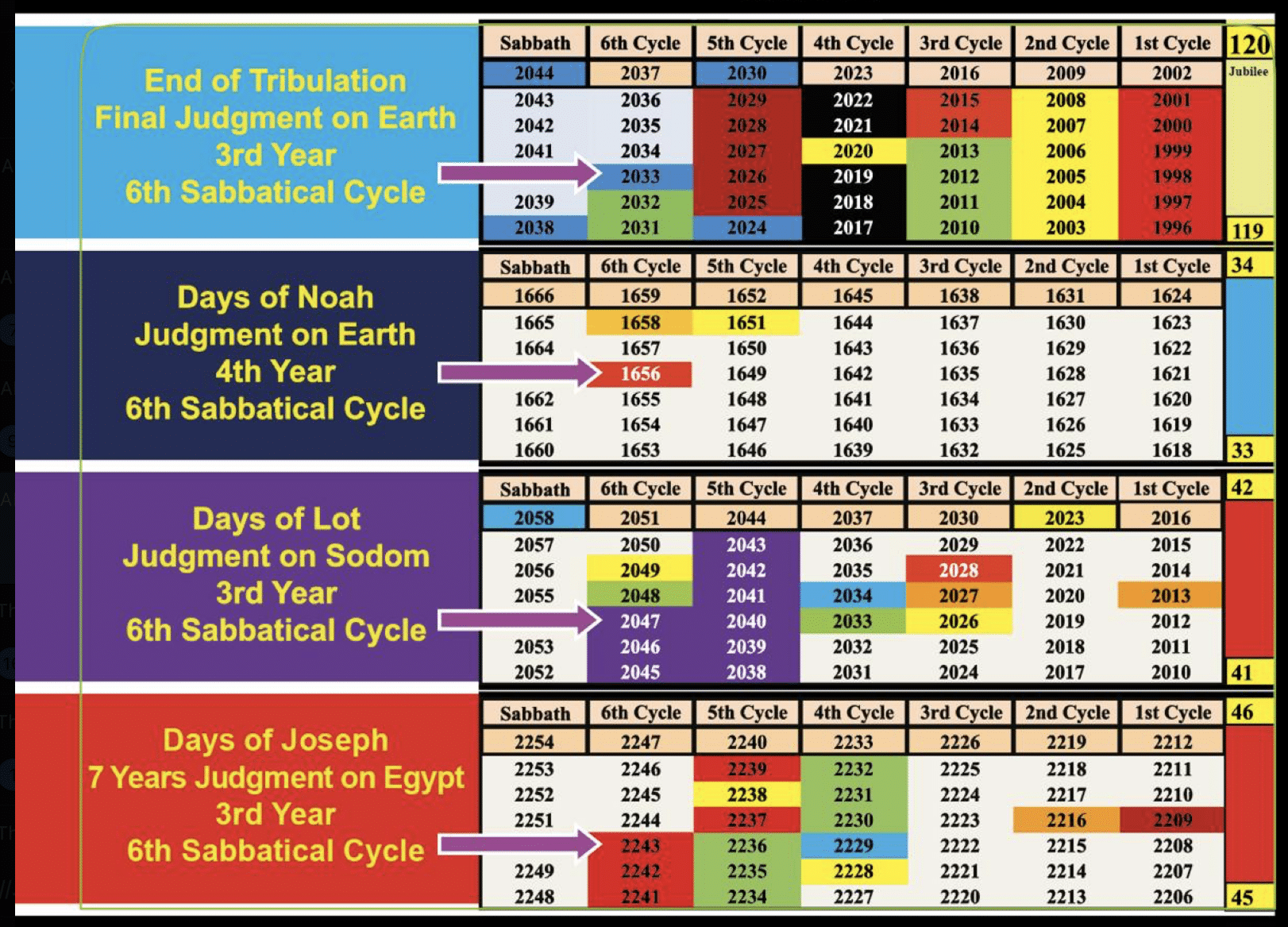
As you read the financial news reports this week keep in mind the Sabbatical cycle of Joseph 7 weeks of plenty and the 7 weeks of famine. The time when they are to switch from one to the other is this fall. As it was in the days of Noah, and as it was in the days of Lot is what Yehshua said in Luke. He did not say anything about as it was in the days of Joseph. This is what we discovered.
We were the ones to warn you about 2020 and 2023, and now 2026. Maybe we don’t know anything. But then again maybe we do.
Pro 25:2 The glory of God is to hide a thing; but the honor of kings is to search out a matter.
Again we ask you if your are ready?
Join Our Sabbath Meetings
Join Our Sabbath Meetings
There are many people in need of fellowship and who are sitting at home on the Sabbath with no one to talk to or debate with. I want to encourage all of you to join us on Shabbat, and to invite others to come and join us as well. If the time is not convenient then you can listen to the teaching and the midrash after on our YouTube channel.
What are we doing and why do we teach this way?
We are going to discuss both sides of an issue and then let you choose. It is the work of the Ruach (Spirit) to direct and to teach you.
The medieval commentator Rashi wrote that the Hebrew word for wrestle (avek) implies that Jacob was “tied”, for the same word is used to describe knotted fringes in a Jewish prayer shawl, the tzitzityot. Rashi says, “thus is the manner of two people who struggle to overthrow each other, that one embraces the other and knots him with his arms”.
Our intellectual wrestling has been replaced by a different kind of struggle. We are wrestling with Yehovah as we grapple with His Word. It is an intimate act, symbolizing a relationship in which Yehovah and you and I are bound together. My wrestling is a struggle to discover what Yehovah expects of us, and we are “tied” to the One who assists us in that struggle.
Today, many say Israel means “Champion of God”, or better — the “Wrestler of God”.
Our Torah sessions each Shabbat teaches you and encourages you to constantly challenge, question, argue against, as well as view alternative views and explanations of the Word. In other words, we are to “wrestle with the Word” to get to the truth. Jews worldwide believe that you need to wrestle with the Word and constantly challenge Dogma, Theology, and views or else you will never get to the Truth.
We are not like most churches where “The preacher talks and everyone listens.” We encourage everyone to participate, to question and to contribute what they know on the subject being discussed. We want you to be a champion wrestler of the Word of Yehovah. We want you to wear the title of Israel, knowing that you not only know but are capable of explaining why you know the Torah to be true with logic and facts.
We have a few rules though. Let others talk and listen. There is no discussion about UFO’s, Nephilim, Vaccines or conspiracy-type subjects. We have people from around the world with different world views. Not everyone cares who is the President of any particular country. Treat each other with respect as fellow wrestlers of the word. Some of our subjects are hard to understand and require you to be mature and if you do not know, then listen to gain knowledge and understanding and hopefully wisdom. The very things you are commanded to ask Yehovah for and He gives to those who ask.
Jas 1:5 But if any of you lacks wisdom, let him ask of God, who gives to all liberally and with no reproach, and it shall be given to him.
We hope you can invite those who want to keep Torah to come and join us by hitting the link below. It is almost like a Torah teaching fellowship talk show with people from around the world taking part and sharing their insights and understandings.
We start off with some music and then some prayers and it’s as though you were sitting around the kitchen back in Newfoundland having a cup of coffee and all of us enjoying each other’s company. I hope you will grace us with your company someday.
Sabbath services begin at 12:30 PM EDT where we will be doing prayers, songs and teaching from this hour.
Shabbat midrash will begin at about 1:15 pm Eastern.
We look forward to you joining our family and getting to know us as we get to know you.
Joseph Dumond is inviting you to a scheduled Zoom meeting.
Topic: Joseph Dumond’s Personal Meeting Room
Join Zoom Meeting
https://us02web.zoom.us/j/3505855877
Meeting ID: 350 585 5877
One tap mobile
+13017158592,,3505855877# US (Germantown)
+13126266799,,3505855877# US (Chicago)
Dial by your location
+1 301 715 8592 US (Germantown)
+1 312 626 6799 US (Chicago)
+1 346 248 7799 US (Houston)
+1 669 900 6833 US (San Jose)
+1 929 436 2866 US (New York)
+1 253 215 8782 US (Tacoma)
Meeting ID: 350 585 5877
Find your local number: https://us02web.zoom.us/u/kctjNqPYv0
Torah Portion
Torah Portions
We read through the entire Torah along with the Prophets and the New Testament once over the course of 3 1/2 years. Or according to the Sabbatical Cycle which means we read it all twice over a 7-year period. This allows us to cover more in-depth rather than being rushed to cover as much as is covered on an annual basis. We allow all to comment and take part in the discussions.
Septennial Torah Portion
If you go to Torah Portion in our archived section, you can then go to the 1st year, which is the 1st year of the Sabbatical Cycle, the one we are in now, as we state at the top of every Newsletter. There, you can scroll down to the proper date and see that this Shabbat, we could very well be midrashing about:
Numbers 2
Ezekiel 43-46
1 John 5
2 John 1
We are in the 1st Sabbatical Cycle in 2024-2025. We go through the entire Bible twice in a 7 year cycle. This means we cover the entire Bible once every 3 1/2 years. It gives us more time to debate and discuss each portion we read.
If you missed last week’s exciting discoveries as we studied that section, you can go and watch past Shabbats on our media section.
Counting the Omer
Counting the Omer
The US Economy as of April 2026
This article is taken in part from a newsletter by Doug Casey’s International Man that was sent to me last week.
The Cost of War with Iran Is Already Crushing the US and World Economy –
And It’s Only the Beginning
Entitlements (Social Security and Medicare), defence, and welfare now dominate the budget. With tens of millions of Baby Boomers retiring in the coming years, no politician will touch entitlements. Defence spending is exploding because of the Iran war. Interest on the national debt is on track to become the largest single budget item.
In short, efforts to reduce expenditures will be meaningless unless it becomes politically acceptable to make chainsaw-like cuts to entitlements, national defense, and welfare while reducing the national debt to lower the interest cost.
In other words, the US would need a leader who—at a minimum—returns the federal government to a limited Constitutional Republic, closes the 128 military bases abroad, ends entitlements, kills the welfare state, and repays a large portion of the national debt — something that will not happen.
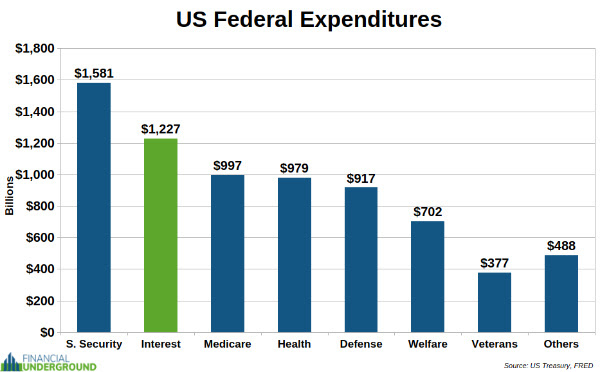
Politicians always choose the easiest path: borrow more. Even confiscating 100% of the wealth of America’s billionaires would not cover a single year of spending. And even after confiscating all billionaire wealth, the US government would still have to borrow more than $200 billion to cover FY 2025 spending. Here’s the bottom line: increasing taxes, even to extreme levels, isn’t going to change the trajectory of this unstoppable trend—even slightly. The truth is, no matter what happens, the deficits will not stop growing, nor will the debt needed to finance them. The growth rate is not even going to slow down. It’s going to increase. That means interest expense on the federal debt will continue exploding higher.
Taxes cannot solve the problem. The deficits will keep growing, and so will the debt needed to finance them. In this case, that means issuing more debt rather than making tough budget decisions or explicitly defaulting.
Consider the recurring debt ceiling farce in the US Congress, which has been raised over 100 times since 1944.
Nearly $10 trillion of US Treasuries mature this year alone, with more than half of the total debt stock coming due by 2028. Much of it is short-term T-bills being rolled over at today’s much higher interest rates — roughly double what they cost in 2022. This locks in massive new interest expenses that must be financed with even more debt.
Every bond that comes due has to be refinanced at today’s much higher rates—locking in substantially larger interest costs for years. What used to roll over quietly can now only be rolled over at roughly double the interest cost seen in 2022.
That’s what the chart below is really showing: the easy-money era is over. The “free money” party ended, and now the bill for the last round of stimulus has to be carried—and paid.
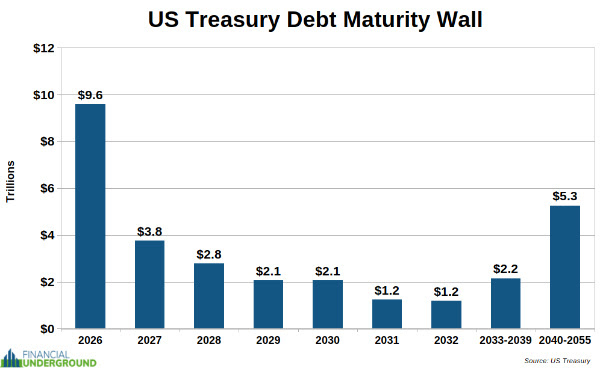
Every time US debt is refinanced at higher rates, it adds interest costs to the deficit—costs that have to be financed with even more debt issuance, compounding the problem. It’s worth noting that about $6.6 trillion of the $9.6 trillion maturing this year—roughly 69%—are short-term T-bills.
That’s typical in a debt crisis. As demand for long-term bonds weakens, investors gravitate to short-term instruments like T-bills instead of 10-year notes and 30-year bonds. It’s the same pattern you see in emerging-market crises. The market shortens maturities as conditions deteriorate. Only a fool would want to lend a bankrupt government money for the long term.
Annual interest on the federal debt now exceeds $1.2 trillion and is still climbing. That means more than 23% of federal tax revenue is going just to service interest on the existing debt.
“We are at a point in which we are borrowing money to pay debt service.
When you keep having debt growth faster than income growth, that means you have debt service encroaching on your spending, and you want to keep spending at the same time.
As that happens, there is a need to get more and more into debt. It accelerates.
We are at the point of that acceleration. We are near that inflection point.“
The financial position of the US government has been gradually deteriorating for decades, so it’s not surprising that many people are complacent. They’ve long heard about the debt problem, and nothing has happened.
However, it is now reaching the tipping point.
That’s because the US government is now borrowing money to pay the interest on the money it has already borrowed, as Dalio noted. Politicians are adding more debt to solve the problems of prior debt. It’s creating a self-perpetuating doom loop.
The federal debt’s interest cost is already higher than the defense budget. It’s on track to exceed Social Security in the coming months and become the biggest in the federal budget.
In short, the skyrocketing interest expense has become an urgent threat to the US government’s solvency.
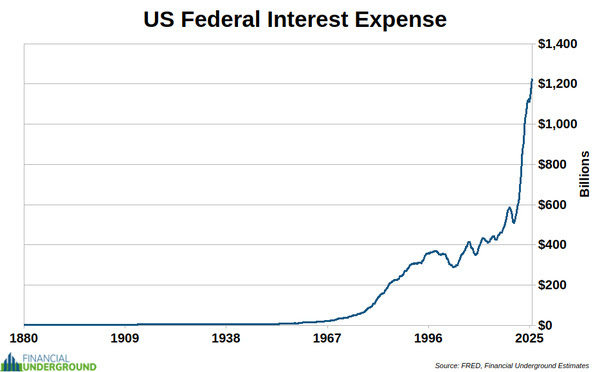
The soaring interest expense threatens the solvency of the US government and forces the Fed to cut interest rates, buy Treasuries, and implement other monetary easing measures to try to control interest costs.
In the bond market, when demand for a bond falls, the interest rate rises to entice buyers.
However, the federal debt is so extreme that allowing interest rates to rise high enough to entice more natural buyers could bankrupt the US government because of the higher interest costs.
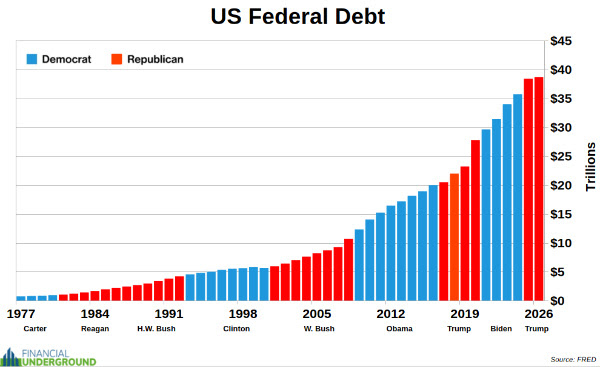
For context, when Paul Volcker raised interest rates above 17% in the early 1980s the US debt-to-GDP ratio was around 30%. Today, it’s north of 123% and rising rapidly.
Today’s higher debt load and accompanying interest expense are why meaningfully higher interest rates are not on the table; the growing interest expense could lead to the US government’s bankruptcy.
That’s a big reason President Trump has stacked the Fed with loyalists who will push for lower interest rates and pursue easy-money policies.
Further, the world isn’t hungry for more US debt right now. It’s an inopportune moment for lackluster demand because supply is exploding higher.
If higher interest rates are off the table and cannot entice more natural buyers, and foreigners aren’t going to step up to the plate, who will finance these growing multi-trillion dollar budget deficits?
The only entity capable is the Federal Reserve, which buys Treasuries with dollars it creates out of thin air.
The only way to keep this system alive is for the Fed to print ever-larger amounts of money. That means inflation and currency debasement. Higher prices then force the government to spend even more on entitlements, defence, and welfare — which requires even more printing. It is a self-perpetuating doom loop.
“He shall lend to you, but you shall not lend to him; he shall be the head, and you shall be the tail.”
The United States, the modern House of Israel (Ephraim), is rapidly becoming the tail and not the head. Aggressive tariffs and anti-NATO rhetoric have alienated most of our former allies. The war with Iran and the potential closure of the Strait of Hormuz are draining our resources and weakening our global position even faster. The exploding cost of fertilizer and the resulting rise in world food prices are adding to the pressure on ordinary people.
We have mentioned a few times now about the shortages in armaments between Russia and the Ukraine and how the US had only a limited supply if they had to go to war with China. How does this shortage come into play now with the current ceasefire?
There was genuine concern during the war (which began February 28, 2026) about U.S. munitions stockpiles being depleted faster than expected:
- The U.S. burned through years’ worth of certain key missiles (especially air-defense interceptors like those used against Iranian drones/missiles, and some offensive systems like Tomahawks and JASSM-ER).
- Pentagon and independent analysts warned that prolonged fighting could strain specific high-end stockpiles (e.g., THAAD interceptors, ATACMS, PrSM).
- Trump himself publicly pushed back against shortage claims, stating on Truth Social that medium- and upper-medium-grade munitions were at “never been higher” levels and that the U.S. had a “virtually unlimited supply” of certain weapons. He acknowledged that the highest-end supplies were “not where we want to be” but blamed prior aid to Ukraine and other conflicts.
However, Trump and administration officials consistently denied that shortages forced the ceasefire. They insisted the U.S. had sufficient stockpiles to continue if needed and were ramping up production (including ordering defense contractors to quadruple output in some cases).
“He shall lend to you, but you shall not lend to him; he shall be the head, and you shall be the tail.” (Deuteronomy 28:44)
Leviticus 26 is the clearest chapter in the entire Bible that explains what happens when a nation (or people) refuses to keep God’s Sabbaths, Sabbatical years, and Jubilee cycles. Key verses that are being fulfilled right now:
-
Leviticus 26:14-16 – “But if you will not obey Me… I will appoint terror over you, wasting disease and burning fever… you shall sow your seed in vain, for your enemies shall eat it.”
-
Leviticus 26:19-20 – “I will break the pride of your power… your strength shall be spent in vain; for your land shall not yield its produce, nor shall the trees of the land yield their fruit.”
-
Leviticus 26:26 – “When I break the supply of your bread… ten women shall bake your bread in one oven, and they shall bring back your bread by weight, and you shall eat and not be satisfied.”
These are not vague spiritual curses. They are economic, agricultural, and military.
- The skyrocketing cost of fertilizer (tied directly to energy prices from the Iran war and potential Hormuz disruption) is already projecting reducing crop yields worldwide.
- Food prices are rising.
- The massive debt and interest payments are breaking the “pride of our power.”
- The war with Iran is draining hundreds of billions of dollars while we are already borrowing to pay interest on previous debt.
All of this is happening because the modern House of Israel (the United States and the nations descended from ancient Ephraim and Manasseh) has rejected the very calendar and Sabbatical laws that God gave to identify His people and bless them.
These are not separate events. They are the direct outworking of the same prophetic curses:
- The debt spiral is the financial expression of “you shall be the tail.”
- The war with Iran and the Hormuz threat are the military/economic expression of enemies consuming our strength.
- The fertilizer and food price explosion is the agricultural expression of the land not yielding its produce.
All of them are accelerating because we are in the final years of the current Sabbatical cycle and approaching the next Jubilee cycle. We are in the final 10 days/years of Awe with just 8 years until Satan is locked away. God is using these events to get our attention and to fulfill His word.
Even in Leviticus 26, God promises restoration if His people repent and return to His ways:
“But if they confess their iniquity… then I will remember My covenant with Jacob, and My covenant with Isaac and My covenant with Abraham I will remember…” (Leviticus 26:40-42)
The curses are real. They are here. But they are also a call to repentance. That is why we keep teaching the biblical calendar, the Sabbatical years, and the Jubilee cycles. That is why we urge you to start counting, to keep the Sabbaths, and to return to the Torah. The same God who is allowing these curses is the same God who will protect and bless those who turn back to Him.
U.S. Farmers Face Fertilizer Affordability Crisis
U.S. Farmers Face Fertilizer Affordability Crisis Ahead of 2026 Planting Season
A new nationwide survey from the American Farm Bureau Federation (AFBF) reveals significant strain on U.S. agriculture: nearly 70% of farmers report they cannot afford to purchase all the fertilizer they need for the 2026 crop year.
The survey, conducted April 3–11, 2026, with over 5,700 respondents from all 50 states and Puerto Rico, highlights how sharply rising fertilizer prices are forcing tough decisions during spring planting. Regional differences are stark: 78% of Southern farmers, 69% in the Northeast, 66% in the West, and 48% in the Midwest say they cannot secure all required fertilizer.
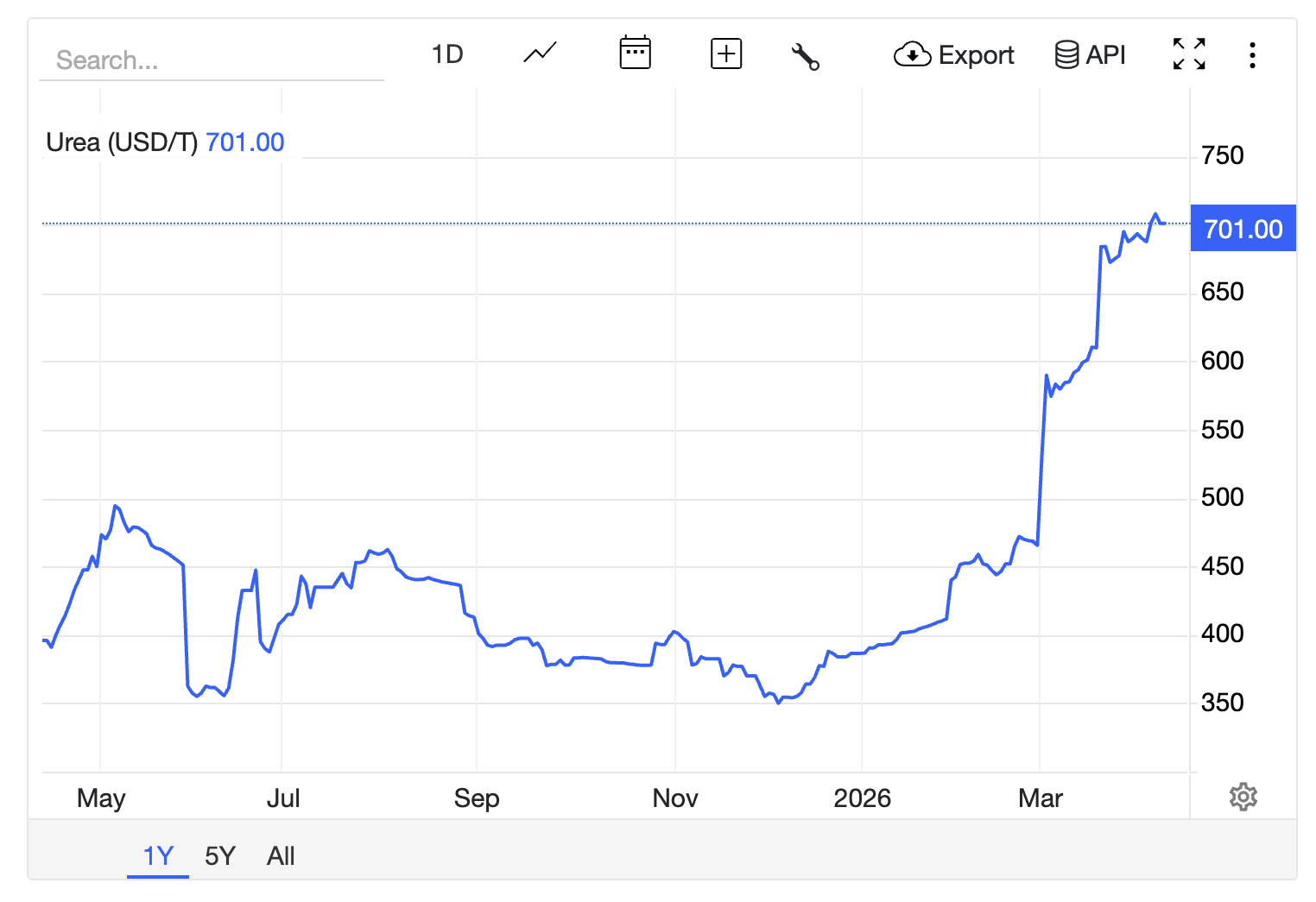
Fertilizer prices, particularly for nitrogen products like urea, have surged in recent months due to geopolitical disruptions from the conflict with Iran and shipping issues in the Strait of Hormuz — a critical route for roughly one-third of global seaborne fertilizer trade. Gulf producers supply a large share of the world’s urea and ammonia, and the resulting supply constraints have driven price increases of 25–40% or more in key markets.
Rising fuel costs are compounding the pressure, as many farmers also face higher expenses for diesel and other inputs. This comes amid already tight farm margins and low commodity prices for some crops.Potential Impacts on Yields and Food SupplyMany farmers are responding by:
- Reducing fertilizer application rates
- Shifting to less fertilizer-intensive crops (such as planting more soybeans and less corn)
- Cutting back on planted acres in some cases
The USDA’s Prospective Plantings report (released March 31, 2026) already shows intentions for 95.3 million acres of corn (down 3% from 2025) and an increase in soybean acres, reflecting these economic realities.
Experts warn that lower fertilizer use could reduce crop yields in 2026, potentially leading to tighter supplies and upward pressure on food prices later in the year and into 2027. While the U.S. has strong domestic production for some fertilizers, global price signals and import reliance for others still affect American farmers.Not all operations are equally impacted — those who pre-purchased or locked in supplies earlier are in a stronger position, but many smaller or later-buying producers are feeling the pinch most acutely.Sources for Further Reading
- American Farm Bureau Federation News Release: Nationwide Survey: Most Farmers Can’t Afford Fertilizer
fb.org
- AFBF Market Intel Analysis: Farm Bureau Survey Reveals Real Impact of Fertilizer Availability and Price
fb.org
- USDA Prospective Plantings Report (March 2026): Full PDF
This situation underscores the vulnerability of global supply chains to geopolitical events and the ongoing challenges in U.S. agriculture. Farmers, policymakers, and industry groups continue to monitor developments closely as the planting season progresses.
I’m going to include the entire article for those of you who want to read it.
Farm Bureau Survey Reveals Real Impact of Fertilizer Availability and Price

Key Takeaways
- Fertilizer pre-booking rates varied significantly by region, with just 19% of Southern producers reporting fertilizer purchases secured ahead of the season, compared to 30% in the Northeast, 31% in the West and 67% in the Midwest, reflecting differences in planting decision timelines and exposure to recent price increases.
- Fertilizer affordability challenges are most acute in the South and Northeast but remain a concern for farmers across all regions. Around 70% of respondents report being unable to afford all the fertilizer they need.
- Farm diesel prices have increased 46% since the end of February, raising costs for fieldwork, fertilizer transport and irrigation during both planting and growing seasons.
- Nearly six in 10 farmers report worsening finances, reflecting rising fertilizer and fuel costs during spring planting and underscoring the urgent need for immediate economic assistance to keep farms gates open.
Rising input costs tied to the conflict in the Middle East are adding strain to an already challenging farm economy. To better understand how global fertilizer market disruptions are affecting producers during spring planting, the American Farm Bureau Federation conducted a Fertilizer Availability Survey of farmers and ranchers across the country. More than 5,700 farmers responded to the survey, which was conducted April 3 through April 11.
Regional Differences Reflect Crop Mix and Supply Exposure
Survey responses show the closure of the Strait of Hormuz is affecting regions across the United States differently because crop production systems and fertilizer needs vary.
Midwestern producers – often relying on a corn and soybean rotation – reported higher pre-booking rates, with 67% securing fertilizer earlier in the season. Given these crop rotations, pre-booking is more common in the Midwest, where fertilizer needs are typically larger and purchasing decisions are often made well ahead of planting. As a result, a larger share of Midwestern farmers reported being able to secure the inputs they need before recent price increases. Even with higher pre-booking rates, nearly one in three Midwestern farmers still report entering the season without securing all of their fertilizer needs.
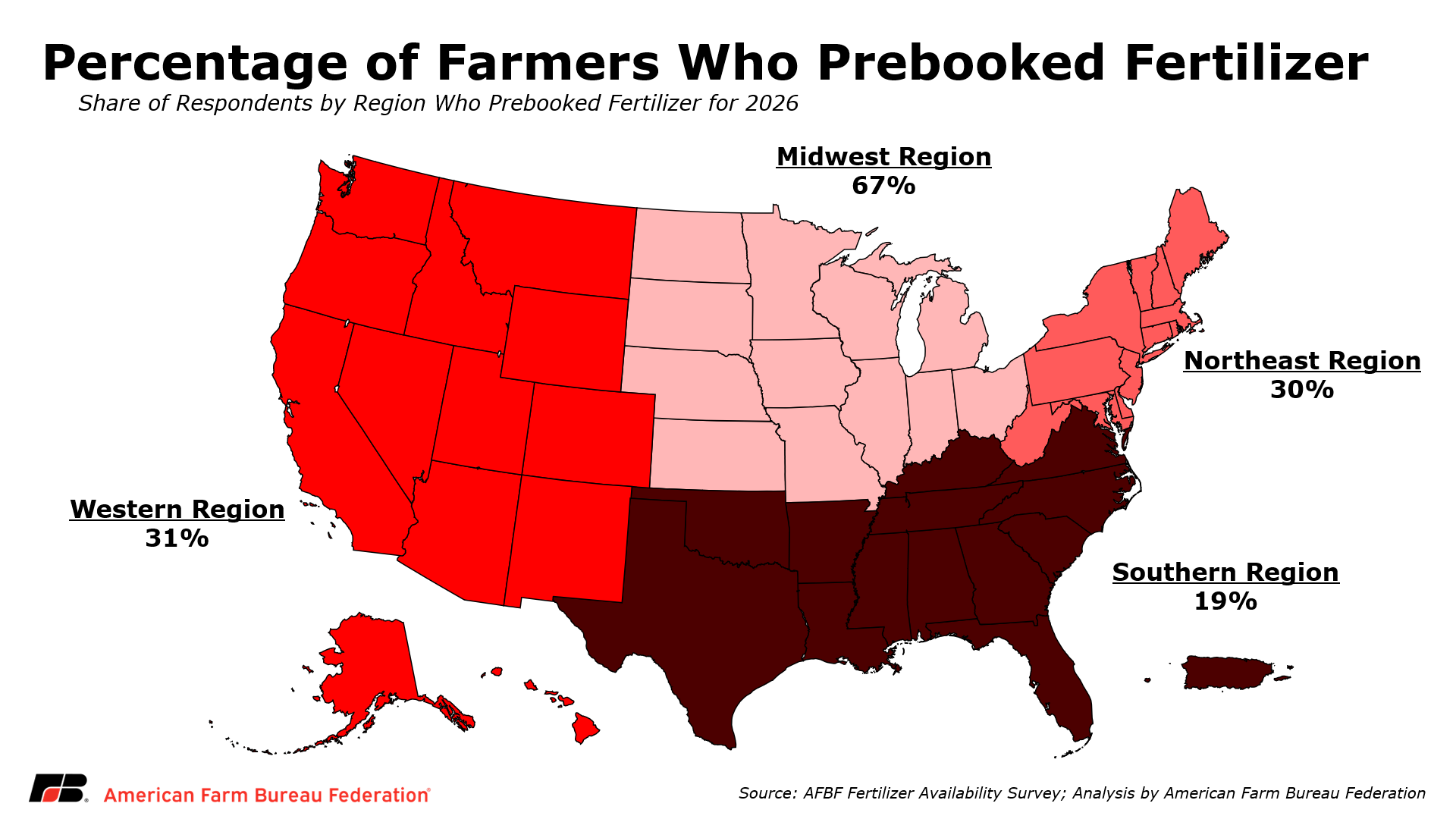
In contrast, producers in other regions are more likely to purchase fertilizer closer to application, increasing exposure to in-season price volatility during periods of market disruption. Nineteen percent of southern farmers pre-booked fertilizer this crop year. Southern producers often grow crops such as cotton, rice, soybeans, corn and peanuts that rely heavily on applied nutrients and can be particularly sensitive to changes in fertilizer costs. Pre-booking rates are similarly limited in other regions, with just 30% of farmers in the Northeast and 31% in the West securing fertilizer ahead of the season.
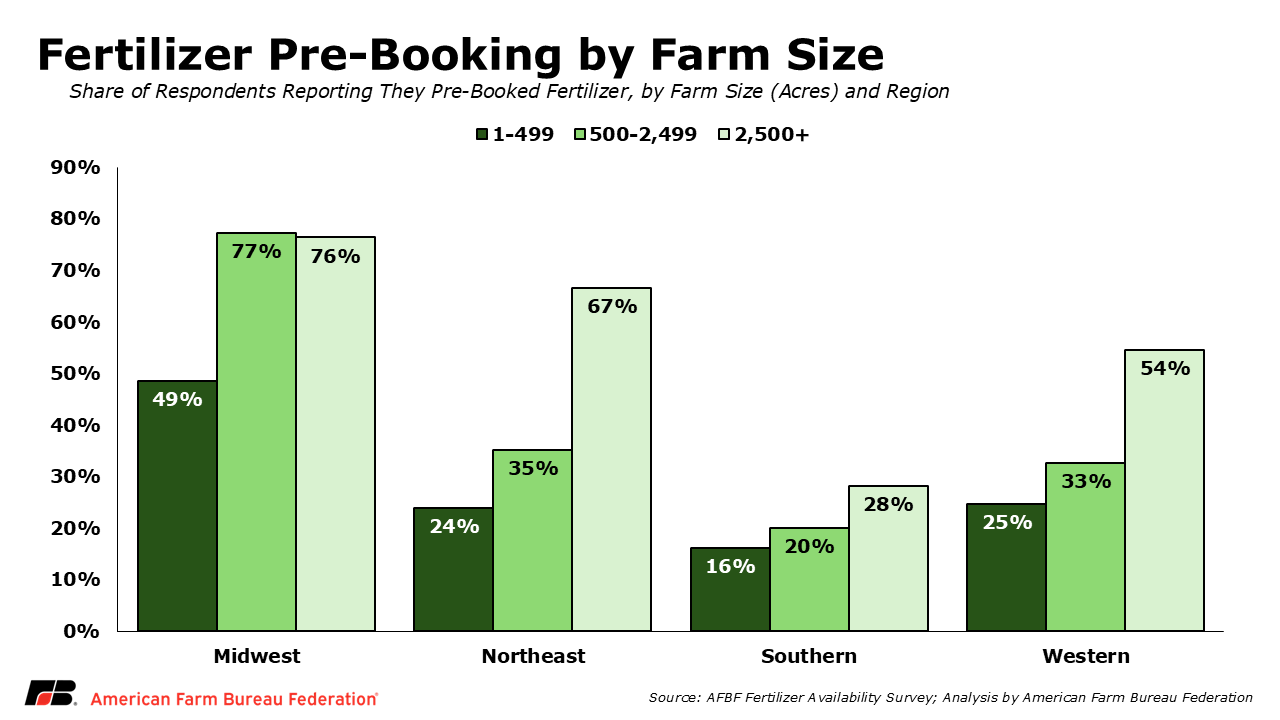
Smaller farms reported substantially lower fertilizer pre-booking rates than larger operations across every region, suggesting greater exposure to recent price volatility during the spring purchasing window. In the Midwest, 49% of farms with 1–499 acres pre-booked fertilizer, compared to 77% of farms with 500–2,499 acres and 76% of farms with 2,500+ acres. The gap was even more pronounced in the Northeast, where only 24% of the smallest farms pre-booked fertilizer, compared to 35% of mid-sized farms and 67% of the largest operations. Similar patterns appeared in the South (16% for 1–499 acres vs. 28% for 2,500+ acres) and West (25% vs. 54%). Because smaller farms are less likely to secure fertilizer ahead of the season, they are more exposed to in-season price increases, which can make it harder to afford full application rates and increase the risk of reduced yields and tighter margins in 2026.
Farmers in the Southern region reported the greatest difficulty securing fertilizer, with 78% unable to afford all needed inputs this season. Producers in the Northeast and West also reported significant challenges, with 69% and 66%, respectively, unable to afford all required fertilizer, compared to 48% in the Midwest. When producers cannot afford full fertilizer application rates, they may reduce nutrient use or shift acreage decisions, both of which increase the risk of lower yields and reduced production potential in the 2026 crop year.
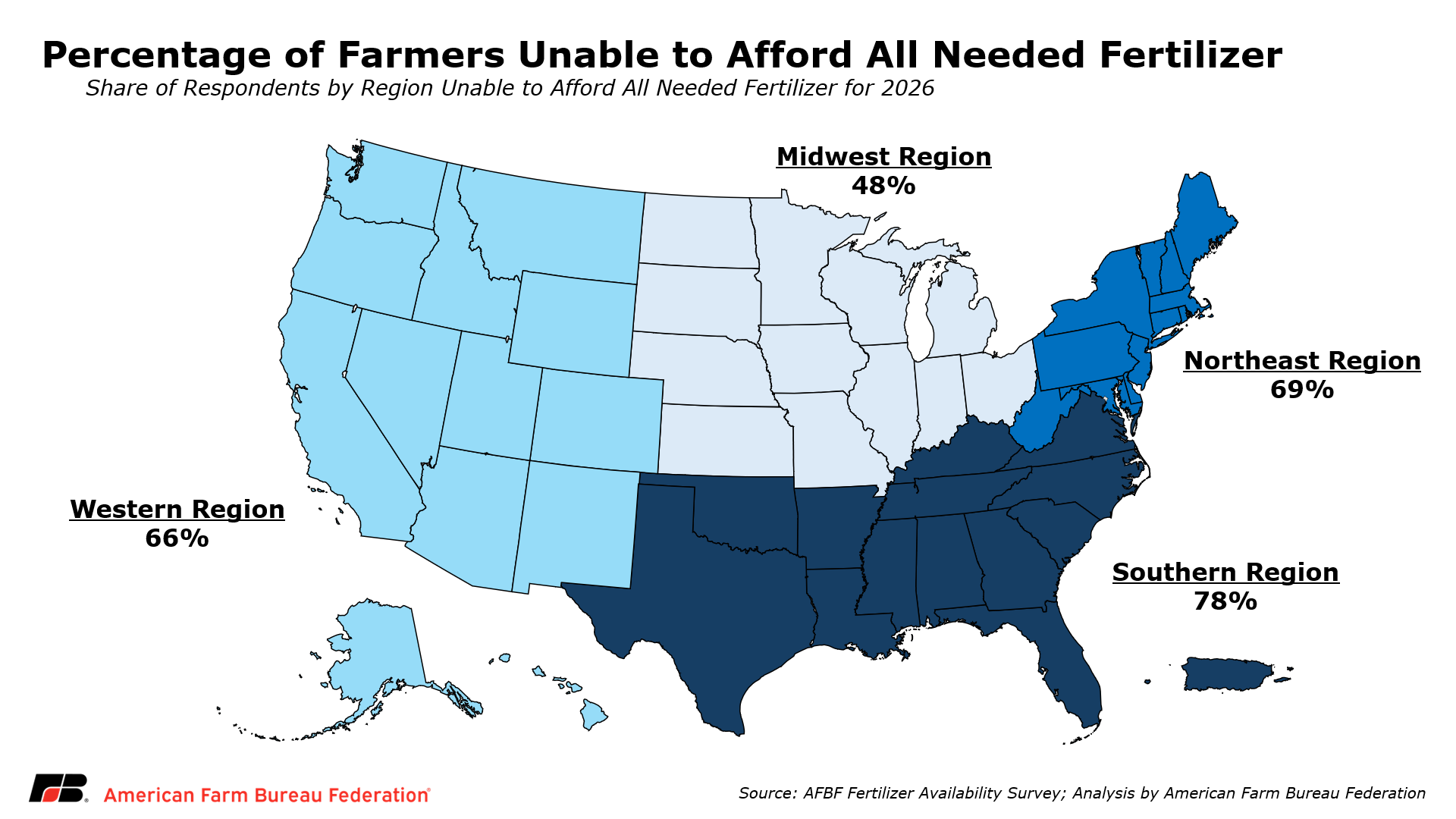
Fertilizer Impact by Commodity
Pre-booking behavior varies significantly across commodities. Nearly half of soybean producers reported pre-booking fertilizer (49%), followed by barley (47%), corn (44%), and wheat (42%) growers. Lower pre-booking rates among cotton (13%) and peanuts (9%), both crops grown in the southern U.S., suggest greater farm exposure to in-season price volatility.
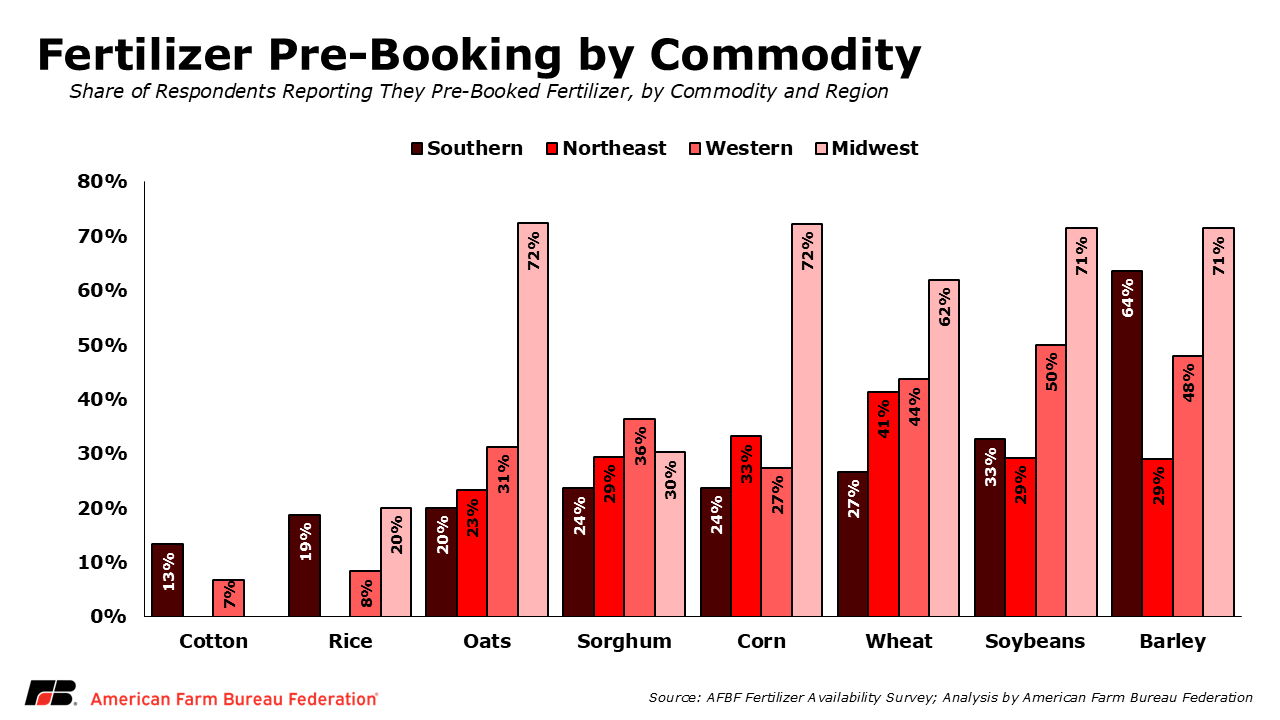
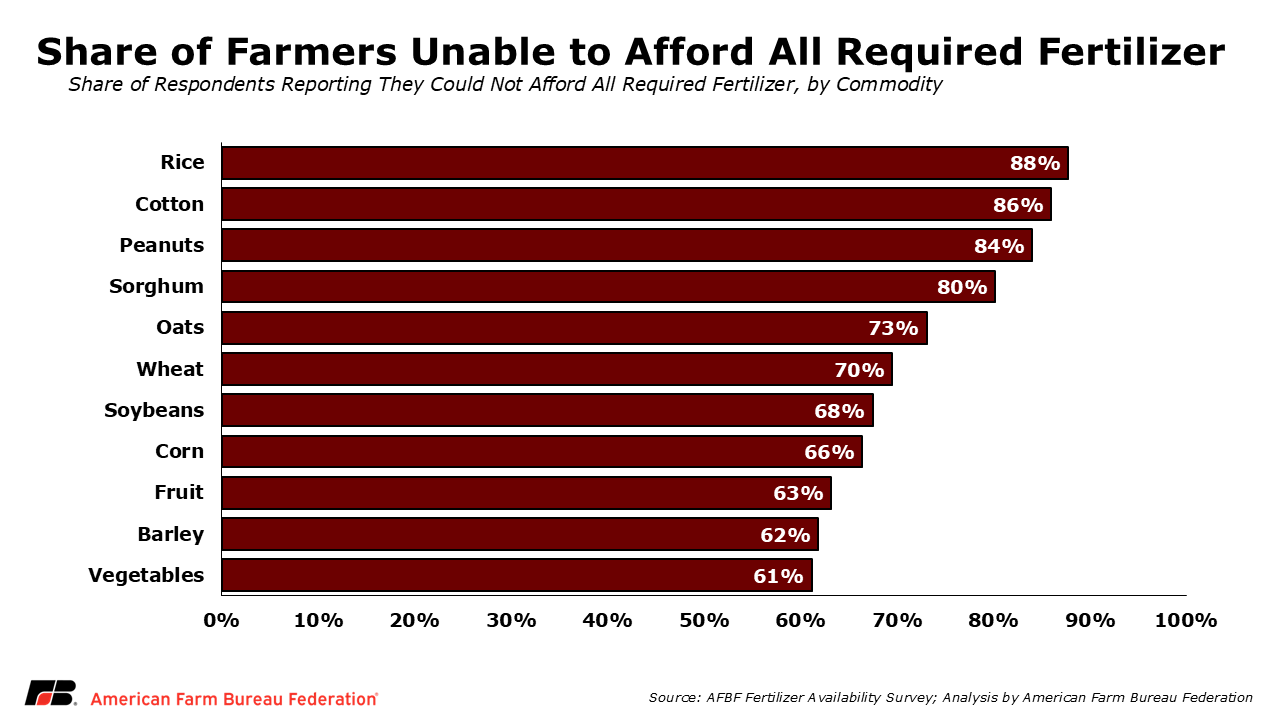
Affordability concerns are even more pronounced when viewed by commodity. More than 80% of rice, cotton and peanut producers reported they cannot afford all required fertilizer, highlighting the vulnerability of these production systems to input cost shocks. Over half of all commodities report not being able to afford all fertilizer needs this year.
Farm Financial Health Remains Under Pressure
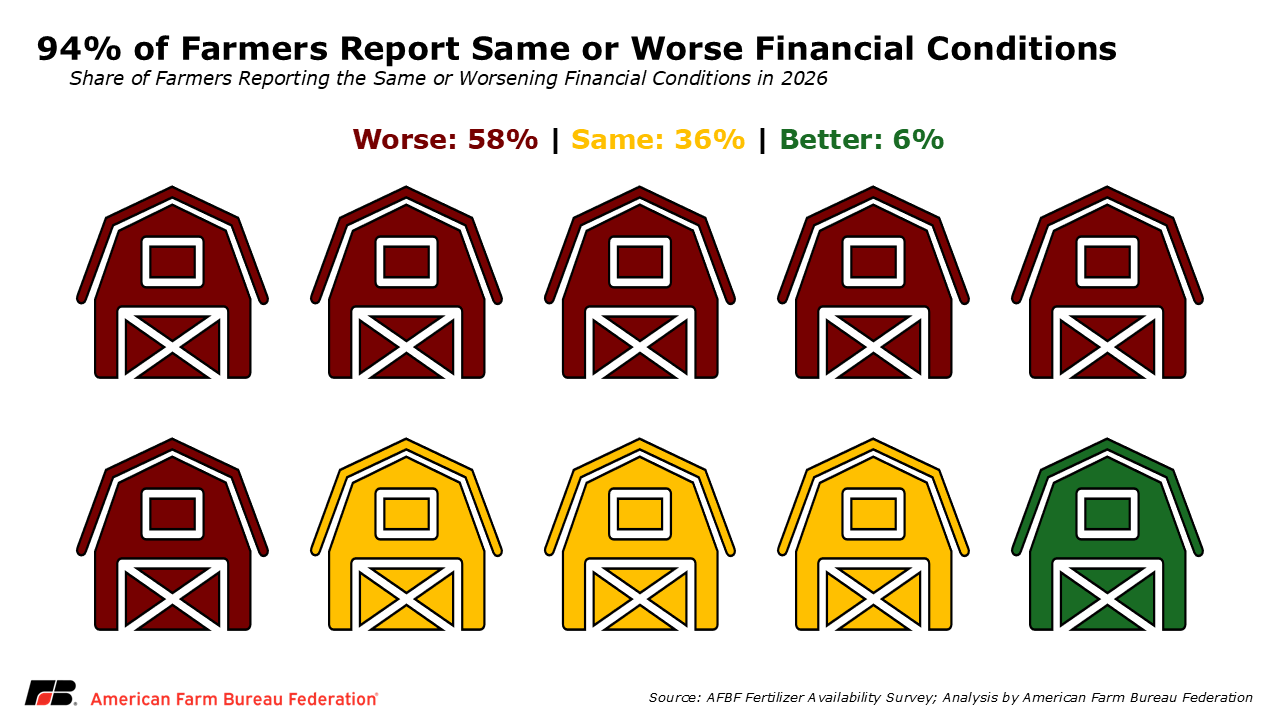
According to the survey, 94% of respondents reported their financial situation has worsened or remained the same since last year, while only 6% reported improvement. Poor financial conditions going into this growing season impacted planting and purchasing decisions, and as a result, rapidly changing fertilizer and fuel market price volatility impacted farmers across the country in different ways – as confirmed by our survey.
Spring planting decisions depend heavily on access to fertilizer and diesel fuel, both of which have been impacted by geopolitical risks that have disrupted global markets. Since the escalation of tensions in the Middle East, nitrogen fertilizer prices have risen more than 30%, while combined fuel and fertilizer costs have increased roughly 20% to 40%. Urea prices have increased by 47% since the end of February, marking the largest month-to-month percentage increase in the price of urea. These increases are occurring when many producers were already facing tight margins for many consecutive years.
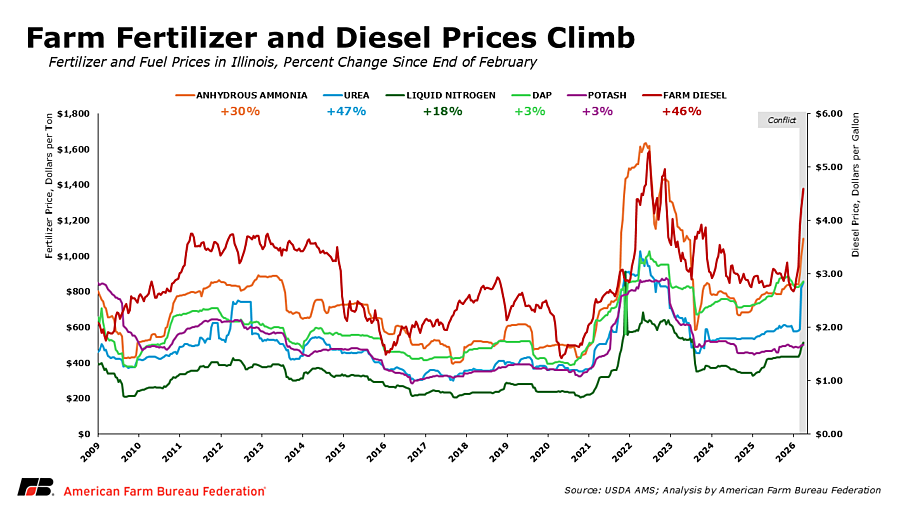
Fuel is a major operating expense during spring planting, affecting machinery operation, fertilizer transport and irrigation. As energy markets tightened following the closure of the Strait of Hormuz, diesel and gasoline prices increased significantly, raising costs across nearly every stage of production. Farm diesel prices have risen 46% since the end of February, marking the largest month-to-month percentage increase in diesel prices over the period.
Higher energy prices also increase the cost of producing nitrogen fertilizer, which relies heavily on natural gas as feedstock. Together, these overlapping increases in fuel and fertilizer expenses help explain why more than 90% of farmers surveyed reported that their financial conditions have worsened or remained the same since last year.
Bottom Line
Fuel and fertilizer markets are the most volatile since Russia’s invasion of Ukraine, and the duration of disruptions in the Middle East and closure of the Strait of Hormuz will ultimately determine farm production expenses in the months ahead – a variable that significantly impacts farm margins given historically low crop prices. While the United States is the world’s largest producer of oil and natural gas, fuel and fertilizer markets remain globally interconnected.
Countries exposed to instability in and around the Persian Gulf account for roughly 49% of global urea exports and about 30% of global ammonia exports. Because these products are essential for crop production, disruptions in the region can influence fertilizer availability and prices well beyond the Middle East.
Survey results suggest many farmers are already adjusting fertilizer purchases and application decisions in response to rising costs. If disruptions persist, these adjustments could affect yields, acreage decisions and overall production potential in the 2026 crop year. The first opportunity to see how farmers reacted will come with USDA’s May World Agricultural Supply and Demand Estimates (WASDE) report, followed by the June 30 Acreage report.
Domestic Food Production Security is National Security
The administration has announced plans to help ensure the safe passage of fuel shipments through key global shipping lanes. Expanding these protections to include agricultural input supplies such as fertilizer should also be a priority given their importance to food production and national security.
Given the worsening financial conditions on the farm, support is building for additional economic aid for farmers in any upcoming legislation to help offset economic hardships made more challenging by recent increases in fertilizer and fuel prices.
Nationwide Survey: Most Farmers Can’t Afford Fertilizer

An overwhelming majority of America’s farmers who responded to a nationwide survey say they cannot afford to purchase enough fertilizer to get them through the year. The percentage who pre-purchased fertilizer varies significantly by region.
Conducted by the American Farm Bureau Federation April 3-11, the survey shows 70% of respondents say fertilizer is so expensive that they will not be able to buy all the fertilizer they need.
More than 5,700 farmers, both Farm Bureau members and non-members, from every state and Puerto Rico took the survey. Farm Bureau economists analyzed the results in the latest Market Intel.
The analysis reveals that almost 8 in 10 farmers in the southern U.S. say they can’t afford all needed supplies this year, followed by the Northeast and West at 69% and 66%, respectively, compared to 48% of the farmers in the Midwest.
Just 19% of farmers in the South prebooked fertilizer purchases in advance of planting season. In the Northeast, only 30% of farmers prebooked, followed by 31% in the West, and 67% in the Midwest. Even with higher pre-booking rates, almost one in three Midwestern farmers still report entering the season without securing all of their fertilizer needs.
The conflict in the Middle East sent fertilizer and fuel prices soaring. The closure of the Strait of Hormuz is keeping critical fertilizer supplies and crude oil from reaching global markets, putting a squeeze on supplies around the world.
“Spring planting decisions depend heavily on access to fertilizer and diesel fuel, both of which have been impacted by geopolitical risks that have disrupted global markets,” the Market Intel states. “Since the escalation of tensions in the Middle East, nitrogen fertilizer prices have risen more than 30%, while combined fuel and fertilizer costs have increased roughly 20% to 40%. Urea prices have increased by 47% since the end of February, marking the largest month-to-month percentage increase in the price of urea. These increases are occurring when many producers were already facing tight margins for many consecutive years.”
Many of the farmers surveyed said they will forego applying fertilizer this spring in hopes that prices will return to an affordable level later in the growing season.
AFBF President Zippy Duvall said, “The skyrocketing cost of fuel and fertilizer is creating more economic hardships for farmers who have already endured years of losses. Without the necessary fertilizers, we’ll face lower yields and some farmers will reduce acres altogether, which will impact food and feed supplies. It’s too early to know how this will affect food availability and prices in the long run, but it’s a warning light that we’ve shared with leaders in Washington. We look forward to working with them to find solutions so farmers can continue to feed families across America.”
According to the survey, 94% of respondents reported their financial situation has worsened or remained the same since last year, while only 6% reported improvement.
Get more survey results and read the full Market Intel here.
Cuba and The Philippines in Trouble
Philippines Fuel and Electricity Situation – April 2026 Update
The Philippines is under significant pressure due to the ongoing Iran war and the disruption of oil supplies through the Strait of Hormuz. Here is the current status based on official government statements and credible reporting as of mid-April 2026. Fuel Situation (Oil / Diesel / Gasoline) The Philippines imports ~90–95% of its oil, with the majority coming from the Middle East. The Hormuz disruption has hit the country hard.
- Current reserves (as of early April 2026):
- Gasoline: ~53–57 days of supply
- Diesel: ~46–50 days of supply
- Jet fuel: ~39 days
- Overall average: ~45–50 days of national fuel inventory
- Government actions:
- On March 24, 2026, President Marcos declared a national energy emergency—the first country in the world to do so in response to the Iran war.
- The government has secured emergency shipments (e.g., 329,000 barrels of diesel from Malaysia in April and deals with Russia, China, India, Japan, and others).
- They are also allowing temporary use of dirtier (Euro-II) fuels to stretch supplies and releasing funds from the Malampaya gas fund.
- How close to running out?
- At current consumption rates, the Philippines has roughly 6–7 weeks of fuel left if no new imports arrive.
- With ongoing emergency procurement, officials say they can stretch supplies into June–July 2026, but prices have already doubled or tripled in some cases (diesel has hit P110–P170 per liter in recent weeks).
- Shortages are already appearing in some remote areas and for specific fuels (especially diesel for transport and generators).
Bottom line on fuel: Not days away from total collapse, but very tight. Without continued imports, serious shortages could begin in late May to early June 2026. The government is scrambling and has declared an emergency to prioritize procurement.
Electricity Situation: The Philippines is not on the verge of nationwide blackouts due to the oil crisis.
- Only ~1% of the country’s electricity is generated from oil-based plants.
- The majority comes from coal (~60–62%) and natural gas (from the Malampaya field, ~14%).
- Coal is mostly imported from Indonesia and Australia (not affected by Hormuz).
- Recent natural gas discoveries at Malampaya are expected to extend supply and bring new gas online by Q4 2026.
Current outlook:
- Power supply for Q2 2026 (April–June) is projected to be sufficient but fragile.
- Reserve margins are thin, especially in the Visayas grid.
- Risk of localized brownouts exists due to plant outages, high summer demand, and transmission constraints — but not primarily from the oil crisis.
- Electricity prices are rising (up to 16–20% expected in April/May) due to higher coal transport costs and demand.
Bottom line on electricity: The country is not about to run out of electricity. Brown-outs may increase in vulnerable areas (especially off-grid islands that rely on diesel generators), but the main grid should hold with current coal and gas supplies. The bigger immediate pain is higher electricity bills and potential localized shortages.
Overall Summary for the Philippines (April 2026)
- Fuel: Critical and tightening fast — 6–7 weeks of reserves at current rates, with emergency imports buying time until June/July. Prices have already surged dramatically.
- Electricity: Manageable for now, but fragile with rising costs and risk of localized brownouts. Not a nationwide collapse scenario.
The Philippines is one of the Asian countries most vulnerable to the Hormuz disruption because of its heavy reliance on Middle Eastern oil imports. The government is actively securing alternative supplies, but the situation remains precarious.
Coal is mostly imported from Indonesia and Australia (not affected by Hormuz).
But do they have fuel for the ships to bring the coal to the Philippines?
Yes — the fuel for the ships bringing coal to the Philippines is a real and growing problem right now. Short Answer: Coal itself is not directly blocked by the Hormuz situation (it mainly comes from Indonesia and Australia), but bunker fuel (the diesel-like fuel that powers cargo ships) is heavily impacted. Shipping costs have surged, and availability is tightening. This is already causing delays, higher freight rates, and some risk of reduced coal deliveries in the coming weeks/months.
Current Situation (as of mid-April 2026) Coal Supply Route
- The Philippines imports most of its coal from Indonesia (the world’s largest exporter) and Australia.
- These routes do not pass through the Strait of Hormuz, so the physical coal supply is not directly cut off.
- Indonesia has publicly assured the Philippines of continued coal exports (confirmed in March 2026 statements).
The Real Problem: Bunker Fuel for the Ships
- Cargo ships burn marine fuel oil (bunker fuel), which is a refined petroleum product.
- The Hormuz crisis has severely disrupted refined fuel supplies in Asia.
- Key Asian bunker hubs (Singapore, South Korea, Japan, China) are experiencing shortages and price spikes because much of their refined fuel supply chain was linked to Middle Eastern crude and refining.
- Shipping lines are already reporting:
- Bunker fuel prices have risen sharply (some routes up 50–100%+ since February).
- Some carriers are imposing bunker surcharges on coal and other cargo to the Philippines.
- Delays and reduced sailing schedules are starting to appear because operators are conserving fuel or rerouting.
Impact on Coal Deliveries to the Philippines
- Short-term (next 4–8 weeks): Coal shipments are still arriving, but at higher cost and with some delays. The government has secured emergency diesel imports to keep critical sectors running, but marine fuel remains tight.
- Medium-term (May–July 2026): If the Hormuz blockade continues or worsens, shipping companies may reduce sailings to the Philippines or pass on even higher costs. This could lead to coal shortages for power plants, driving up electricity prices and risking brownouts.
- The Philippines has already declared a national energy emergency (March 24, 2026) partly because of this vulnerability.
Bottom Line
- Coal itself: Not blocked by Hormuz.
- Ships carrying the coal: Yes — they are affected by bunker fuel shortages and skyrocketing prices. This is the weak link.
- The result is higher electricity costs and potential supply strain for coal-fired power plants (which generate ~60% of the country’s electricity).
The government is actively trying to secure alternative fuel supplies and has allowed temporary use of dirtier (Euro-II) fuels to stretch reserves, but the situation remains precarious.
Cuba With No Electricity and No Water
How Cubans Are Coping with No (or Very Little) Electricity in April 2026? Cuba is in the middle of one of its worst energy crises in decades. As of mid-April 2026, the national power grid is extremely fragile. Blackouts are not occasional — they are the daily reality for most of the island’s ~11 million people.
Current Situation (April 2026)
- Daily blackouts average 16–20+ hours in many areas, with some regions experiencing near-total outages for days at a time.
- Peak demand is around 3,000 MW, but actual generation is often below 1,300 MW — a massive deficit.
- The crisis is driven by:
- Aging, broken-down power plants (many thermoelectric units offline).
- Severe fuel shortages (exacerbated by the U.S. oil blockade and limited imports from Russia/Venezuela).
- Frequent cascading failures when one plant goes down.
Power is being restored in stages after each major collapse, but it is patchy and unreliable. Hospitals and water pumping stations get priority, but even they are affected.
How Ordinary Cubans Are Coping Day-to-Day
People have adapted out of necessity, but the situation is exhausting and degrading quality of life:
- Daily Life & Routine:
- Families plan their entire day around when power might return. People wake up early to cook, charge phones, or do laundry during brief windows of electricity.
- Many sleep during the hottest part of the day and stay up late when it’s cooler and power might be on.
- Streets are dark at night; people use phone flashlights, candles, or small solar lanterns.
- Food & Cooking:
- Refrigerators fail quickly — food spoils fast. People eat what they can immediately or cook communal meals outdoors using wood, charcoal, or small propane stoves.
- Many rely on canned goods, rice, beans, and whatever fresh produce is still available (often limited due to fuel shortages affecting transport).
- Water:
- No electricity means no water pumps → many apartments and neighborhoods have no running water for days.
- Residents carry water from neighbors who have wells, rooftops, or stored supplies. Bathing and flushing toilets become major challenges.
- Health & Hygiene:
- Hospitals operate on generators with limited fuel.
- Heat exhaustion is common (especially in Havana’s humid climate).
- Lack of refrigeration increases foodborne illness risk.
- Some elderly and vulnerable people are suffering greatly.
- Protests & Frustration:
- Rare public protests have occurred (people banging pots and pans, small street demonstrations).
- Many Cubans express deep exhaustion: “We have to get used to surviving” is a common sentiment.
- Creative Adaptations:
- Rooftop solar panels and small solar kits are becoming more common (though expensive and limited).
- Electric bikes/motorcycles (when they can be charged) are used for short trips.
- Neighbors share resources and power when it’s available.
Overall Mood
Cubans are resilient and have endured blackouts for years, but the current crisis (worsened by fuel shortages and infrastructure decay) is pushing many to their limit. There is growing frustration, quiet despair, and in some cases anger directed at both the government and external pressures (including the U.S. oil blockade).The situation is not “no electricity at all” 24/7 everywhere, but frequent, prolonged outages that make normal life extremely difficult.
Western European Leaders Betray the West
Western European Leaders Betray the West
by Guy Millière

The entire Western world needs to take a clear stand.
Iran’s regime — not to be confused with its tormented people, many of whom have been sacrificing their lives since 1999 trying to oust it — has, since its installation in 1979, threatened “Death to America” (“the Great Satan”) and “Death to Israel” (“the Little Satan”).
“When you chant ‘Death to America!’ it is not just a slogan,” Iran’s late Supreme Leader Ali Khamenei announced in 2023, “it is a policy.” The year before, he predicted:
“Death to America will happen. In the new order I am talking about, America will no longer have any important role.”
In 2008, Iran’s then President Mahmoud Ahmadinejad promised that Israel “will be wiped off [the map].”
The so-called “moderate” former Iranian President Ali Akbar Hashemi Rafsanjani, on “Al Quds Day,” December 14, 2001, said:
“The use of even one nuclear bomb inside Israel will destroy everything…. It is not irrational to contemplate such an eventuality.”
The Iranian regime, after creating its proxy terrorist group Hezbollah in 1982, lost no time turning magnificent Lebanon into a failed state. For years, Iran has been among the primary funder of Hezbollah, Yemen’s Houthis and Palestinian Islamic Jihad, as well as providing material support for Hamas in the Gaza Strip. Iran was also deeply involved in planning the Hamas invasion of Israel on October 7, 2023.
For 39 years running, Iran has boasted the prestigious label, conferred on it by the US State Department, of the “world’s leading state sponsor of terrorism.” Iran, along with Qatar, is reportedly a principal financier of international Islamic terrorism as well as a leading agent of global destabilization.
Iran’s regime is responsible for killing 241 American servicemen in the 1983 attack on the US Marines barracks in Beirut, as well as hundreds of American soldiers in Iraq between 2003 and 2011. It has also orchestrated terrorist attacks and attempted assassinations within the United States, including the September 11, 2001 attacks.
For years, despite repeated denials and proudly evading international inspections, Iran’s regime has been trying to acquire nuclear weapons. US Special Envoy Steve Witkoff detailed that Iran’s representatives had actually opened negotiations by announcing that they had enough uranium enriched to 60% — days away from converting to the weapons-grade level of 90% — for 11 nuclear bombs “in one week, maybe 10 days at the outside.”
Although the United States and Israel carried out strikes on Iran’s main nuclear facilities in June 2025, Iran claimed that they still control roughly 460 kg of 60% enriched uranium.
Israel and the United States seem to have concluded, as US President Franklin Roosevelt had regarding the Third Reich in 1941, that, “When you see a rattlesnake poised to strike, you do not wait until he has struck to crush him.”
The Iranian regime’s “a week to 10 days” must have sounded sufficiently like an “imminent threat” and a “clear and present danger” to have the Trump Administration decide that it would be preferable to neutralize the regime before the regime neutralized the United States.
The war, launched on February 28, should have had the support of the entire Free World. It did not.
In the United States, before the election of President Donald Trump, four sitting presidents — Bill Clinton, George W. Bush, Barack Obama and Joe Biden – as well as countless officials from both sides of the aisle, had announced that Iran must not be allowed to acquire nuclear weapons, but had never done anything about it.
Worse, the Obama and Biden Administrations, by trying to bribe Iran’s regime into slowing its nuclear weapons development, instead effectively funded and enabled it — complete with “sunset clauses” in Obama’s 2015 JCPOA “nuclear deal,” which would have enabled Iran legitimately to have as many nuclear weapons as it liked by October 2025. When Trump cancelled the JCPOA in 2018, that was the bullet he skillfully dodged.
The same kind of bribe had already backfired earlier with North Korea. In 1994, Clinton negotiated the “Agreed Framework” with North Korea to freeze and then dismantle its existing nuclear weapons program. Clinton then saw to it that Japan and South Korea provided North Korea’s leader, Kim Jong II, with more than $4 billion — which he immediately seems to have used to complete his nuclear program. Nobody stopped him.
It was only a few years ago that the Biden Administration was claiming that Iran represented a major danger. Then Secretary of State Antony Blinken announced in October 2021 that time was “running short“. Today, US Senate Minority Leader Chuck Schumer, who eloquently wrote against supporting Obama’s nuclear deal, says that attacking Iran before it could attack the West constitutes “a war of choice, not necessity”.
There was no point in allowing Iran to become another North Korea. “You want to see the stock market go down?” Trump asked on Fox News. “Let a couple of nuclear bombs be dropped on us.”
Other American politicians have wrongly accused the Trump administration of violating the arguably unconstitutional 1973 War Powers Act. Article 2(c) recognizes the president’s authority to deploy armed forces without prior Congressional approval following an “attack upon the United States… or its armed forces” for up to 60 days without Congressional approval, with a possible extension of 30 days. Iran possesses a long history of launching armed attacks against U.S. armed forces.
Trump did not ask America’s allies for troops or even materiel. He merely requested the use of military bases — some of which, such as Diego Garcia in the Indian Ocean, are shared by the UK and the US — or for fly-over rights.
The reactions of most Western European leaders were, in diplospeak, “disappointing ” — dismissive and cowardly — and remain so to this day.
Just hours after the elimination of Khamenei, French President Emmanuel Macron stated that military operations against Iran were “dangerous for all” and had to stop immediately. While “deploring” Hezbollah’s terrorist attacks on Israel, Macron urged Israel to cease its military operations in Lebanon and seems to want to save Hezbollah. Macron added that France would only “act to defend its allies” – thereby evidently excluding Israel and the United States from France’s allies.
A few hours later, British Prime Minister Keir Starmer declared he would only support a “peaceful, negotiated solution.”
German Chancellor Friedrich Merz emphasized that “Germany is not a party to this war” –overlooking, as Trump wasted no time pointing out, that the US, which has almost single-handedly been funding Europe’s defense since the end of World War II through NATO, was not a party to Russia’s war on Ukraine.
When, on March 15, Trump called upon European leaders to participate in the defense of the Strait of Hormuz, every last one refused, despite their being far more dependent on oil and gas shipped through the Strait of Hormuz than the US.
Trump warned European countries that failing to heed his call could have consequences. After NATO Secretary General Mark Rutte urged European leaders to reconsider their response, several, along with Japan, issued a joint statement on March 19, expressing their “readiness to contribute.”
Macron then “clarified” his position. France, he stated, might agree to intervene only after the “intense phase of the conflict has ended” — when French intervention would be useless.
German Defense Minister Boris Pistorius stated that Germany would act only after a ceasefire was declared — when the battle was over.
Starmer, while maintaining his refusal, organized instead a virtual meeting with officials from more than 40 countries to find a “diplomatic solution” to the problem. To what surely must have been everyone’s incalculable astonishment, no diplomatic solution could be found.
Macron, surpassing himself, closed French airspace to American and Israeli military aircraft involved in military operations against Iran’s regime and Hezbollah. Spain’s Prime Minister Pedro Sánchez, by denying US military aircraft access to NATO bases in Spain from the first day of the war, had already made the same decision. Most disappointingly, Italy’s otherwise extraordinary Prime Minister Giorgia Meloni refused access to the NATO base in Sigonella, Sicily. Austria, not to be left out, invoked its ostensible “neutrality” and closed its airspace to American military aircraft.
The United Kingdom is supposed to allow US bombers to use military bases on its territory at least for “defensive missions“. Initially, Starmer refused to allow American aircraft the use of the joint US-UK airbase Diego Garcia; he finally allowed access, after the airstrikes were pretty much over, but only for “defensive missions.” In Germany, until now, the Ramstein airbase theoretically remains available for use by the U.S. Air Force. Scandalously, NATO-affiliated or joint bases — for which the US covers the overwhelming majority of operating costs and maintenance — were closed to US warplanes by the very countries that host them. “Allies” of the United States, obstructing its military operations, were forcing US warplanes to take long, costly detours.
Trump, in return, is reviewing America’s relationship with NATO.
Macron, visiting Japan on April 1, tried to persuade Prime Minister Sanae Takaichi to stop relying solely on Washington. Macron then went to South Korea, where he urged “middle power” countries to unite against the US and China. He appeared to see no difference between the United States, a democracy fighting against a monstrous regime, and China, a totalitarian country that supports Iran’s regime.
On April 2, France, along with Russia and China — Iran’s allies — vetoed a UN Security Council resolution, drafted by Arab states and supported by the US, that condemned Iran’s actions against the Arab countries of the Persian Gulf and called for the use of force to unblock the Strait of Hormuz. The next day, France obtained a “separate agreement” or tacit permission through diplomatic channels for a ship belonging to a company, CMA CGM, owned by French-Lebanese businessman Rodolphe Saadé, to pass through the Strait.
For decades, Western European countries have been living for free under the umbrella of American defense. Instead of spending money on armies to ensure their security, Europe’s leaders have built costly welfare states and promoted the idea that virtually all conflicts can be solved by appeasing the enemy and yielding to his demands. This idea gained even more momentum after the collapse of the Soviet Union, the “holiday from history,” when military budgets throughout the West declined even further. Meanwhile, Western European leaders had begun to speak of American presidents defending the United States with contempt.
The immigration to Western Europe of increasingly large Muslim populations, who never assimilated and seem quite devoted to a hatred for Israel and Jews — as well as for Christians — has contributed to a resurgence in antagonism toward Jews among political leaders seeking votes throughout Western Europe.
While all Western European leaders expressed their horror after Hamas’s massacres on October 7, 2023, many quickly accused Israel of cruelty, when, in fact, its military was acting not only in its own defense but also to eliminate threats against Europe. Some leaders even falsely accused Israel of “genocide” when in fact it is actually Hamas, in Article 7 of its 1988 Charter, that calls for the annihilation of all Jews – similar to the criminal spirit of the blood libels so common during the ugliest moments of Europe’s past.
Most of these politicians in Europe never condemned decades of atrocities committed by Iran’s regime. On January 9, 2026 — at the very moment Iran’s regime was slaughtering more than 30,000 of its unarmed people on the streets — Starmer, Macron and Merz published a joint statement heroically expressing “deep concern.” That was it.
Trump used a single word to characterize the leaders of West European countries: “cowards.”
“Western Europe is profoundly afflicted by a political and sociological death wish,” wrote Conrad Black last month. “The United States will not save them from that; only they can.”
The prospect of “civilizational erasure” was also raised by the 2025 US National Security Strategy.
Israel — which most West European leaders in power seem to hold in contempt — is clearly the most reliable ally of the United States; it is these West European leaders who deserve to be held in contempt. Under their dismal and unprincipled leadership, and their wanton surrender to demanding newcomers, Western Europe as we know it may well be heading toward collapse.
Dr. Guy Millière, a professor at the University of Paris, is the author of 27 books on France and Europe.
Are You Ready for the Wheat Harvest?
Shavuot 2026:
Are You Ready for the Wheat Harvest
and the Next Great Outpouring?
Shavuot has a Hebrew linguistic connection, and it is rooted directly in the language itself:
- Shavuot (שבועות) is the plural of shavu’a (שבוע) — “week” (a period of seven).
- Shevuot (שבועות) is the plural of shevu’ah (שבועה) — “oath” or “sworn covenant.”
The two words are spelled and pronounced almost identically. This is a classic Hebrew pun (paronomasia) that rabbinic sources themselves note in connection with the Sinai covenant (e.g., the people swearing “All that Yehovah has spoken we will do” in Exodus 19:8 and 24:3,7). The Talmud (Shabbat 86b–88a) and later commentaries highlight this wordplay to explain why Shavuot became associated with covenant renewal at Sinai (1379 B.C. in your chronology).
“In the third month after the children of Israel had gone out of the land of Egypt, on the same day, they came to the Wilderness of Sinai.” (Exodus 19:1)
The people arrived, purified themselves for three days, and on what aligns with the 50th day from the wave sheaf (per Leviticus 23:15-21), they swore the great oath:
“All that Yehovah has spoken we will do!” (Exodus 19:8; 24:3, 7)
This was the formal ratification of the marriage covenant (ketubah) between Yehovah and Israel — with thunder, fire, smoke, and the giving of the Ten Commandments (and the fuller Torah instructions). Shavuot is therefore the annual remembrance of this oath-taking and covenant renewal. Rabbinic tradition later called it Z’man Matan Torateinu (“the time of the giving of our Torah”), but the Torah itself ties it to the harvest and the assembly at Sinai. This sets the template: Shavuot = day of covenant oath + renewal after a time of deliverance or judgment.
Shavuot — The Wheat Harvest Has Come (The Agricultural Command)
Let us begin where Yehovah begins — with the plain command in His Written Torah.
“And you shall count for yourselves from the day after the Sabbath, from the day that you brought the sheaf of the wave offering: seven Sabbaths shall be completed. Count fifty days to the day after the seventh Sabbath; then you shall offer a new grain offering to Yehovah. You shall bring from your dwellings two wave loaves of two-tenths of an ephah. They shall be of fine flour; they shall be baked with leaven. They are the firstfruits to Yehovah.” (Leviticus 23:15-17)
This is Chag HaKatzir — the Feast of Harvest (Exodus 23:16). Notice the details Yehovah emphasizes. The count does not begin on a fixed date. It begins with the aviv barley — the green ears that must be ripe enough for the wave sheaf on the day after the weekly Sabbath following Passover. Only then do we count seven complete weeks (49 days) plus one more day to reach the 50th — Shavuot.
Shavuot — The Feast of Oaths and the Renewal of the Covenant
The rabbis call Shavuot Z’man Matan Torateinu — the time of the giving of the Torah. That is true, but it is only part of the story. It is also called the Feast of Oaths because of the solemn vow the people made at Sinai.
On the very day that would later become Shavuot, the children of Israel stood at the foot of the mountain and swore:
“All that Yehovah has spoken we will do!” (Exodus 19:8; 24:3,7)
They entered into a marriage covenant with the Creator of the universe. The thunder, lightning, fire, and smoke were the wedding canopy. The Ten Commandments were the ketubah — the marriage contract. Shavuot is therefore the annual renewal of those vows.
This is why the traditional reading for Shavuot is the Book of Ruth. Ruth, a Moabite Gentile, made her own oath of loyalty:
“Where you go, I will go; where you lodge, I will lodge; your people shall be my people, and your God, my God.” (Ruth 1:16)
She was grafted into the commonwealth of Israel through covenant faithfulness and became the great-grandmother of King David — whose lineage leads directly to Messiah. Ruth pictures the wild olive branches (us) being grafted into the cultivated olive tree (Romans 11). Shavuot is the feast of that grafting.
Shavuot calls us back to the Written Torah given at Sinai and the Ruach that empowers us to keep it. The feast is not about adding layers of man-made takanot; it is about returning to the simple, powerful covenant Yehovah made with us.
The Pattern of Covenant Renewal in the Third-Month Season
While the Torah does not date every covenant event to the precise 50th day, a clear seasonal pattern emerges in the third month — the very season in which Shavuot falls and in which the Sinai event is explicitly placed (Exodus 19:1).
After the flood, the chronology places key moments in the period after the waters receded. The ark rested on the mountains of Ararat in the seventh month (Genesis 8:4). By the first month of the following year, the earth was drying (Genesis 8:13). Noah then exited the ark, built an altar, offered sacrifices, and received the covenant promises:
Gen 8:13 And it happened in the six hundred and first year, at the beginning, on the first of the month, that the waters were dried up from off the earth. And Noah removed the covering of the ark and looked. And, behold, the face of the earth was dried!
Gen 8:14 And in the second month, on the twenty-seventh day of the month, the earth was dry.
Gen 8:15 And God spoke to Noah, saying,
Gen 8:16 Go out of the ark, you and your wife and your sons and your sons’ wives with you.
Gen 8:17 Bring out with you every living thing that is with you, of all flesh, of fowl, of cattle, and of every creeping thing that creeps upon the earth, so that they may breed abundantly in the earth, and be fruitful and multiply upon the earth.
Gen 8:18 And Noah went out, and his sons and his wife and his sons’ wives with him.
Gen 8:19 Every animal, every fowl, and every creeping thing, all which creeps upon the earth after their families, went forth out of the ark.
God’s Covenant with Noah
Gen 8:20 And Noah built an altar to Jehovah. And he took of every clean animal, and of every clean bird, and offered burnt offerings on the altar.
“And Jehovah smelled a sweet odor. And Jehovah said in His heart, I will never again curse the ground for man’s sake, because the imagination of man’s heart is evil from his youth. And I will not again smite every living thing as I have done. While the earth remains, seedtime and harvest, cold and heat, summer and winter, and day and night shall not cease.” (Genesis 8:21-22)
The covenant includes mutual commitments: humanity must respect life (no eating blood), and Yehovah swears never to flood the earth again. This was a clear covenant oath made after global judgment, with a new beginning for humanity. The third-month timing fits the agricultural and festival season later commanded for Shavuot. Later biblical echoes, such as the covenant renewal under King Asa in the third month (2 Chronicles 15:10–15), show this as a recurring season for recommitting to Yehovah.
Abraham and Covenant Confirmation in the Third Month
The Torah also links Abraham to firstfruits themes and covenant moments in the third month and early summer season. Genesis 15 records the covenant of the pieces, with its dramatic oath-like ratification — a smoking firepot and flaming torch passing between the divided animals. Genesis 17 records the covenant of circumcision as the sign in the flesh, along with the promise of multiplied seed and nations. This occurs when Abraham is 99, and the timing of related events (including Isaac’s birth the following year) falls within the harvest and firstfruits window.
Abraham’s life is filled with altar-building, sacrifices, and oaths (for example, the well of the oath at Beersheba in Genesis 21:31, where seven lambs symbolize the oath and echo the “weeks”/oaths wordplay of Shavuot). While the Torah does not pin every detail to the exact 50th day, the third-month season repeatedly surfaces for covenant confirmations and firstfruits themes. Abraham’s faithfulness models the very oath-keeping that Shavuot calls us to renew each year.
Taken together, these examples reveal a consistent Torah rhythm: after judgment or testing comes a season of covenant confirmation, oath-swearing, and new beginnings. This rhythm reaches its clearest and most detailed expression at Sinai in 1379 B.C. and continues in the New Covenant outpouring on Shavuot in 31 C.E.
The New Covenant Fulfillment — Acts 2 and the Writing on the Heart
Fast-forward approximately 1,500 years to Jerusalem on the very same day — Shavuot.
The disciples were gathered, counting the Omer just as Leviticus commands. Suddenly:
“There came a sound from heaven, as of a rushing mighty wind, and it filled the whole house where they were sitting. Then there appeared to them divided tongues, as of fire, and one sat upon each of them. And they were all filled with the Holy Spirit…” (Acts 2:2-4)
Three thousand souls were added that day. What happened was the direct fulfillment of the promise in Jeremiah 31:31-34 and Ezekiel 36:26-27: the Torah would no longer be only on tablets of stone but written on hearts of flesh. The Ruach HaKodesh did not abolish the Torah — He empowered us to walk in it.
This is the “better covenant” mediated by Yeshua (Hebrews 8:6). The same fire that descended on Sinai now descends on human hearts. The same oath we swore at the mountain is now sealed with the blood of the Lamb and the power of the Spirit.
The Prophetic Dimension — The Final Harvest and the 120th Jubilee
Shavuot is not only backward-looking; it is powerfully forward-looking. The Apostle Paul ties it directly to the resurrection:
“But now Messiah is risen from the dead, and has become the firstfruits of those who have fallen asleep… But each one in his own order: Messiah the firstfruits, afterward those who are Messiah’s at His coming… In a moment, in the twinkling of an eye, at the last trumpet.” (1 Corinthians 15:20-23, 51-52)
The two loaves waved at Shavuot are the firstfruits of the greater harvest that will occur when the final trumpet sounds. We are living in the closing years of the 120th Jubilee cycle. The 120th Jubilee is the one that brings the final restoration. The birth pains are unmistakable: nations rising against nations, the Strait of Hormuz blockaded, fertilizer shortages threatening global food supplies in 2026 and beyond, economic shaking, and signs in the heavens and earth. These are exactly the things Yeshua told us to watch for in Matthew 24 and Luke 21.
The wheat fields are white for harvest. Yehovah is looking for mature grain — people who have allowed the trials of these last days to produce the fruit of the Spirit: love, joy, peace, long suffering, kindness, goodness, faithfulness, gentleness, self-control (Galatians 5:22-23). Only mature wheat can be ground into the bread that feeds the nations.
Israel — Yehovah’s Firstfruits
Yehovah Himself calls Israel His firstfruits — the dedicated, holy portion of His harvest.
“Israel was holiness unto Yehovah, the firstfruits of His increase [or “the firstfruits of His harvest”]: all that devour him shall offend; evil shall come upon them, saith Yehovah.” (Jeremiah 2:3)
In the Hebrew, the phrase is reishit tevuatoh — the first portion of His produce. Just as the firstfruits offerings in Leviticus were set apart exclusively for Yehovah and could not be eaten by others without guilt (Leviticus 22:10, 16; 23:10-14), so Israel was consecrated to Him alone in the early days after the Exodus.
This declaration in Jeremiah 2:3 is not a passing metaphor. It directly illuminates the central symbol of Shavuot — the two wave loaves of leavened wheat bread. Leviticus 23:17 states clearly: “They are the firstfruits to Yehovah.” These two loaves, baked with leaven because they represent redeemed but still imperfect people, are waved before Yehovah on this feast. One loaf pictures Judah; the other pictures Ephraim (the scattered house of Israel). Together they form the firstfruits company — the very nation Yehovah called “the firstfruits of His harvest” in Jeremiah 2:3.
At Sinai in 1379 B.C., Israel as a whole was set apart as holy and swore the covenant oath, becoming Yehovah’s dedicated firstfruits people. The two loaves waved every Shavuot remind us of that consecration and point forward to the greater fulfillment: the redeemed from both houses of Israel, plus those grafted in from the nations, presented as the initial harvest before the full ingathering at the end of the age.
This connection reinforces the urgency of our preparation. If ancient Israel was once Yehovah’s holy firstfruits, then in these closing years of the 120th Jubilee cycle we must live as mature wheat — set apart, obedient, and producing the fruit of the Spirit. Only then will we be ready to be waved as part of the final firstfruits company when the last trumpet sounds.
Yehovah also calls Israel His firstborn son (Exodus 4:22), carrying the same “first and set-apart” idea. The New Testament builds on this foundation: James 1:18 speaks of believers as “a kind of firstfruits of His creatures,” and Revelation 14:4 describes the 144,000 as “firstfruits to God and to the Lamb.” These passages echo Jeremiah’s imagery and expand it to the wider redeemed family.
This truth strengthens our Shavuot message powerfully: Yehovah has always viewed His covenant people as sacred firstfruits belonging exclusively to Him. In this final week of the Omer, the question remains — are we living as holy, devoted firstfruits ready for the greater harvest?
What You Must Do This Final Week of the Omer
We have seven days left. Use them wisely.
- Examine your heart. Ask the Ruach to search you. Are you walking in obedience? Are you producing wheat or just chaff?
- Renew your oath. Read Exodus 19–24 aloud. Stand in your own prayer closet and swear again: “All that Yehovah has spoken, I will do — by Your Spirit.”
- Study Ruth and Acts 2 side by side. See the beautiful pattern of redemption.
- Pray for the harvest. Intercede for the scattered sheep of Israel and for those still outside the covenant.
- Keep the feast according to the sighted moon. Confirm the new moon and aviv barley. Do not follow traditions that break the link to the land.
- Prepare practically. Stock what you can for the coming uncertainties, but above all stock your heart with the Word.
Brethren, the wheat harvest is coming. Yehovah is preparing His firstfruits. The fields are white and ready. The sickle is in the hand of the One who stands ready to gather.
Will you be counted among those who stand ready when the final Shavuot trumpet sounds?
Chag Shavuot Sameach in advance!
May we all be found ready as the Bride making herself pure for the Bridegroom.
Ten Days After Ascension & The Ten Days of Awe
Ten Days After Ascension & The Ten Days of Awe
We are now in the final week of the Omer count in 2026, just days away from Shavuot. Yeshua, our Messiah, rose from the dead on the day of the wave sheaf and remained with His disciples for 40 days, teaching them about the Kingdom. On the 40th day He ascended to the Father. For the next ten days the disciples gathered in the upper room in Jerusalem, continuing “with one accord in prayer and supplication” (Acts 1:14). On the 50th day — Shavuot — the Ruach HaKodesh was poured out in power, the Torah was written on hearts, and the firstfruits harvest of the New Covenant began.
This ten-day window after the ascension is not empty time. It is a deliberate season of expectant waiting, unity, and preparation. When we place it side by side with the 10 Days of Awe (Yamim Noraim) in the fall — from the Feast of Trumpets (Yom Teruah) to Yom Kippur — remarkable parallels appear. Yehovah has built mirrored patterns into His calendar that teach us how to live in these last days.
The Spring Pattern: The Final Ten Days After Ascension
- 40th day — Yeshua ascends (Acts 1:9).
- Next ten days — the disciples wait together in prayer, replacing Judas, searching the Scriptures, and preparing their hearts.
- 50th day (Shavuot) — the mighty rushing wind, tongues of fire, the outpouring of the Ruach HaKodesh, and 3,000 souls added in one day (Acts 2).
This is the bridge from the visible presence of the King to the indwelling power of the Spirit—from personal teaching to corporate empowerment for the harvest.
The Fall Pattern: The Ten Days of Awe
- Feast of Trumpets (Yom Teruah) — the shofar blasts suddenly, like a thief in the night. Many see this as the day that pictures the return of our High Priest and King, Yeshua. We do not see Him coming in the same way the world expects; He comes unexpectedly, as a thief (1 Thessalonians 5:2; Revelation 16:15; Matthew 24:36 — “Of that day and hour no one knows,” a phrase tied by many to the uncertainty of the new-moon sighting of Trumpets).
- Next ten days (Days of Awe) — a season of deep introspection, repentance (teshuvah), prayer, fasting, seeking God’s face, and making things right. It is a time of holy awe and fear of the Lord.
- Yom Kippur — the culmination: atonement is made, destinies are sealed, the people are cleansed, and preparation is complete for the joy of Sukkot.
Chiastic and Mirrored Patterns We Can Glean
When we compare the two ten-day periods side by side, a beautiful chiastic (mirrored) structure emerges — A-B-B-A — that reveals Yehovah’s consistent way of preparing His people:
A — Sudden Departure / Unseen Transition
Ascension: Yeshua leaves visibly on the 40th day and returns to the Father. There are 10 days until Shavuot.
Trumpets: Yeshua returns as the High Priest and King “as a thief in the night” — sudden, unexpected, and unseen by the sleeping world. There are 10 days until the final judgment on Yom Kippur
B — Ten Days of Waiting, Prayer, and Heart Preparation
Spring: The disciples wait in unified prayer and supplication.
Fall: The people wait in awe, repentance, self-examination, and seeking Yehovah’s face.
B’ — Culmination in Divine Outpouring / Sealing and Cleansing
Spring: Shavuot — the Ruach HaKodesh is poured out, Torah is written on hearts, and power is released for the firstfruits harvest. The Covenant is agreed to.
Fall: Yom Kippur — atonement is completed, cleansing occurs, and destinies are sealed before the greater ingathering. Those not keeping the Covenant are removed.
A’ — Empowerment / Restoration for the Full Harvest
Spring: The empowered firstfruits company (the two loaves) is sent out to gather the greater harvest.
Fall: After Yom Kippur comes the joy of Sukkot — dwelling with God, the final ingathering, and the fullness of the Kingdom.
This chiastic mirror shows that Yehovah uses ten-day seasons of preparation in both the spring and fall to ready His people for a major divine act. One prepares for the firstfruits outpouring (Shavuot); the other prepares for final atonement and ingathering (Yom Kippur and Sukkot). Together they form one harmonious calendar rhythm: presence → departure/awakening → waiting/seeking → outpouring/sealing → harvest/restoration.
What This Means for Us in 2026 and Beyond
We are living in the closing years of the 120th Jubilee cycle. The birth pains are intensifying — wars, blockades in the Strait of Hormuz, fertilizer shortages threatening food supplies, and global shaking. These are the very signs Yeshua told us to watch for.
The ten days after the ascension in the spring and the ten Days of Awe in the fall both teach us the same urgent lesson: Do not sleep on duty. Stay awake, stay watchful, renew your oath (“All that Yehovah has spoken, we will do”), and prepare your heart through prayer and obedience. The High Priest is coming — whether pictured in the spring pattern of ascension and outpouring or in the fall pattern of the trumpet and atonement. In both cases the call is clear: be among those who are watching and working, not among those caught sleeping.
As we finish this Omer count in 2026, let us emulate the disciples in those ten days after ascension. Gather in prayer, examine our walk, intercede for the scattered sheep of Israel, and cry out for a fresh outpouring of the Ruach. The same pattern that led to Shavuot power will lead us through the final Days of Awe and the greater fulfillment approaching 2033.
The two loaves waved on Shavuot represent us — the firstfruits company from both houses of Israel and the grafted-in. The mirrored ten-day seasons show us exactly how to become ready to be waved as mature grain when the final trumpet sounds.
Brethren, Yehovah’s calendar is not random. The chiastic mirrors built into the feasts are there for us to glean from. In this final week of the Omer, let us use the pattern He has given: wait expectantly, seek His face, renew the covenant, and stand ready.
Another issue here in the US is refineries. Depending on where oil is pumped, refineries are not equipped to refine the crude oil in the US. We ship that out and depend on foreign crude which needs less refining which US refineries process. It takes 6 years to build a refinery for the crude here, and takes up to 25 years to break even for the cost of a new refinery. With the push for alternatives worldwide, they believe the market will not be worth the cost of new refineries! We are not preparing well!! This adds to the overall problems as this world is not seeking God but depending on their ideological beliefs instead. No matter how we look at it, unless this world turns back and repents, the rate of collapse is elevating at unbounded rates. This is all happening as prophecy said. There will be many desperately seeking answers and we must be ready to give an answer! Pray! Obey! Study! Be ready! Trouble is not coming, it is here. Above all, as this unfolds, let the peace of Christ which surpasses understanding guard our hearts and minds, let the joy of the Lord of the outcome be our strength as we press on. The love of many will draw cold due to increasing lawlessness. Hold fast, prepare, draw near to Yehovah, pray, obey, praise Yehovah in the midst as only He is in control. He is our provider and protector. We must remind each other and build one another up. For eye has not seen, nor ear heard, the glories which are to come! What are the puny years of our lives compared to Yehovahs timeless eternity! Let faith BE the assurance of things hoped for, the substance of things unseen! Hallelujah!
Well said, Bobbyb. Thank you for sharing.
Amen! Thank you.
Another issue here in the US is refineries. Depending on where oil is pumped, refineries are not equipped to refine the crude oil in the US. We ship that out and depend on foreign crude which needs less refining which US refineries process. It takes 6 years to build a refinery for the crude here, and takes up to 25 years to break even for the cost of a new refinery. With the push for alternatives worldwide, they believe the market will not be worth the cost of new refineries! We are not preparing well!! This adds to the overall problems as this world is not seeking God but depending on their ideological beliefs instead. No matter how we look at it, unless this world turns back and repents, the rate of collapse is elevating at unbounded rates. This is all happening as prophecy said. There will be many desperately seeking answers and we must be ready to give an answer! Pray! Obey! Study! Be ready! Trouble is not coming, it is here. Above all, as this unfolds, let the peace of Christ which surpasses understanding guard our hearts and minds, let the joy of the Lord of the outcome be our strength as we press on. The love of many will draw cold due to increasing lawlessness. Hold fast, prepare, draw near to Yehovah, pray, obey, praise Yehovah in the midst as only He is in control. He is our provider and protector. We must remind each other and build one another up. For eye has not seen, nor ear heard, the glories which are to come! What are the puny years of our lives compared to Yehovahs timeless eternity! Let faith BE the assurance of things hoped for, the substance of things unseen! Hallelujah!
Well said, Bobbyb. Thank you for sharing.
Amen! Thank you.
Shalom Joseph. As you’ve said many times, trouble is not coming, it’s here! Food, water, fuel, will be in short supply to say nothing of Yehovah’s Word. For not keeping the Shemitah Years (seven-year land rest) the Judeans spent 70 years in Babylonian captivity. Could this be added to your Seven Year Cycle?
Shalom Joseph. As you’ve said many times, trouble is not coming, it’s here! Food, water, fuel, will be in short supply to say nothing of Yehovah’s Word. For not keeping the Shemitah Years (seven-year land rest) the Judeans spent 70 years in Babylonian captivity. Could this be added to your Seven Year Cycle?
Joseph, your insight always amazes me. May you be blessed in YAHSHUA.
Joseph, your insight always amazes me. May you be blessed in YAHSHUA.