


Newsletter 5861-048
The 2nd Year of the 5th Sabbatical Cycle
The 30th year of the 120th Jubilee Cycle
The 4th day of the 12th month, 5861 years after the creation of Adam
The 5th Sabbatical Cycle after the 119th Jubilee Cycle
The Sabbatical Cycle of the Red Heifer, Famine, Captivity & The 2 Witnesses
January 24, 2026
Shabbat Shalom to the Royal Family of Yehovah,
A World Straining Under a New Order
We are witnessing a steady drift — some would say a bulldozing — toward a global order that appears less grounded in the rule of law and more shaped by the dictates of power and threats. The world is constantly going from one stress to another.
The Russia-Ukraine war is now entering its fifth year, a conflict that has claimed hundreds of thousands of lives, devastated cities, and driven millions from their homes. The West has no desire to get involved. Ukrainian soldiers are depleted and worn out.
In East Asia, China continues to project military and economic strength toward Taiwan, reinforcing its claims and escalating regional tensions. Trump has taken his cues from Putin and Xi and is throwing his own weight around over what he wants.
Across the Middle East, the war between Israel and Hamas has stretched on for more than two years, with Gaza in ruins. Iran continues violent repression of its own citizens, causing global condemnation but limited direct intervention from Western powers. The U.S. government, mindful of the risks of broader escalation — including Iranian retaliation against U.S. allies — has favoured strategic signalling and force posturing over overt strikes. The question is, once the US has its defences in place for itself and Israel, will it strike? I believe prophecy says the Ayatollah is not yet replaced. The expected brutal retaliation of Iran has caused Israel to remove as much of the Hezbollah threat as it can so that it cannot join Iran when it does strike. Talks of a preemptive strike are heard on both sides. Who is going to be the first?
American Power & The ‘Board of Peace’ Initiative
At the World Economic Forum in Davos on January 21–22, 2026, President Trump unveiled a new diplomatic instrument — the “Board of Peace.” This initiative was formally inaugurated with a signing ceremony alongside leaders from over 20 countries and is tied to a long-promoted 20-point plan for Gaza ceasefire, reconstruction, and governance, endorsed by United Nations Security Council Resolution 2803 in late 2025.
According to published reports today, the Board is presented as a body to coordinate post-conflict stabilization, reconstruction, and broader peace objectives — beginning with Gaza but envisioned to have a wider global reach. Countries that have affirmed participation include several from the Middle East, South America, and parts of Europe, while major Western democracies such as the U.K., France, Canada, Germany, and Italy have so far declined to sign.
Key features of the initiative as reported:
-
Trump serves as Chairman, with a role described as having substantial influence over decision-making.
-
Membership costs: permanent seats are tied to contributions of at least $1 billion, though three-year terms without such payment are possible.
-
Critics say the Board could rival or undermine the United Nations by replicating or bypassing existing multilateral frameworks.
-
Some nations have expressed skepticism or declined to participate outright due to concerns about legitimacy, costs, or the initiative’s structure.
The initiative’s ambition and financial structure — especially its price tag for permanent seats — have drawn particular scrutiny, even among countries that value peace coordination.
Davos, Diplomacy & Peace Through Strength?
President Trump, speaking at Davos, projected confidence that his approach — often described as “peace through strength” — will yield durable peace, particularly in the Middle East. He linked his Gaza plan, the Board of Peace, and broader diplomatic efforts as parts of a unified strategy.
Earlier tariff threats tied to U.S. interests in Greenland were de-escalated shortly thereafter, with Trump announcing a framework for discussing Arctic security that avoided direct confrontation—and market disruption.
Yet skepticism remains widespread among traditional allies, who question the structure, funding model, and overarching goals of this new peace council. Whether this strategy leads to lasting peace — or deepens geopolitical fault lines — remains an open question.
Shifting U.S. Naval Posture
Amid heightened tensions with Iran, U.S. naval deployments have been a focal point of speculation. Open-source tracking and multiple news sources indicate that as of January 2026:
-
USS George H.W. Bush (CVN-77) recently left Norfolk in mid-January 2026 and is operating outside the U.S. Central Command area of responsibility, likely in Atlantic or Mediterranean waters. There is no clear evidence it is headed into the Persian Gulf at this time.
-
The Abraham Lincoln CSG departed the South China Sea/Western Pacific in mid-January 2026 and transited the Strait of Malacca on January 18, 2026 (westbound toward the Indian Ocean).
-
As of January 22, 2026, it was in the Indian Ocean (confirmed by USNI News, The War Zone, and ship-tracking data from MarineTraffic and other sources).
-
It is en route to the CENTCOM area (Middle East), specifically expected to arrive in the Arabian Sea or northern Arabian Sea/Persian Gulf region in the coming days.
-
Estimated arrival: January 23–25, 2026
- When Trump was threatening to attack Iran, there were now fleets in the area to assist in defending against an Iranian attack on all assets in the region and in Israel. Since then, there has been a rapid buildup of defensive positions. To this end, Israel has been taking out Hezbollah positions so they can not join with Iran at the same time to launch more missiles on Israel and overwhelm her.
Global Hypocrisy & the Silence on Repression
Despite clear reports of brutality within Iran, approaching 20,000 deaths by the regime, mass protest movements in Western cities — particularly those that emerged as soon as Israel began to attack Hamas for invading Israel — have been muted. Their silence is stunning. From the United Nations to self-styled global protest movements, the contrast between rhetoric and action for Iran’s slaughter is showing the liberal hypocrisy to its fullest. It was never about humanity. They do not care. What they do care about is their hatred of Israel.
A Biblical Lens: Peace, Peace When There Is No Peace
History and prophecy intersect with current events in the minds of many observers. The Bible warns of times when humanity will proclaim peace and safety even as deeper disorder unfolds. I have been watching Trump’s Abraham Accords with prophecy in mind. Now he has sprung the Board of Peace or the Charter of Peace on the world, striving to be awarded the Nobel Prize and to create his Trump Gaza strip. I cannot help but hear the words coming from the pages of the Bible. I do not see peace. I do see threats, bullying, and economic attacks to force others to yield to President Trump’s position.
When they shall say, “Peace.”
1 Thessalonians 5:3–5 (KJV)
3 For when they shall say, Peace and safety; then sudden destruction cometh upon them, as travail upon a woman with child; and they shall not escape.
4 But you, brethren, are not in darkness, that that day should overtake you as a thief.
5 For you are all the children of light, and the children of the day: we are not of the night, nor of darkness.
These verses warn that proclamations of peace are not inherently signs of peace itself — and that sudden judgment can follow complacency.
“Peace, peace, when there is no peace”
Jeremiah 8:11 (KJV)
For they have healed the hurt of the daughter of my people slightly, saying, Peace, peace; when there is no peace.
This scripture cautions against superficial assurances — a theme echoed by observers who see grand diplomatic gestures without underlying justice or stability.
Prophetic Themes and the Times We Face
Scripture also speaks of nations and conflicts — including references to Gog and Magog, Elam, the Beast, and the role of collective powers (often associated with modern alliances). These prophecies emphasize that only a remnant will remain faithful and preserved in the midst of this coming upheaval.
Applied symbolically to nations like the United States — home to about 330 million people — a remnant of ten percent would be roughly 33 million. Whether interpreted literally, spiritually, or symbolically, the core message is clear: the timeline of human events may unfold more swiftly and unexpectedly than many expect.
We are in the final ten days of Awe right now. The year 2026 begins with Aviv potentially next month. Judgment will be completed by 2033, just a mere 8 years away. Satan will be locked away at the end of the Great Tribulation in 2033. This means the Two Witnesses will die at Passover in 2030. Understanding this, then you know they begin their work of stopping the rain around the world for 3 1/2 years, and that begins in the fall of 2026.
Rev 11:3 And I will give power to My two witnesses, and they will prophesy a thousand, two hundred and sixty days, clothed in sackcloth.
Rev 11:4 These are the two olive trees and the two lampstands standing before the God of the earth.
Rev 11:5 And if anyone will hurt them, fire proceeds out of their mouth and devours their enemies. And if anyone will hurt them, so it is right for him to be killed.
Rev 11:6 These have authority to shut up the heaven, that it may not rain in the days of their prophecy. And they have authority over waters to turn them to blood, and to strike the earth with every plague, as often as they desire.
Closing Thought
We stand at a unique juncture: diplomatic innovation, strategic pressure, shifting alliances, and prophetic interpretation all converge in 2026. Peace initiatives rise even as conflict endures. And the eternal question remains: will today’s proclamations of peace produce peace — or merely mask deeper unrest?
The festival dates have all been updated at https://sightedmoon.com/holy-days/. If the barley is Aviv by Wave Sheaf Day on March 8, 2026, then all these dates are very close, depending on when the moon will be seen. Once again, this confirms the Hebrewism Yehshua said, that no one would know the day or the hour. We are just not sure until we actually see the barley and sight the moon; then we will know for certain.
We also launched Sightedmoon Radio in December 2025, with Ryan Nall as our host and manager. https://live365.com/station/Sightedmoon-Radio-a64763 We are still in the process of building it out, but Ryan has permitted me to announce it to you all so that you can tune in and enjoy my selection of music and our ongoing teachings. We have been working on it since November 2025 and have much more to do. You may not like my music, but we hope to add more in the future. Yes, we pay royalties for every song on our platform. We hope to have this on FM and Sirius soon, so you can listen while driving to and from work.
You can also now go to the app store and download the Live365 app onto your iPhone and then search for Sightedmoon Radio and start to listen to us whenever you want to hear wholesome Messianic music, or some old-time country gospel, or an interview as we continue to add to our program.
I would also like to encourage you to subscribe to our podcasts at sightedmoon.com. Please share these podcasts on your social media platforms and let others know what you are learning here. You can sign up and receive updates when each new podcast comes out by signing up at this link: https://www.subscribebyemail.com/sightedmoon.blubrry.com/feed/podcast/
I want to encourage you all to give the gift that keeps on giving. Give your loved ones a copy of It Was A Riddle Not A Command and tell them it shows precisely which day Jesus was born on. Let this book do for them what you cannot do yourself. Let it convict them. Then you can have that conversation you have been praying Yehovah will grant you by having your family in this walk with you. Get a copy and give it to them today. https://sightedmoon.com/riddle-lp/. We read this book at the Shabbat meetings a few years ago and have recently published videos that include the readings and the midrash that followed. Please have a look in order to whet your appetite to share this book (YouTube Link).
We also need your support and ask that you consider buying us a coffee each day this month. Just that little bit of help on your part will help us cover the ads, website costs, and promotions so others can learn as well. Our ad campaigns are in full swing as I write and will be for the next two months. Join us and be part of this work at the end of this age. I also want to thank everyone who has supported us each month for many years. You have paid it forward and made it possible for those new people Yehovah is now calling. I hope others will join us and help carry this torch to the next level.
It Was A Riddle Not A Command
It Was A Riddle Not A Command
Listen to this Podcast discussing one of Joseph’s most popular books.
You Can Learn the Secret Meaning of:
No One Knows the Day of the Hour
Why does no One Know When Jesus was born?
When Does the Thief in the Night Come?
Why Are the Foolish Virgins Rejected?
No One Knows The Day or The Hour is a Hebrew idiom or parable.
Jesus spoke in parables to conceal His message which He later explained to the Apostles.
No One Knows The Day or the Hour is telling you the very day He will come back on!
The exact opposite to what you thought it said!
This is the very same day when He first came.
The Book of Revelation Tells you the very day and hour He was born.
You are given clues in Revelation about the thief that comes in the night, about being caught naked and ashamed. All of these clues tell you about the very day He is coming back.
Paul wrote to the Thessalonians telling them they had no need to write them about the Day of the Lord
FOR THEY KNEW FULL WELL THE MOEDIM!!!
Knowing the Moedim shows you the Day and Hour No Man Can Know.
We are also told about the Two Witnesses in the Book of Revelation…
What revelations do the Two Witnesses show you about the birth of Jesus?
There was a heavenly Host praising God when Jesus was born.
This, too, tells you the Day He was born.
Are you aware that the 5 Foolish Virgins did not understand what the Thief in the Night was?
Do You?
All these questions and so much more are explained in detail.
It was a Riddle for us to figure out.
It was not a command that we could not know.
We can KNOW.
YOU Can Know!

Thoroughly researched and profoundly significant!
5.0 out of 5 stars
There just isn’t a better book on Christian prophecy than this! What an eye opener!
Of the many books and articles that I have read on prophecy in my personal search for truth, this is the only one that does not rely on old ideas that were developed hundreds of years ago when knowledge was minimal. So much more has been learned through historical and archeological research. The world has changed so much that before now no one could have clearly envisioned how prophecy might play out.
I think the average Christian doesn’t realize that recent developments in technology and huge increases in knowledge offer us a unique opportunity to raise the veil so that we might see clearly what was once hidden behind a dark glass.
After learning about these things and seriously considering the Bible, with a willingness to set aside my traditional beliefs about prophecy, I have come to the conclusion that this book is inspired by God. Mr. Dumond presents compelling information that overturns long held assumptions and unverified beliefs making the entire body of prophetic knowledge fully accessible. As a matter of fact I think that just about anyone with no previous knowledge of the Bible would understand things that scholars have devoted their lives to explaining.
I would like everyone to know what is being shown in the pages of this book. No serious truth seeker should pass up the opportunity to have their eyes opened through its revelations. I believe it is the most important book ever written,- next to the Bible itself.
Thank you Joseph Dumond.
Amazon Customer: Ross Boraan

Order your copy Today!

New Moon 12th Month
New Moon 12th Month
The New Moon of the 12th month was on Tuesday night, January 20, 2026. It was a 30-day month, as the moon was not seen on the 29th day. This means that on Tuesday Evening and Wednesday, the 21st of January was be the 1st of the 12th month.
If you go to the Library, scroll down to Perpetual Calendar, and click the live one, you will see the month populated once I have filled it in. This way, you can compare yours to ours to know you are doing it right.
I have filled in the 11th and 12th months for you to review.
Sightedmoon.com Podcasts
Sightedmoon.com Podcasts
Here is the link to all the podcast Ryan is now cranking out. https://podcasts.apple.com/us/podcast/sightedmoon-podcasts/id1208198329
Subscribe to the podcast here https://sightedmoon.blubrry.com/subscribe-to-podcast/
I encourage you all to subscribe so you can listen to it in your car or while working around the house.
The Stones Cry Out Part 1 & Part 2
The Stones Cry Out Part 1 & Part 2
Do you want to know how to prove the Zadok Calendar, the Enoch Calendar, and the Book of Jubilee Calendar false?
Do you want to know how the calendar issue became so confusing?
I got this awesome endorsement and I want to share it here now. with you.

In The Stones Cry Out, I walk you through the history of each change and why those changes came about, starting with the Maccabean days. Yes, it all began around 164 B.C. When Yehshua was here, he was dealing with two schools of thought. The Sadducees were all but wiped out when the Temple fell in 70 C.E. This left only the Pharisees, who began to be persecuted after the failure of the Bar Kochbah Revolt in 134 C.E.
The truth began to become out of focus around 160 C.E. when Rabbi Jose wrote the Seder Olam. This work originally was written to proof Simon Bar Kochbah was the Messiah. When that did not pan out the history was later revived and then redacted as the truth into the Mishneh Torah by Rabbi Judah ha Nasi in 180 C.E. After this the Jerusalem Talmud begins to debate these issues. It was then during this time as the Jerusalem Talmudist are forced to flee and the Babylonian Talmudist continue to grow until the 6th century that Hillel came up with a solution to help them keep the Holy Days at the proper time while they were out of the land of Israel. He did this in 358 C.E. This work was then modified and adjusted over the next 800 years with additions added and other rejected. Until it was finally redacted once again in 1177 by Rambam. And with that we now have the modern Hillel calendar which includes the errors passed on during each redaction. These errors included the time of the Sabbatical and Jubilee years.
Once the Temple was destroyed in 70 C.E., the Jews recorded time by counting from the time It was destroyed. This is why the 40 tombstones of Zoar, which record this information, are crucial to understand.
When you understand why the Postponement rules were first created so that the crescent moon would not be seen in another part of the world before it was seen in Israel then you can understand how they were still trying to follow the crescent moon to begin the month. The Tombstones show us this exact thing. The tombstones also show us when the Jews changed from a crescent moon to a Conjunction moon to begin the month. They also show us when the Jews changed the year from the month of Aviv to the Tishri to begin the year.
I really want you to understand these things so you know why you do what you do as far as following a calendar to keep Yehovah’s moedim.
Get your Free copies of The Stones Cry Out Part 1 and Part 2 here https://sightedmoon.com/the-stones-cry-out-lp/
And share this information with your FB friends and Bibles Study groups. If they don’t like it, it never cost them anything.
Get your copy today. If you want a paperback copy, I have them on Amazon for the least amount they would let me post them there. Order both of them and start to understand the history of how these changes affect those who follow Yehovah and keep His Feasts.
I would like to add this recent comment to encourage you all to get this book and learn these truths. And the Book is FREE. You have no reason not to get it.
Most people assume that Hillel created the calendar in 358 C.E. They then assume that because it was a Sanhedrin, they are not allowed to change in order to obey Yehovah. The Hillel calendar has been changed many times since 358 C.E. up until 1177 C.E. Few people talk about these changes but we do in our latest Book The Stones Cry Out Part 1 which is free on our website. The Hillel calendar was changed on many occasions and many sought to make other changes during this time. They never needed a Bet Din to approve those changes. They just did them. So this excuse that we do not have the right to obey Yehovah because the Bet Din has not approved it is a crock of crap.
You have the obligation to obey Yehovah. You have the duty to prove which calendar you are to go by. You must prove it beyond all doubt. Yehshua never followed the Hillel calendar. Nor did any of the Apostles.
The reason no man can know the day or the hour is because it refers to a crescent moon to begin the 7th month. That is the day He was born on and the day He comes to judge on. At a day and hour no one can know. Using the Hillel calendar predicts Yom Teruah years in advance so every one knows when to keep it. But even in the Hillel calendar they keep two days of Yom Teruah reckoning back to the sighted moon. Also in the postponement rules developed long after Hillel, they again state that if the conjunction is at a certain time then the day begins at such and such, in order that the moon will not be seen in another part of the world before it is seen in Israel. That was rule number 2.
Everyone has to choose. You have the right to be wrong. But if you choose to be wrong then you also must live with the consequences that come with sin. And that is the death penalty for not keeping the Holy Days, these Sabbath at the proper time. It is your choice.
Just because you write in to me to justify your position does mean it is right. It just means your sounding off.
Allow me to share this endorsement of our latest book again. If you have read our books, please share your thoughts about them with us in the comments below or email me.
And yes, many observe the Equinox. There are many who are deceived, improperly educated. And this is why Joe puts out a newsletter every week, why he writes books, why the SightedMoon Zoom Shabbat service started, why he travels to places like England and the Philippines to share this message and why were are going to the NRB in February. The calendar is always a divisive issue in social circles because the details are many, that’s why there are so many books Joe has written. I’m not looking to put Joe on a pedestal here. This is not about Joe worship. But Joe has tenaciously studied out the calendar from every angle, not to prove himself right, to to seek to find and share what Yehovah is telling us about His Calendar.
In The Stones Cry Out, Joe has shared the history of all the different groups within Israel, and the beliefs they had about the scriptures and the feast days and the calendar. When you line it all up, you can see for yourself the how and why these misunderstandings and arguments about how and where and why they came about.
This is my new favourite book and I’m only 60-70 pages in. And I encourage you to read the footnotes in this one. Sometimes there’s more footnote on the page than Joe’s words.
Sombra Wilson
When I wrote Stones Cry Out, I wanted it to be one of our FREE books so everyone would have it. It is more of an encyclopedia than a book to read. It will be your quick resource book; you will have access to every question about any calendar, how it got started, and who started it. You will also learn the history of how the Mishnah was assembled, when it was assembled and why. Then, you will learn how that information was transferred into both the Jerusalem and the Babylonian Talmud until it reached its final stage in the Mishneh Torah. Along with this progression, the calendar also progressed and changed long after 358 C.E. when Rabbi Hillel first published it. But…what was before the Hillel calendar? What does the Mishnah record about those things?
The Stones Cry Out was originally going to be one book explaining all the various proofs we have discovered, demonstrating when the Sabbatical and Jubilee years are throughout history.
You can know; it is not a mystery.
As I began to write The Stones Cry Out, I quickly found myself going back, time and time again, to explain how the calendar is behind the confusion of the Sabbatical and Jubilee years. The Rabbis, as they began to write the Mishnah, incorporated wrong understandings, and those errors were written into what became known as the Talmud and then the Mishneh Torah. The expulsion from the land and subsequent persecutions in trying to send out messengers to report the barley being found or the crescent moon being seen, proved to be more and more dangerous over time. All of these things took place over 14 centuries.
Then as I was working on The Stones Cry Out, I discovered that many people were now accepting the Zadok calendar as factual. This is when we pivoted to include all the details of the various calendars that have crept back into public knowledge today and are being used to mislead new people who are just starting to learn about the calendar. All of this was directly connected to the period starting with the Hasmonaeans, up to the destruction of the Temple. Then, with the compiling of the Mishnah, the studies that led into the writing of the Jerusalem Talmud, then the Babylonian Talmud and finally the Mishneh Torah, each error that was added is compounded over time.
The Stones Cry Out, Part 1 explains the history of how each compilation of the Oral Torah incorporated errors, leading the followers thereof away from the actual Torah. In understanding these facts, it is then possible to understand more readily how the Sabbatical and Jubilee years were then mixed and later changed. By explaining all this history, I will be able to help you the reader understand the tombstones when most authorities do not. They have assumed, to their error, the Hillel calendar to have always been in use since Mount Sinai. Not understanding the history of the calendars is why most authorities dismiss the tombstones as too confusing to use. Once you understand The Stones Cry Out Part 1, Part 2 will be very easy to grasp.
Daniel 7:25 tells us he will change the appointed seasons and commandments. Many assume Constantine did this when he made Sunday the Sabbath. Few have considered the calendar’s many changes and how they relate to us today. Hidden in this proverbial swamp of confusion is the truth about the Sabbatical and Jubilee years. The Sabbatical and Jubilee years reveal the truths about the calendar that have been hidden for almost 2000 years.
We are in the very last days and Yehshua warned us that during this time:
Mat 24:10 And then many will be offended, and will betray one another, and will hate one another.
Mat 24:11 And many false prophets will rise and deceive many.
Mat 24:12 And because iniquity shall abound, the love of many will become cold.
Mat 24:13 But he who endures to the end, the same shall be kept safe.
Paul also warned Timothy about these last days, warning that some would leave the truth and begin to follow demonic teachers:
1Ti 4:1 But the Spirit expressly says that in the latter times some shall depart from the faith, giving heed to seducing spirits and teachings of demons,
Paul again warned the Thessalonians that the Great Falling away would take place in the last days. How can you fall away if you have never come to know the truth? So who is Paul talking to? Those who are called and answer that calling begin to walk this road of restoration back to Yehovah, and then at some point along that walk, they change and leave this walk following the teachings of demons to false calendar.
2Th 2:1 Now we beseech you, my brothers, with regard to the coming of our Lord Jesus Christ and our gathering together to Him,
2Th 2:2 that you should not be soon shaken in mind or troubled, neither by spirit, nor by word or letter, as through us, as if the Day of Christ is at hand.
2Th 2:3 Let not anyone deceive you by any means. For that Day shall not come unless there first comes a falling away, and the man of sin shall be revealed, the son of perdition,
2Th 2:4 who opposes and exalts himself above all that is called God, or that is worshiped, so that he sits as God in the temple of God, setting himself forth, that he is God.
We must endure until the end. We must not let ourselves become offended by personalities and leave the faith once given.
I want you all to have access to and the ability to read this book and use it as a reference. https://sightedmoon.com/the-stones-cry-out-lp/ Click on the link fill in the form and you will have access to the FREE PDF anywhere in the world. If you want a copy you can hold in your hands we have published it at Amazon for the lowest price they would allow us. Order you copy after Shabbat and begin to read it today.

Torah Portion
Torah Portions
We read through the entire Torah along with the Prophets and the New Testament, once over the course of 3 1/2 years. Or according to the Sabbatical Cycle which means we read it all twice over a 7-year period. This allows us to cover more in-depth rather than being rushed to cover as much as is covered on an annual basis. We allow all to comment and take part in the discussions.
Septennial Torah Portion
If you go to Torah Portion in our archived section, you can then go to the 1st year, which is the 1st year of the Sabbatical Cycle, the one we are in now, as we state at the top of every Newsletter. There, you can scroll down to the proper date and see that this Shabbat, we could very well be midrashing about:
Leviticus 17
Ezekiel 4-6
Proverb 30
Acts 26
We are in the 1st Sabbatical Cycle in 2024-2025. We go through the entire bible twice in a 7 year cycle. This means we cover the entire bible once every 3 1/2 years. It gives us more time to debate and discuss each portion we read.
If you missed last week’s exciting discoveries as we studied that section, you can go and watch past Shabbats on our media section.
Our Celtic Roots
Our Celtic Roots
A big thanks to our very first underwriter of the podcast. Joseph Dumond is an international speaker. He teaches the ancient roots of the Gaelic people at Sightedmoon.com.
You’ll hear me mention him in each episode of the podcast at the end of the show. This is not exactly advertising. It’s awareness promotion. I have no more than four more slots available every month if you, your business or your band want to be mentioned as an underwriter of the podcast.
Join Our Sabbath Meetings
Join Our Sabbath Meetings
There are many people in need of fellowship and who are sitting at home on the Sabbath with no one to talk to or debate with. I want to encourage all of you to join us on Shabbat, and to invite others to come and join us as well. If the time is not convenient then you can listen to the teaching and the midrash after on our YouTube channel.
What are we doing and why do we teach this way?
We are going to discuss both sides of an issue and then let you choose. It is the work of the Ruach (Spirit) to direct and to teach you.
The medieval commentator Rashi wrote that the Hebrew word for wrestle (avek) implies that Jacob was “tied”, for the same word is used to describe knotted fringes in a Jewish prayer shawl, the tzitzityot. Rashi says, “thus is the manner of two people who struggle to overthrow each other, that one embraces the other and knots him with his arms”.
Our intellectual wrestling has been replaced by a different kind of struggle. We are wrestling with Yehovah as we grapple with His Word. It is an intimate act, symbolizing a relationship in which Yehovah and you and I are bound together. My wrestling is a struggle to discover what Yehovah expects of us, and we are “tied” to the One who assists us in that struggle.
Today, many say Israel means “Champion of God”, or better — the “Wrestler of God”.
Our Torah sessions each Shabbat teaches you and encourages you to constantly challenge, question, argue against, as well as view alternative views and explanations of the Word. In other words, we are to “wrestle with the Word” to get to the truth. Jews worldwide believe that you need to wrestle with the Word and constantly challenge Dogma, Theology, and views or else you will never get to the Truth.
We are not like most churches where “The preacher talks and everyone listens.” We encourage everyone to participate, to question and to contribute what they know on the subject being discussed. We want you to be a champion wrestler of the Word of Yehovah. We want you to wear the title of Israel, knowing that you not only know but are capable of explaining why you know the Torah to be true with logic and facts.
We have a few rules though. Let others talk and listen. There is no discussion about UFO’s, Nephilim, Vaccines or conspiracy-type subjects. We have people from around the world with different world views. Not everyone cares who is the President of any particular country. Treat each other with respect as fellow wrestlers of the word. Some of our subjects are hard to understand and require you to be mature and if you do not know, then listen to gain knowledge and understanding and hopefully wisdom. The very things you are commanded to ask Yehovah for and He gives to those who ask.
Jas 1:5 But if any of you lacks wisdom, let him ask of God, who gives to all liberally and with no reproach, and it shall be given to him.
We hope you can invite those who want to keep Torah to come and join us by hitting the link below. It is almost like a Torah teaching fellowship talk show with people from around the world taking part and sharing their insights and understandings.
We start off with some music and then some prayers and it’s as though you were sitting around the kitchen back in Newfoundland having a cup of coffee and all of us enjoying each other’s company. I hope you will grace us with your company someday.
Sabbath services begin at 12:30 PM EDT where we will be doing prayers, songs and teaching from this hour.
Shabbat midrash will begin at about 1:15 pm Eastern.
We look forward to you joining our family and getting to know us as we get to know you.
Joseph Dumond is inviting you to a scheduled Zoom meeting.
Topic: Joseph Dumond’s Personal Meeting Room
Join Zoom Meeting
https://us02web.zoom.us/j/3505855877
Meeting ID: 350 585 5877
One tap mobile
+13017158592,,3505855877# US (Germantown)
+13126266799,,3505855877# US (Chicago)
Dial by your location
+1 301 715 8592 US (Germantown)
+1 312 626 6799 US (Chicago)
+1 346 248 7799 US (Houston)
+1 669 900 6833 US (San Jose)
+1 929 436 2866 US (New York)
+1 253 215 8782 US (Tacoma)
Meeting ID: 350 585 5877
Find your local number: https://us02web.zoom.us/u/kctjNqPYv0
The Charter of the Peace Council
The Charter of the Peace Council
The Charter of the Peace Council—formally known as the Board of Peace (or Trump Board of Peace)—was announced in mid-January 2026, with invitations sent to at least 60 nations. As of January 21, 2026 (11:38 AM EST), not all invitees have publicly confirmed acceptance or signing, and the full list of signatories may evolve (a potential signing ceremony is planned for January 23, 2026, in Davos). Based on confirmed reports from reliable sources, here is a compiled list of countries that have publicly accepted invitations, agreed to join, or signed on (unique entries, avoiding duplicates). Estimates suggest up to 25 nations have accepted, but only those explicitly named are listed below:
- Argentina
- Armenia
- Azerbaijan
- Bahrain
- Belarus
- Canada
cbsnews.com
- Egypt
- Hungary
- Israel
- Kazakhstan
- Kosovo
- Morocco
- Turkey
reuters.com
- United Arab Emirates (UAE)
- Vietnam
Additional Notes
- This list is based on public confirmations as of today; some sources indicate additional acceptances (e.g., up to 25 total), but without naming them all.
- Several invited countries have declined or are hesitant, including Norway, Sweden, France, India, and potentially others in Europe (e.g., formulating a common position).
- The charter focuses on Gaza reconstruction but has broader global ambitions; signatories include many from the Middle East and Abraham Accords participants, reflecting Trump’s peace initiatives.
These countries have been invited (but have not yet signed): Jordan, Pakistan, and Greece.
I asked Grok to explain the Charter of the Peace Council to me. I also demand all sources so that these facts can be confirmed.
Here is the answer I got. We all need to keep an eye on this because we know the timing in the Jubilee Cycle and where we are. The Thief in the Night is what 2024 represented.
1Th 5:2 For you yourselves know accurately that the day of the Lord comes like a thief in the night.
1Th 5:3 For when they shall say, Peace and safety! Then sudden destruction comes on them, as travail upon a woman with child. And they shall not escape.
1Th 5:4 But you, brothers, are not in darkness, that the Day should overtake you like a thief.
President Trump is not sending out a “Charter of the Peace Council” per se, but rather invitations to world leaders accompanied by the charter for a new international body called the Board of Peace (sometimes referred to as the “Trump Board of Peace” in the media). This initiative was formally announced in mid-January 2026, and it’s generating significant global discussion, especially at the World Economic Forum (WEF) in Davos, Switzerland, where Trump spoke today (January 21, 2026). I’ll break this down step by step based on the latest available information, addressing each part of your question. Note that this appears to be a rapidly evolving situation, with a potential signing ceremony for the Board planned for January 23, 2026, on the sidelines of Davos. What is the Board of Peace and Its Charter? The Board of Peace is a new U.S.-led international organization chaired by President Trump himself. It was initially proposed in September 2025 as part of Trump’s 20-point plan to end the Gaza conflict (post the October 7, 2023, Hamas attack and subsequent war). The U.N. Security Council endorsed its creation via Resolution 2803 in November 2025, authorizing it for a two-year term specifically to oversee Gaza’s postwar administration, reconstruction, demilitarization (including Hamas disarmament), and economic recovery.
However, the charter—drafted and distributed by the White House in January 2026—expands its scope far beyond Gaza to “promote stability, restore dependable and lawful governance, and secure enduring peace in areas affected or threatened by conflict” worldwide.
Key features from the 11-page charter (8 chapters, 13 articles):
- Leadership: Trump is the “inaugural Chairman” with significant veto power. There’s no fixed term mentioned, raising concerns he could hold the role indefinitely or for life (not tied to his presidency).
- Membership: Trump nominates countries for three-year terms. At least 60 nations (including all U.N. Security Council permanent members) have received invitations. Permanent seats can be bought for a $1 billion upfront payment to fund operations.
Confirmed or early joiners include Israel, UAE, Bahrain, Egypt, Turkey, Hungary, and others (many Abraham Accords signatories).
- Structure: An Executive Board (announced January 16, 2026) implements decisions, including figures like former UK PM Tony Blair, Sen. Marco Rubio (R-FL), Jared Kushner, and others with diplomacy, development, or business expertise.
Country-specific sub-boards (e.g., for Gaza) would handle local issues.
- Philosophy: The charter criticizes existing institutions (implied to include the U.N.) as “failed” and promises a “pragmatic, results-oriented” approach that’s “nimble and effective.”
The charter was attached to invitations sent to world leaders, positioning Trump as the central figure in global peacemaking. Is This Replacing the U.N. Due to Its Failures? Not officially, but it’s widely seen as a potential rival or bypass to the U.N., especially given Trump’s criticisms of the organization (e.g., calling it ineffective on conflicts like Gaza or Ukraine).
The Board was born from U.N. authorization for Gaza, but the charter ignores that limited mandate and the U.N. Charter itself, framing the Board as a permanent, Trump-led alternative for “global conflict resolution.”
Critics (e.g., diplomats and experts from Crisis Group) argue it undermines the U.N. Security Council by giving Trump veto-like power and allowing “pay-to-play” permanent seats, potentially cutting out other veto holders like Russia or China.
U.S. officials insist it’s complementary, not a replacement, but the expansion raises fears of weakening multilateralism.
Trump’s recent withdrawal from 31 U.N. agencies (January 5, 2026) adds to perceptions he’s building a U.S.-dominated parallel system.
Connection to the Abraham Accords The Board directly builds on Trump’s 2020 Abraham Accords (peace/normalization deals between Israel and the UAE, Bahrain, Sudan, and Morocco).
Many early board members are Accords signatories (e.g., UAE, Bahrain, Israel, Egypt), and the Gaza plan envisions an “Abraham Gateway” logistics hub to integrate Gaza into Gulf supply chains.
Trump aims to expand the Accords (e.g., potentially including Saudi Arabia), using the Board as a vehicle for broader Middle East peace/economic integration.
The charter’s global focus could position it as an “Accords 2.0” for conflict resolution beyond Israel-Arab ties. Prophetic Implications: “Peace When There Is No Peace” From a biblical prophetic viewpoint (which aligns with your work at sightedmoon.com), this could evoke verses like Jeremiah 6:14 (“They have healed the wound of my people lightly, saying, ‘Peace, peace,’ when there is no peace”) or 1 Thessalonians 5:3 (“While people are saying, ‘Peace and safety,’ destruction will come on them suddenly”). Critics see the Board as a facade for U.S./Trump dominance rather than genuine peace, especially amid ongoing Gaza devastation (no Gaza mention in the charter, despite its origins) and Middle East tensions.
Trump’s Davos claim of “peace in the Middle East” (despite no full Hamas disarmament and Iran’s unrest) might fit this “false peace” narrative, potentially signaling end-time deceptions in Jubilee cycle teachings. Trump’s Davos Statement Today and the Iran Context Yes, in his Davos speech this morning (around 9:30 AM EST / 3:30 PM CET), Trump claimed “peace in the Middle East,” citing the Gaza plan and saying Hamas must disarm or be “blown away very quickly.”
He tied this to the Board, promoting it as a success. However, this contrasts with escalating U.S.-Iran tensions: Trump was briefed yesterday on strike options amid Iran’s protests and threats; U.S. personnel are pulling from bases, but strikes are paused after “assurances.” An attack could happen soon, undermining the “peace” claim and fitting prophetic warnings of sudden destruction. What Is President Trump Trying to Do? Trump appears to be leveraging his deal-making style to create a Trump-branded, U.S.-centric peacemaking body that starts with Gaza but expands globally, funded by wealthy nations and bypassing U.N. bureaucracy he views as failed.
Goals include:
- Cementing his legacy via the Abraham Accords expansion and the Gaza resolution.
- Positioning the U.S. (and himself) as the ultimate arbiter of global conflicts.
- Attracting investments (e.g., $1B fees) for reconstruction/economic projects.
- Countering rivals like China/Russia in peacemaking.
Critics see it as imperialistic or a “pay-to-play” club.
You’re not missing much—this is unfolding in real-time, with Iran tensions adding volatility.
Tithing Biblical Truth vs. Tradition In Response to a Question
Tithing
Biblical Truth vs. Tradition
In Response to a Question
Shalom Brethren,
Two weeks ago, we published our teaching on tithing. I received an email from one of our readers stating that the Torah does not require tithing on money, only on crops. I felt I had addressed this in the article and was about to leave it there. I then decided to put the question through AI and get a definitive answer to this question, which has come up in the past by others.
They said, “Tithing was a tradition added by the Rabbis in the Middle Ages.” They argued that tithing must apply only to agricultural produce (fruits of the land, livestock) as per the Torah, not to modern income such as wages or business earnings.
If that’s true, how could ministries like Sightedmoon.com function without broader support? We just paid Kinsta for the year of over $5000, and we have Camtasia due, and it is going to cost over $1000 to renew. I think I am going to send them a bag of carrots and another of cabbage.
I appreciate questions like this—they push us back to Scripture. But let me clarify: I did not say tithing itself was a medieval rabbinic invention.
I put this subject to Grok, and I argued with it over each aspect and verse presented. Here are the results.
Biblical tithing is commanded in the Torah, but it’s specifically on agricultural increase (grain, wine, oil, herds, flocks)—not money, wages, or non-land income. The idea of a mandatory 10% on all earnings (ma’aser kesafim) is indeed a later rabbinic tradition. Let’s unpack this biblically, address the practical concerns, and see how early believers handled giving. The Biblical Command: Tithing on Produce, Not Income. The Torah clearly defines tithing as 10% of the land’s yield and livestock:
- Leviticus 27:30–32 (NKJV): “And all the tithe of the land, whether of the seed of the land or of the fruit of the tree, is the LORD’s… And concerning the tithe of the herd or the flock… the tenth one shall be holy to the LORD.”
- Deuteronomy 14:22 (NKJV): “You shall truly tithe all the increase of your grain that the field produces year by year.”
- Numbers 18:21 (NKJV): “Behold, I have given the children of Levi all the tithes in Israel as an inheritance in return for the work which they perform…”
Notice: Tithing is tied to what the land produces—not money from trades, fishing, carpentry, or modern jobs like ministry wages or software licenses. In ancient Israel, farmers and herders tithed; city dwellers (labourers, merchants) did not under Torah law. No verse commands tithing cash income or profits. This was God’s provision for the Levites, the poor, and feasts—not a universal tax on all earnings. Addressing the Practical Concern: Ministry Costs and Survival. You raised a vital point: Sightedmoon.com couldn’t operate if support was limited to “fruits from the land.” Absolutely—our expenses are real and ongoing:
- $5,500 annually for our website platform to host teachings, videos, and resources.
- $20,000 for our current PR campaign to spread the Jubilee message wider.
- $26,000 for our booth at the NRB convention (February 2026) to connect with broadcasters and reach more brethren.
- Monthly wages to keep the team producing content.
- $1,000+ for renewals like Camtasia (video editing) and other licenses (e.g., translation apps) to make our materials accessible globally.
If tithing were strictly agricultural, ministries like ours (or ancient prophets/teachers) couldn’t function. But Scripture shows giving isn’t limited to produce—it’s about freewill offerings and generous hearts for God’s work (Exodus 35:5–29; 2 Corinthians 9:7). Your support through donations isn’t “unbiblical”—it’s how the work advances today.
Ma’aser Kesafim: Origins of the Rabbinic Tradition
The idea of tithing 10% on money/income (ma’aser kesafim, “tithe of money”) is not from the Torah—it’s a rabbinic extension that developed later:
- Talmudic Period (200–500 CE): Rabbis like those in the Babylonian Talmud (Shabbat 119a; Ketubot 50a) began applying tithing principles to non-agricultural earnings for charity (tzedakah). It was seen as a pious custom (minhag) to support the poor, not a Torah command.
- Medieval Codification (10th–16th Centuries): Authorities like Maimonides (Rambam, 12th c., Mishneh Torah, Matnot Aniyim 7:5) recommended giving 10–20% of income to charity. The Shulchan Aruch (Yoreh De’ah 249:1, 16th c.) formalized it as a custom: “Every man is obligated to give charity… and it is good to tithe one’s earnings.” Rema (Rabbi Moses Isserles) notes it’s “a fine custom” but not obligatory like biblical tithing.
- Purpose: This was to extend Torah generosity in a non-agrarian society, but it’s rabbinic tradition—not Mosaic law. The Torah never requires it.
Tithing in Early Christianity: From Produce to Freewill Giving
Early believers shifted from strict agricultural tithing to generous, Spirit-led giving:
- New Testament: Yeshua upheld tithing produce (Matthew 23:23; Luke 11:42), but Paul taught freewill offerings for ministry/the poor (1 Corinthians 9:13–14; 2 Corinthians 9:6–7: “Each one must give as he has decided in his heart, not reluctantly or under compulsion, for God loves a cheerful giver”).
- Early Church (1st–4th Centuries): The Didache (c. 100 CE) encouraged firstfruits giving but not mandatory tithing. Tertullian (c. 200 CE) described voluntary contributions. By the 4th century, some churches collected “tithes” on income, but it was a local custom, not universal.
- Medieval Shift: The Catholic Church formalized 10% on income (c. 585 CE Council of Macon; 1199 CE under Innocent III), influencing Protestant views. But this was ecclesiastical law, not a biblical command.
The Bottom Line for Us Today
Brethren, from every angle, I submitted to Grok in support of tithing of money; it gave biblical answers as shared above. I am forced to conclude that biblical tithing is on land produce—not income. Rabbinic ma’aser kesafim is a good custom for charity, but not Torah-required. Early Christians modeled generous, voluntary support for the Gospel. My conscience tells me I have to share these results and not hide this truth from you. I do not agree, but I cannot prove this information false.
Sightedmoon.com relies on your cheerful gifts to cover real costs and help spread the Jubilee truth. If Yehovah has blessed you through this work, consider partnering with us—your support keeps the warnings going out. Thank you for standing with the remnant. Shalom!
When Did Yeshua Keep Passover?
When Did Yeshua Keep Passover?
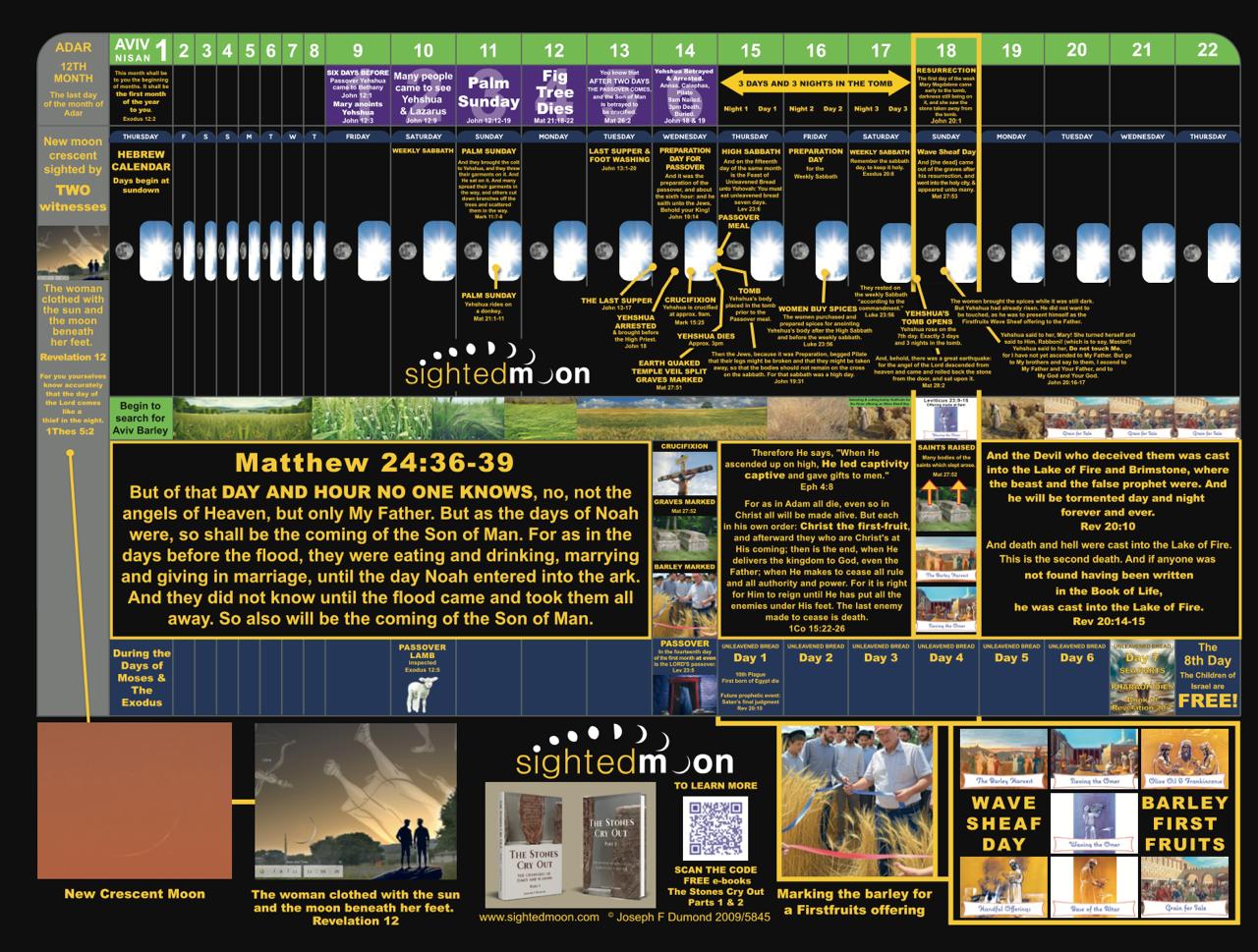
I have asked Pauline to create this graphic for us so that we can address the wide variety of calendar issues many have. It is now one of our banners, and we will share it with those who come to our booth at NRB this coming February. Above is the Aviv side and below is the Thief in the Night side. There are a number of teachings we can do from each banner about the calendar.
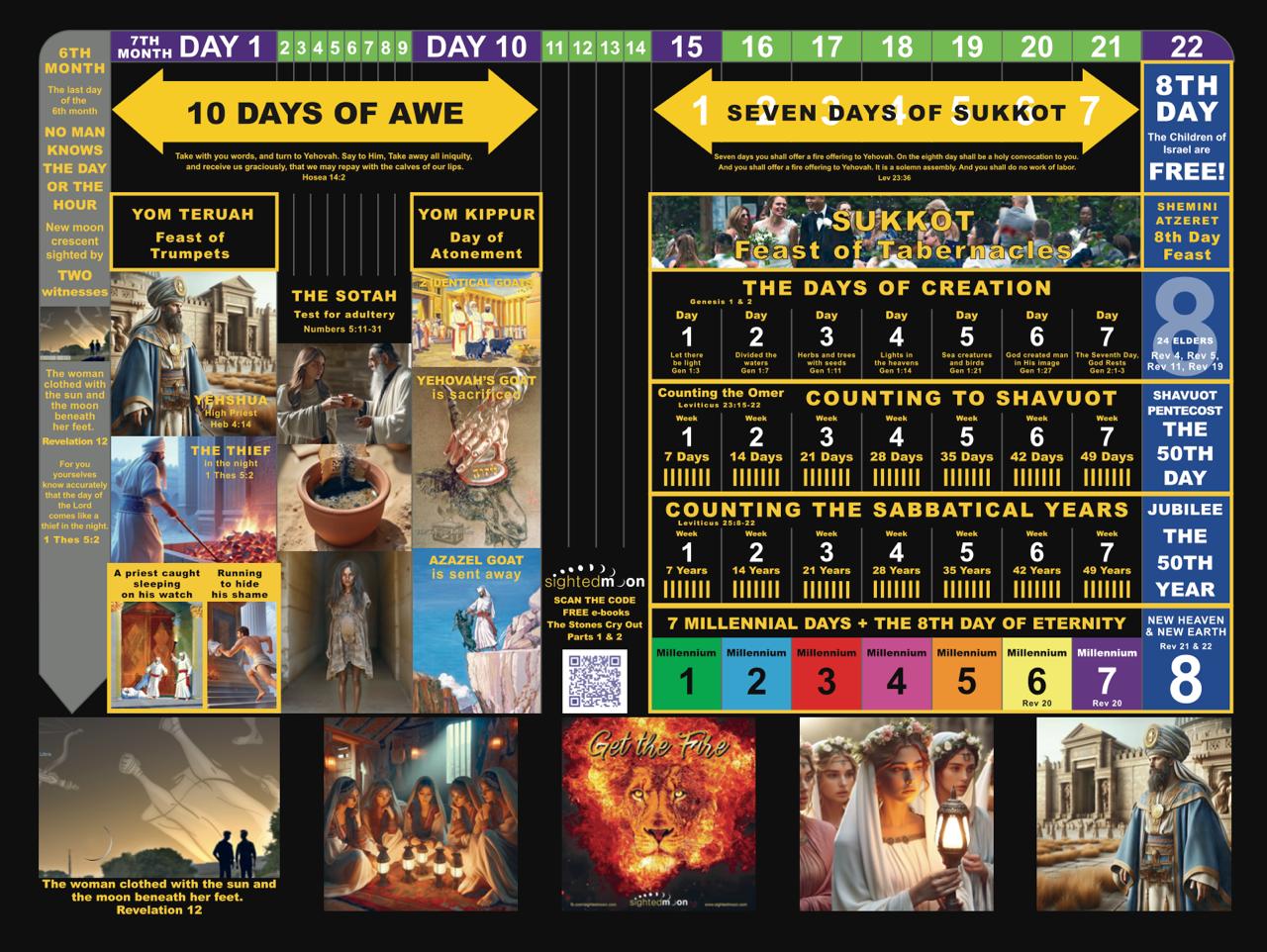
Today I want to use the first banner to explain a few things.
We all know and understand that Yehshua was killed at 3 PM on a Wednesday afternoon, at the very same time the lambs were killed that would be eaten for Passover. This was Nisan or Aviv, the 14th day. You can see in the chart below that the 14th is on the green line, and below that is Wednesday. Each day begins at sunset the night before.
When we count Wednesday night, Thursday night, and Friday Night, we have a total of 3 nights.
When we count Thursday day, Friday Day, and then Saturday day, we have a total of 3 nights. This gives us a grand total of 3 days and 3 nights.
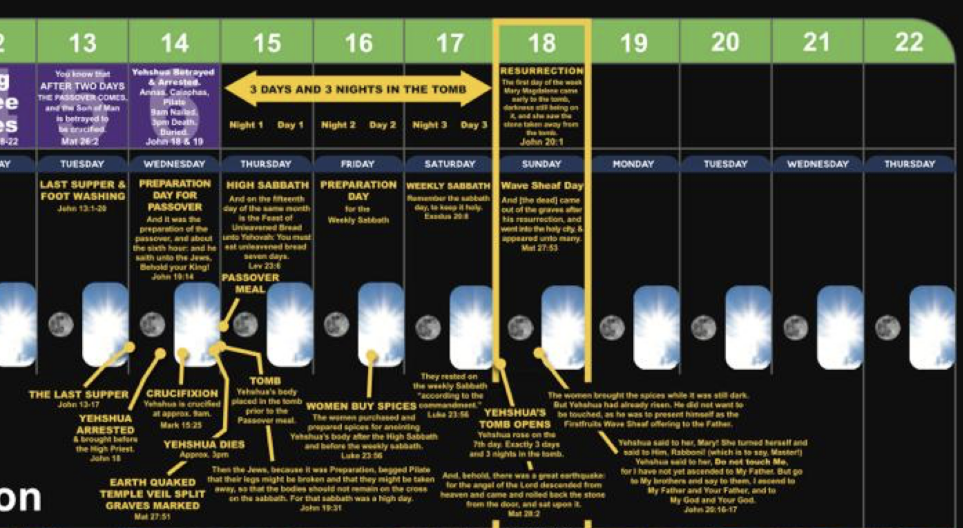
I would like to confirm that the lamb had to be killed on the 14th, just before the 15th.
Exo 12:3 Speak to all the congregation of Israel, saying, In the tenth of this month they shall take to them each man a lamb for a father’s house, a lamb for a house.
Exo 12:4 And if the household is too little for the lamb, let him and his neighbor next to his house take according to the number of the souls, each one, according to the eating of his mouth, you shall count concerning the lamb.
Exo 12:5 Your lamb shall be without blemish, a male of the first year. You shall take from the sheep or from the goats.
Exo 12:6 And you shall keep it up until the fourteenth day of the same month. And the whole assembly of the congregation of Israel shall kill it in the evening.
The evening here is at the end of the 14th as the 15th is about to begin. Yehshua was killed at 3 PM, which is the time when the evening sacrifices were made.
Lev 23:5 In the fourteenth day of the first month, between the evenings, is Jehovah’s Passover,
Lev 23:6 and on the fifteenth day of the same month is the Feast of Unleavened Bread to Jehovah. You must eat unleavened bread seven days.
You are commanded to eat Unleavened Bread for 7 days. Not 8, but 7.
Num 9:3 In the fourteenth day of this month, between the evenings, you shall keep it in its appointed time. You shall keep it according to all its statutes, and according to all the ceremonies of it.
Num 9:4 And Moses spoke to the sons of Israel to prepare the Passover.
Num 9:5 And they prepared the Passover on the fourteenth day of the first month between the evenings, in the wilderness of Sinai. According to all that Jehovah commanded Moses, so all the sons of Israel did.
Deu 16:1 Observe the month Abib, and keep the Passover to Jehovah your God. For in the month of Abib, Jehovah your God brought you forth out of Egypt by night.
Deu 16:2 And you shall therefore sacrifice the Passover to Jehovah your God, of the flock and the herd, in the place which Jehovah shall choose to place His name there.
Deu 16:3 You shall eat no leavened bread with it. Seven days you shall eat unleavened bread with it, the bread of affliction, for you came forth out of the land of Egypt in haste, so that you may remember the day that you came forth out of the land of Egypt all the days of your life.
Deu 16:4 And there shall be no leavened bread seen with you in all your borders for seven days. Nor shall any of the flesh which you sacrificed in the first day at evening remain all night until the morning.
Deu 16:5 You may not sacrifice the Passover within any of your gates, which Jehovah your God gives you,
Deu 16:6 but at the place which Jehovah your God shall choose to place His name in, there you shall sacrifice the Passover at evening, at the going of the sun, at the time that you came out of Egypt.
Deu 16:7 And you shall roast and eat in the place which Jehovah your God shall choose. And in the morning you shall turn and go to your tents.
Deu 16:8 Six days you shall eat unleavened bread. And on the seventh day shall be a solemn assembly to Jehovah your God. You shall do no work.
Let me just place this here for you all to read as you study the chart above.
Step-by-Step Timing of Passover and Unleavened Bread
- Select and Kill the Lamb on the 14th:
- On the 10th day, select a perfect lamb (Exodus 12:3–5).
- Keep it until the 14th day.
- Kill it at twilight (as the sun goes down) on the 14th (Exodus 12:6; Leviticus 23:5; Deuteronomy 16:6). This is the “Lord’s Passover.”
- Twilight means “between the evenings”—right as the 14th day ends and the 15th begins at sunset.
- Eat the Lamb That Night (Start of the 15th):
- After sunset (now the beginning of the 15th day), roast and eat the lamb (Exodus 12:8–9).
- Eat it with unleavened bread (no yeast/leaven) and bitter herbs (Exodus 12:8).
- No leavened bread is allowed with it (Exodus 12:15–20; Deuteronomy 16:3).
- Days of Unleavened Bread (15th–21st):
- The Feast of Unleavened Bread starts on the 15th and lasts 7 days (Exodus 12:15–20; Leviticus 23:6–8).
- Remove all leaven from your home on the first day (15th) and eat only unleavened bread for the full week.
- The 15th and 21st are holy convocations (no work).
Why the Lamb Is Eaten on the 15th
- The killing happens at the end of the 14th (twilight/sunset).
- Eating happens right after, which is the start of the 15th (since days begin at evening—Genesis 1:5; Leviticus 23:32).
- This makes the Passover meal the beginning of Unleavened Bread, eaten without leaven.
In simple terms: you are to kill the lamb as the 14th ends (sunset), then eat it as the 15th begins—with unleavened bread for 7 days. This pattern points to Yeshua as the Passover Lamb, crucified on the 14th, and the meal shared that evening.
Yehshua was killed on the 14th in the exact same way Moses described the Passover lamb would be killed: at 3 PM at the end of the 14th, the going down of the sun, as we just read in Deuteronomy.
Deu 16:6 but at the place which Jehovah your God shall choose to place His name in, there you shall sacrifice the Passover at evening, at the going of the sun, at the time that you came out of Egypt.
Yehshua said in Matthew that He would be in the grave for three days and three nights. It was not two nights and one day, but three full days and three full nights. And we must count from the end of the 14th day on Wednesday, as the chart above shows you.
Mat 12:39 But He answered and said to them, An evil and adulterous generation seeks after a sign. And there shall be no sign given to it except the sign of the prophet Jonah.
Mat 12:40 For as Jonah was three days and three nights in the belly of the huge fish, so the Son of Man shall be three days and three nights in the heart of the earth.
This was the only sign He gave that He was the Messiah. If your Messiah was in the grave on Good Friday and ascended easter Sunday, then he is not the Messiah. Yehshua said many times He would rise from the grave on the 3rd day.
Mat 16:21 From that time Jesus began to show His disciples that He must go to Jerusalem and suffer many things from the elders and chief priests and scribes, and be killed, and be raised again the third day.
Mat 17:22 And while they stayed in Galilee, Jesus said to them, The Son of Man shall be betrayed into the hands of men.
Mat 17:23 And they will kill Him, and the third day He will be raised again. And they grieved exceedingly.
Mat 20:17 And going up to Jerusalem, Jesus took the twelve disciples apart in the way, and said to them,
Mat 20:18 Behold, we go up to Jerusalem. And the Son of Man shall be betrayed to the chief priests and to the scribes, and they shall condemn Him to death.
Mat 20:19 And they shall deliver Him to the nations to mock and to scourge and to crucify. And the third day He shall rise again.
Mrk 8:31 And He began to teach them that the Son of Man must suffer many things and be rejected by the elders and the chief priests and scribes, and be killed, and after three days rise again.
Mrk 9:31 For He taught His disciples and said to them, The Son of Man is delivered into the hands of men, and they shall kill him. And after He is killed, He shall rise the third day.
Mrk 10:34 And they will mock Him, and will scourge Him, and will spit on Him, and will kill Him. And the third day He shall rise again.
Luk 9:22 saying, The Son of Man must suffer many things and be rejected by the elders and chief priests and scribes, and be slain, and be raised the third day.
Luk 18:33 And they will scourge Him and put Him to death, and the third day He will rise again.
Luk 24:46 And He said to them, So it is written, and so it behoved Christ to suffer and to rise from the dead the third day,
Jhn 2:19 Jesus answered and said to them, Destroy this temple and in three days I will raise it up.
Jhn 2:20 Then the Jews said, This temple was forty-six years building, and will you rear it up in three days?
Jhn 2:21 But He spoke of the temple of His body.
With all of these scriptures, there is no doubt that Yehshua had to be in the grave for 3 days and 3 nights, not a shorter period. Knowing that He died on the 14th and that the 14th was a Wednesday, let us now confirm when Yehshua came out of the grave.
Mat 28:1 But late in the week, at the dawning into the first day of the week, Mary Magdalene and the other Mary came to see the tomb.
Mrk 16:1 And when the sabbath was past, Mary Magdalene and Mary, the mother of James and Salome, had bought sweet spices so that they might come and anoint Him.
Mrk 16:2 And very early in the morning, the first day of the week, they came upon the tomb, the sun having risen.
Luk 24:1 And on the first of the sabbaths, while still very early, they came to the tomb bringing the spices which they had prepared, and certain others with them.
Jhn 20:1 The first of the sabbaths Mary Magdalene came early to the tomb, darkness still being on it, and she saw the stone taken away from the tomb.
All the commentaries state that she came just before or at sunrise that Sunday morning. And when she got there, the tomb was empty.
Therefore, the only way for Yehshua to be our Messiah is for His crucifixion to have taken place on the Wednesday of the 14th and for the High Day that John speaks of to begin at sunset when they had to take the bodies off the tree.
Jhn 19:31 Then the Jews, because it was Preparation, begged Pilate that their legs might be broken, and that they might be taken away, so that the bodies should not remain on the cross on the sabbath. For that sabbath was a high day.
The 14th was the preparation day for the High Holy Day of the 1st day of Unleavened Bread. The bodies could not be left up there on a Hoy Day.
Lev 23:7 On the first day you shall have a holy convocation. You shall do no work of labor,
Lev 23:8 but you shall offer a fire offering to Jehovah seven days. In the seventh day is a holy convocation. You shall do no work of labor.
Deu 16:3 You shall eat no leavened bread with it. Seven days you shall eat unleavened bread with it, the bread of affliction, for you came forth out of the land of Egypt in haste, so that you may remember the day that you came forth out of the land of Egypt all the days of your life.
Deu 16:4 And there shall be no leavened bread seen with you in all your borders for seven days. Nor shall any of the flesh which you sacrificed in the first day at evening remain all night until the morning.
I think we have a very solid case for Yehshua being crucified on the 14th at 9 AM and then dying at 3 PM in the evening. He had to be taken down before sunset and the start of the 1st High Holy Day of Unleavened Bread. He was in the grave for 3 days and 3 nights, and then on the 1st day of the week, while it was still dark and the sun was just rising, Mary was at the tomb, and it was already empty.
I would now like to show you the chart above and expand it a bit.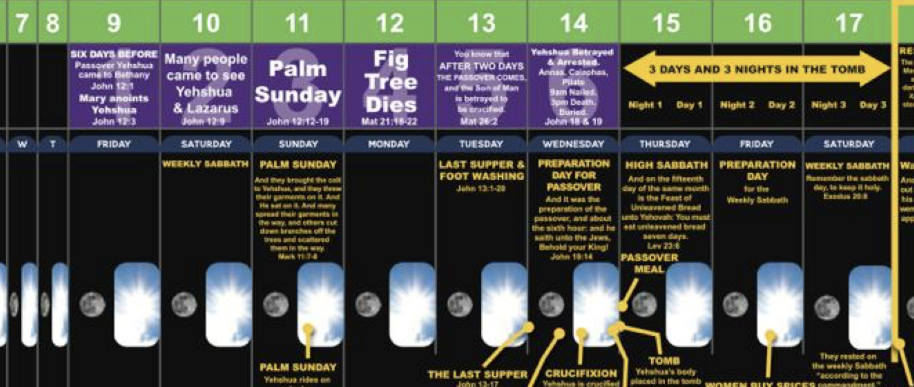
In Exodus 12, we learn about the initiation of the Passover.
Exo 12:1 And Jehovah spoke to Moses and Aaron in the land of Egypt, saying,
Exo 12:2 This month shall be to you the beginning of months. It shall be the first month of the year to you.
Exo 12:3 Speak to all the congregation of Israel, saying, In the tenth of this month they shall take to them each man a lamb for a father’s house, a lamb for a house.
Exo 12:4 And if the household is too little for the lamb, let him and his neighbor next to his house take according to the number of the souls, each one, according to the eating of his mouth, you shall count concerning the lamb.
Exo 12:5 Your lamb shall be without blemish, a male of the first year. You shall take from the sheep or from the goats.
Exo 12:6 And you shall keep it up until the fourteenth day of the same month. And the whole assembly of the congregation of Israel shall kill it in the evening.
Exo 12:7 And they shall take some of the blood and strike on the two side posts and upon the upper door post of the houses in which they shall eat it.
Yehshua is known to be the Lamb of God.
Jhn 1:29 The next day John sees Jesus coming to him and says, Behold the Lamb of God who takes away the sin of the world!
Jhn 1:36 And looking upon Jesus as He walked, he says, Behold the Lamb of God!
Rev 5:4 And I wept very much, because no one was found worthy to open and to read the book, nor to look at it.
Rev 5:5 And one of the elders said to me, Do not weep. Behold, the Lion of the tribe of Judah, the Root of David, has prevailed to open the book and to loose the seven seals of it.
Rev 5:6 And I looked, and lo, in the midst of the throne and of the four living creatures, amidst the elders, a Lamb stood, as if it had been slain, having seven horns and seven eyes, which are the seven Spirits of God sent forth into all the earth.
Rev 5:7 And He came and took the book out of the right hand of Him sitting on the throne.
Every detail of the Passover Exodus is replayed now in the Crucifixion of Yehshua. It will also be replayed in these last days, when Israel must flee again on Passover night. Knowing which night that is will be crucial as to whether you live or die.
Yehshua was the Lamb of Yehovah, and He, as the lamb, He too had to be examined and then killed. Just as that lamb was taken into the houses of those who were about to kill it, Yehshua was examined during those days leading up to His death, and he was found not guilty.
Mrk 12:13 And they sent certain of the Pharisees and of the Herodians to Him, to catch Him in His words.
Mat 26:59 And the chief priests and the elders and all the sanhedrin sought false witness against Jesus, in order to put Him to death.
Mat 26:60 But they found none; yea, though many false witnesses came, they found none. But at last two false witnesses came up
Luk 23:1 And rising up, all the multitude of them led Him before Pilate.
Luk 23:2 And they began to accuse Him, saying, We have found this one perverting the nation and forbidding them to give tribute to Caesar, saying himself to be a king, Christ.
Luk 23:3 And Pilate asked Him, saying, Are you the king of the Jews? And He answered him and said, You say it.
Luk 23:4 And Pilate said to the chief priests and to the people, I find no fault in this man.
Luk 23:13 And when he had called together the chief priests and the rulers and the people,
Luk 23:14 Pilate said to them, You have brought this Man to me as perverting the people. And behold, having examined Him before you, I have found no fault in this Man regarding those things of which you accuse Him;
Luk 23:15 no, nor even Herod, for I sent you to him, and lo, nothing worthy of death has been done by Him.
Luk 23:16 Therefore I will chastise Him and release Him.
Luk 23:17 (For it was necessary for him to release one to them at the feast.)
Luk 23:22 And he said to them the third time, Why? What evil has He done? I have found no cause of death in Him, therefore I will chastise Him and let Him go.
These are the events that show the final examination, followed by the slaughter of Yehshua. He was and is the Lamb of Yehovah.
Now, let’s examine the timeline of these events, which will again demonstrate that He was killed on Wednesday and resurrected three days later at the end of the Sabbath.
Jhn 11:55 And the Jews’ Passover was near. And many went out of the country up to Jerusalem before the Passover in order to purify themselves.
Jhn 11:56 Then they sought Jesus, and spoke with one another as they stood in the temple, What does it seem to you, that He will not at all come to the feast?
Jhn 11:57 And all the chief priests and the Pharisees had given commands, that if anyone knew where He was, he should make it known so that they might seize Him.
At the end of John chapter 11 we are told it is close to Passover, and then we read in the very next chapter in verse 1:
Jhn 12:1 Then, six days before the Passover, Jesus came to Bethany, where Lazarus was (who had died, whom He raised from the dead).
Jhn 12:2 Then they made a supper there for Him. And Martha served, but Lazarus was one of those reclining with Him.
Six days before Passover is there for you to count on the chart above. We know Yehshua was killed on Wednesday, the 14th, and had to be in the grave before Passover, which began on the 15th after sunset at the end of the 14th.
Jhn 19:31 Then the Jews, because it was Preparation, begged Pilate that their legs might be broken, and that they might be taken away, so that the bodies should not remain on the cross on the sabbath. For that sabbath was a high day.
When we count back six days from the 14th, we arrive on Friday, Aviv 9. On that Friday, Aviv 9, 31 AD, Yehshua arrived at Martha, Mary and Lazarus’s home in Bethany. Verse 2 says they made Him super. This is Friday evening, so the super meal is the Shabbat meal, which means it is now the start of the 10th day of Aviv, when the lambs are to be brought into the homes and examined. Yeshua was our Lamb in EVERY detail.
Friday Nisan 9
Jhn 12:1 Then, six days before the Passover, Jesus came to Bethany, where Lazarus was (who had died, whom He raised from the dead).
Jhn 12:2 Then they made a supper there for Him. And Martha served, but Lazarus was one of those reclining with Him.
Friday is the sixth day and the day Yehshua arrives at the house of Lazarus, Mary, and Martha. Observe that Mary prepared dinner for Him. The sixth day (Friday) has ended, and with sunset, they enter the Sabbath on Friday evening, enjoying a Sabbath meal together.
Then in verse 3 we read about the oil being poured on the feet of Yehshua by Mary and then how Judas rebuked her and then was himself rebuked.
Jhn 12:3 Then Mary took a pound of ointment of pure spikenard, very costly, and anointed the feet of Jesus, and wiped His feet with her hair. And the house was filled with the odor of the ointment.
Jhn 12:4 Then said one of His disciples (Judas Iscariot, Simon’s son, who was to betray Him)
Jhn 12:5 Why was this ointment not sold for three hundred denarii and given to the poor?
Jhn 12:6 He said this, not that he cared for the poor, but because he was a thief and held the moneybag and carried the things put in.
Jhn 12:7 Then Jesus said, Let her alone. She has kept this for the day of My burial.
Jhn 12:8 For you have the poor with you always; but you do not always have Me.
Mat 26:6 And when Jesus was in Bethany, in the house of Simon the leper,
Mat 26:7 a woman came to Him, having an alabaster box of very precious ointment, and poured it on His head as He reclined.
Mat 26:8 But when His disciples saw it, they were indignant, saying, To what purpose is this waste?
Mat 26:9 For this ointment might have been sold for very much and given to the poor.
Mat 26:10 When Jesus understood it, He said to them, Why do you trouble the woman? For she has done a good work on Me.
Mat 26:11 For you have the poor with you always, but you do not always have Me.
Mat 26:12 For in putting ointment on My body, she did itfor My burial.
Mat 26:13 Truly I say to you, Wherever this gospel shall be proclaimed in the whole world, that which this woman has done shall be spoken of also, for a memorial of her.
Mark says the exact same thing.
Mrk 14:3 And being in Bethany in the house of Simon the leper, as He reclined, a woman came with an alabaster vial of pure, costly ointment of spikenard. And she broke the vial and poured it on His head.
Mrk 14:4 And some were indignant to themselves, and said, Why was this waste of the ointment made?
Mrk 14:5 For it might have been sold for more than three hundred denarii, and be given to the poor. And they were incensed with her.
Mrk 14:6 And Jesus said, Let her alone! Why do you trouble her? She has done a good work towards Me.
Mrk 14:7 For you have the poor with you always, and whenever you desire you may do them good. But you do not have Me always.
Mrk 14:8 She has done what she could. She has come beforehand to anoint My body for the burying.
Mrk 14:9 Truly I say to you, Wherever this gospel shall be proclaimed in all the world, this also that she has done will be spoken of for a memorial of her.
Saturday Nisan 10
John then goes on to tell us of the crowd that came to see both Yehshua and Lazarus. This was not at supper time, but had to have been on the Sabbath the next day. None of the other Gospels record anything John said from 1-11.
Jhn 12:9 Then a great crowd of the Jews learned that He was there. And they did not come for Jesus’ sake only, but also that they might see Lazarus, whom He had raised from the dead.
Jhn 12:10 But the chief priests consulted that they might put Lazarus to death also,
Jhn 12:11 because many of the Jews went away and believed on Jesus because of him.
We must point out something here that almost everyone misses. This Sabbath day, when Yehshua was brought into the home of Lazarus and all these people came to see both Him and Lazarus, was, in fact, the 10th day of the month of Nisan, when you are to select the lamb and bring it into your home. Mary, Martha, and Lazarus did this, and so did the crowd that came the next day. Mary, Martha, and Lazarus selected Yehshua and brought Him in at the start of the Sabbath, the 10th of the month of Nisan. Then, the next day, which was still the Sabbath, the crowd came, and they, too, selected Yehshua.
In the chart, the 10th day is Saturday, the Sabbath. Wednesday, the day of the crucifixion, is the 14th day. Each day begins at sunset the day before. The 15th day, when the Passover meal is eaten at sunset, is the start of Thursday.
From the City of David to Bethany is about a 20-30 minute walk. The temple was in the City of David above the Gihon Spring.
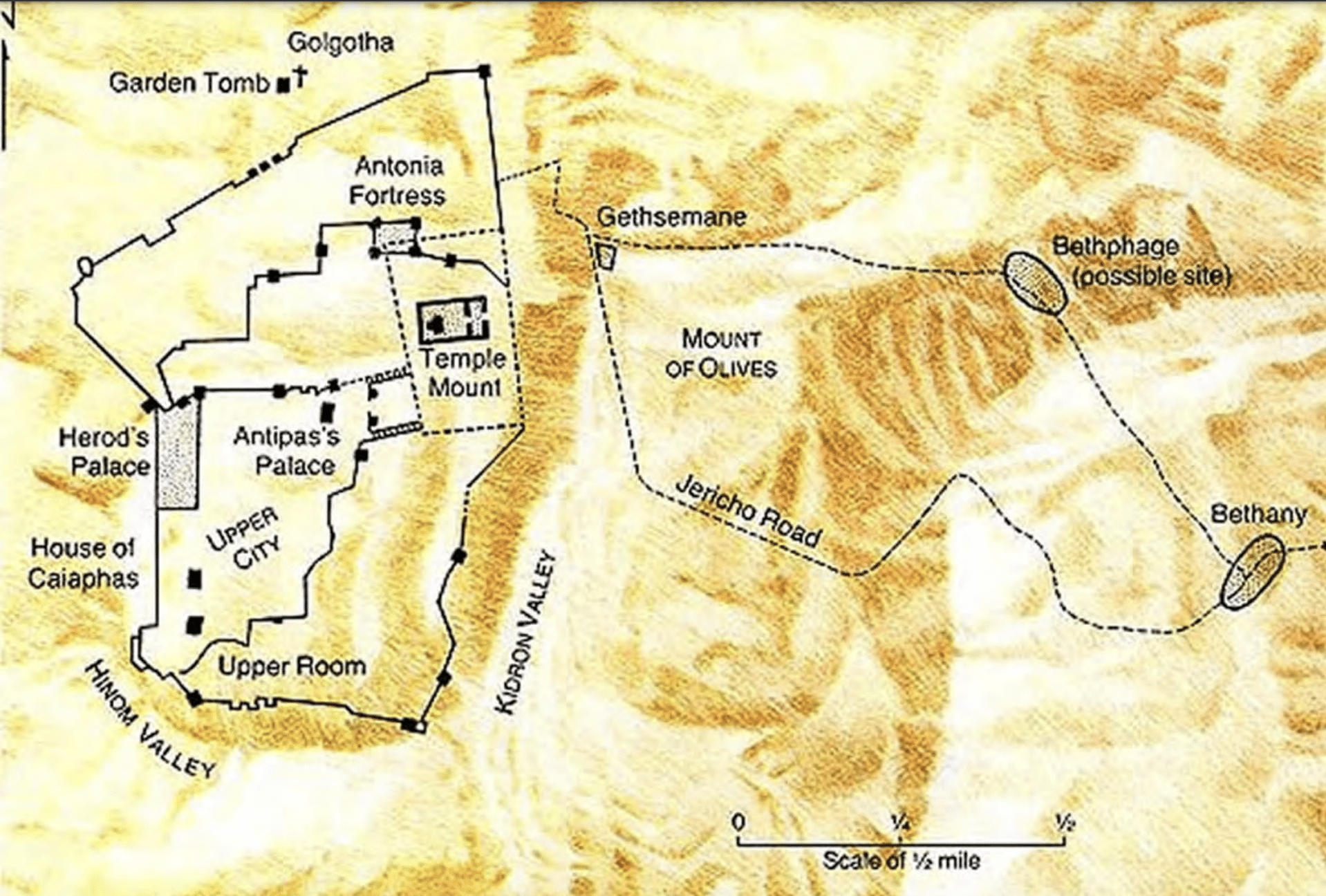
Sunday Nisan 11
Continuing in John from where we just left off, he says the next day, after these men came to see them at Lazarus’s house. The next day after Shabbat is Sunday. This is now Palm Sunday
Jhn 12:12 On the next day, when they heard that Jesus was coming to Jerusalem, a great crowd who had come to the Feast
Jhn 12:13 took branches of palm trees and went out to meet Him. And they cried, Hosanna! “Blessed is the King of Israel who comes in the name of the Lord!”
Jhn 12:14 And finding an ass colt, Jesus sat on it; as it is written,
Jhn 12:15 “Fear not, daughter of Zion; behold, your King comes sitting on the foal of an ass.”
Jhn 12:16 But His disciples did not know these things at the first. But when Jesus was glorified, then they remembered that these things were written of Him, and that they had done these things to Him.
Jhn 12:17 Then the crowd witnessed, those who were with Him when He called Lazarus out of the tomb and raised him from the dead.
Jhn 12:18 Because of this the crowd also met Him, because they heard that He had done this miracle.
Jhn 12:19 Then the Pharisees said among themselves, Do you see how you gain nothing? Behold, the world has gone after Him.
His disciples did not understand these things at first, but when Jesus was glorified, they remembered that these things had been written about Him and that they had done these things to Him.
Mark will now begin to describe the events of Palm Sunday.
Mrk 11:1 And when they drew near to Jerusalem, to Bethphage and Bethany, at the Mount of Olives, He sent out two of His disciples.
Mrk 11:2 And He said to them, Go into the village over across from you. And as soon as you have entered into it, you will find a colt tied, on which no one of men has ever sat. Untie it and bring it.
Mrk 11:3 And if anyone says to you, Why do you do this? Say that the Lord has need of him, and immediately he will send him here.
Mrk 11:4 And they went, and they found the colt tied by the door outside, in a place where two ways met. And they untied him.
Mrk 11:5 And certain of those who stood there said to them, What are you doing, untying the colt?
Mrk 11:6 And they said to them even as Jesus had commanded. And they let them go.
Mrk 11:7 And they brought the colt to Jesus, and they threw their garments on it. And He sat on it.
Mrk 11:8 And many spread their garments in the way, and others cut down branches off the trees and scattered them in the way.
Mrk 11:9 And those going before, and those following, cried out, saying, Hosanna! Blessed is He who comes in the name of the Lord!
Mrk 11:10 Blessed is the kingdom of our father David, who comes in the name of the Lord! Hosanna in the highest!
Mrk 11:11 And Jesus entered into Jerusalem and into the temple. And when He had looked around on all things, the hour already being late, He went out to Bethany with the Twelve.
This is Sunday, and Yehshua rides in on a colt on this Palm Sunday, and then goes up to the Temple, looks around, and then leaves, going back to Bethany because it was already late.
Mathew records more events that took place that same day.
Mat 21:1 And when they drew near Jerusalem, and had come to Bethphage, to the Mount of Olives, then Jesus sent two disciples,
Mat 21:2 saying to them, Go into the village across from you. And immediately you will find an ass tied, and a colt with her. Untie them and bring them to Me.
Mat 21:3 And if anyone says anything to you, you shall say, The Lord has need of them, and immediately He will send them.
Mat 21:4 All this was done so that it might be fulfilled which was spoken by the prophet, saying,
Mat 21:5 “Tell the daughter of Zion, Behold, your King comes to you, meek, and sitting on an ass, even a colt the foal of an ass.”
Mat 21:6 And the disciples went and did as Jesus commanded them.
Mat 21:7 And they brought the ass, even the colt, and put their clothes on them, and He sat on them.
Mat 21:8 And a very great crowd spread their garments in the way. Others cut down branches from the trees and spread them in the way.
Mat 21:9 And the crowds who went before, and those who followed, cried out, saying, Hosanna to the Son of David! Blessed is He who comes in the name of theLord! Hosanna in the highest!
Mat 21:10 And when He had come into Jerusalem, all the city was moved, saying, Who is this?
Mat 21:11 And the crowd said, This is Jesus the prophet, from Nazareth of Galilee.
Luke also records this same event as follows:
Luk 19:28 And saying these things, He went in front, going up to Jerusalem.
Luk 19:29 And it happened as He drew near Bethphage and Bethany, toward the mount called Mount of Olives, He sent two of the disciples,
Luk 19:30 saying, Go into the village across from you, and having entered, you will find a colt tied up, on which no one of men has yet sat. Untie it and bring it.
Luk 19:31 And if anyone asks you, Why are you untying it? You will say this to him, Because the Lord has need of it.
Luk 19:32 And going, those who were sent found as He had said to them.
Luk 19:33 And as they were untying the colt, its owners said to them, Why are you untying the colt?
Luk 19:34 And they said, The Lord has need of him.
Luk 19:35 And they brought him to Jesus. And they threw their garments on the colt. And they set Jesus on it.
Luk 19:36 And as He went, they spread their clothes in the way.
Luk 19:37 And when He had come near, even now at the descent of the Mount of Olives, all the multitude of the disciples began to rejoice and praise God with a loud voice for all the mighty works which they had seen,
Luk 19:38 saying, Blessed is the King coming in the name of the Lord! Peace in Heaven and glory in thehighest!
Luk 19:39 And some of the Pharisees from the crowd said to Him, Teacher, rebuke your disciples.
Luk 19:40 And He answered and said to them, I tell you that if these should be silent, the stones would cry out.
Jesus Weeps over Jerusalem
Luk 19:41 And as He drew near, He beheld the city and wept over it,
Luk 19:42 saying, If you had known, even you, even at least in this day of yours, the things for your peace! But now they are hidden from your eyes.
Luk 19:43 For the days will come on you that your enemies will raise up a rampart to you, and will surround you, and will keep you in on every side.
Luk 19:44 And they will tear you down, and your children within you, and will not leave a stone on a stone because you did not know the time of your visitation.
Monday Nisan 12
Mark then continues and tells us the events of the next day after Palm Sunday, which is now Monday, the 12th of Nisan. But notice that Mark says Yehshua cleansed the Temple and overturned the tables on Monday. Mathew and Luke mixed those events with those of Palm Sunday. It seems to me that Mark was an actual witness, while Matthew and Luke wrote about these events after the fact.
Mrk 11:12 And on the next day, they going out of Bethany, He was hungry.
Mrk 11:13 And seeing a fig-tree with leaves afar off, He went to it, if perhaps He might find anything on it. And when He came to it, He found nothing but leaves, for it was not the season of figs.
Mrk 11:14 And Jesus answered and said to it, No one shall eat fruit of you forever. And His disciples heard.
Jesus Curses the Fig Tree
Mat 21:18 And returning early to the city, He hungered.
Mat 21:19 And seeing a fig tree in the way, He came to it and found nothing on it except leaves only. And He said to it, let no fruit grow on you forever. And immediately the fig tree withered away.
Mat 21:20 And when the disciples saw, they marveled, saying, How quickly the fig tree has withered away!
Mat 21:21 Jesus answered and said to them, Truly I say to you, If you have faith and do not doubt, you shall not only do this miracle of the fig tree, but also; if you shall say to this mountain, Be moved and be thrown into the sea; it shall be done.
Mat 21:22 And all things, whatever you shall ask in prayer, believing, you shall receive.
Jesus Cleanses the Temple
Mrk 11:15 And they came to Jerusalem. And entering into the temple, Jesus began to cast out those who bought and sold in the temple. And He overthrew the tables of the money-changers and the seats of those who sold doves.
Mrk 11:16 And He would not allow any to carry a vessel through the temple.
Mrk 11:17 And He taught, saying to them, Is it not written, “My house shall be called the house of prayer for all nations?” But you have made it a den of thieves.
Mrk 11:18 And the scribes and the chief priests heard. And they sought how they might destroy Him. For they feared Him, because all the people were astonished at His doctrine.
Mrk 11:19 And when evening came, He went out of the city.
Jesus Cleanses the Temple
Mat 21:12 And Jesus went into the temple of God and cast out all those who sold and bought in the temple, and overthrew the tables of the money-changers, and the seats of those who sold doves.
Mat 21:13 And He said to them, It is written, “My house shall be called the house of prayer”; but you have made it a den of thieves.
Mat 21:14 And the blind and the lame came to Him in the temple, and He healed them.
Mat 21:15 And when the chief priests and scribes saw the wonderful things which He did, and the children crying in the temple, and saying, Hosanna to the Son of David, they were angry.
Mat 21:16 And they said to Him, Do you hear what these say? And Jesus said to them, Yes, have you never read, “Out of the mouth of babes and sucklings You have perfected praise?”
Mat 21:17 And leaving them, He went out of the city to Bethany, and spent the night there.
Jesus Cleanses the Temple
Luk 19:45 And entering into the temple, He began to cast out those selling and buying in it,
Luk 19:46 saying to them, It is written, “My house is a house of prayer,” but you have made it a den of thieves.
Luk 19:47 And He taught in the temple daily. But the chief priests and the scribes and the chief of the people sought to destroy Him.
Luk 19:48 And they could not find what they might do, for all the people were hanging on Him, listening.
Tuesday Nisan 13
We have now reached the conclusion of Monday, Nisan 12. Mark said in Mark 11:19 And when evening came, He went out of the city. They went back to Bethany and then described the events that occurred on Tuesday, Nisan 13, as they returned to the Temple early that morning. I am not going to quote everything that took place at the Temple on this day. You can go and read about all of this in (Matthew 21:23–23:39; Luke 20:1–21:4).
Mrk 11:20 And passing on early, they saw the fig-tree dried up from the roots.
Mrk 11:21 And Peter, remembering, said to Him, Rabbi, behold, the fig tree which You cursed has withered away.
Mrk 11:22 And answering Jesus said to them, Have faith of God.
Mrk 11:23 For truly I say to you that whoever shall say to this mountain, Be moved and be cast into the sea, and shall not doubt in his heart, but shall believe that what he said shall occur, he shall have whatever he said.
Mrk 11:24 Therefore I say to you, All things, whatever you ask, praying, believe that you shall receive them, and it will be to you.
Mrk 11:25 And when you stand praying, if you have anything against anyone, forgive it so that also your Father in Heaven may forgive you your trespasses.
Mrk 11:26 But if you do not forgive, neither will your Father in Heaven forgive your trespasses.
The Authority of Jesus Challenged
Mrk 11:27 And they came again to Jerusalem. And as He was walking in the temple, the chief priests and the scribes and the elders came to Him
Mrk 11:28 and said to Him, By what authority do you do these things? And who gave you this authority to do these things?
Mrk 11:29 And Jesus answered and said to them, I will also ask of you one thing, and answer Me, and I will tell you by what authority I do these things.
Mrk 11:30 The baptism of John, was it from Heaven, or from men? Answer Me.
Mrk 11:31 And they reasoned within themselves, saying, If we shall say, From Heaven, he will say, Why then did you not believe him?
Mrk 11:32 But if we shall say, From men, they feared the people, for all held John to be a prophet indeed.
Mrk 11:33 And they answered and said to Jesus, We cannot tell. And answering Jesus said to them, Neither do I tell you by what authority I do these things.
You can read about all the events that happened that Tuesday in Mark up until Chapter 13. I am including them here for you to read.
The Parable of the Tenants
Mrk 12:1 And He began to speak to them by parables. A man planted a vineyard, and set a fence about it, and dug a wine-vat, and built a tower, and he let it out to vinedressers, and went away.
Mrk 12:2 And at the season he sent a servant to the vinedressers, so that he might receive from the vinedressers the fruit of the vineyard.
Mrk 12:3 And taking him, they beat him and sent himaway empty.
Mrk 12:4 And again he sent to them another servant. And stoning that one, they struck him in the head, and sent him away, insulting him.
Mrk 12:5 And again he sent another. And they killed him, and many others, beating some and killing some.
Mrk 12:6 Therefore, still having one son, his own beloved, he also sent him to them last of all, saying, They will respect my son.
Mrk 12:7 But those vinedressers said among themselves, This is the heir! Come, let us kill him and the inheritance shall be ours.
Mrk 12:8 And they took him and killed him and cast himout of the vineyard.
Mrk 12:9 Therefore what will the lord of the vineyard do? He will come and destroy the vinedressers and will give the vineyard to others.
Mrk 12:10 And have you not read this scripture “TheStone which the builders rejected has become the Head of the corner:
Mrk 12:11 this was from the Lord, and it is marvelous in our eyes”?
Mrk 12:12 And they sought to seize him, but feared the crowd. For they knew that He spoke the parable against them. And leaving Him, they went away.
Paying Taxes to Caesar
Mrk 12:13 And they sent certain of the Pharisees and of the Herodians to Him, to catch Him in His words.
Mrk 12:14 And coming, they said to Him, Teacher, we know that you are true and you care about no one. For you do not look to the face of men, but teach the way of God in truth. Is it lawful to give tribute to Caesar, or not?
Mrk 12:15 Shall we give, or shall we not give? But knowing their hypocrisy, He said to them, Why do you tempt Me? Bring me a denarius so that I may see.
Mrk 12:16 And they brought it. And He said to them, Whose image and inscription is this? And they said to Him, Caesar’s.
Mrk 12:17 And answering Jesus said to them, Render to Caesar the things that are Caesar’s, and to God the things that are God’s. And they marvelled at Him.
The Sadducees Ask About the Resurrection
Mrk 12:18 Then the Sadducees came to Him, who say there is no resurrection. And they asked Him, saying,
Mrk 12:19 Teacher, Moses wrote to us, If a man’s brother die and leaves his wife, and leaves no children, his brother should take his wife and raise up seed to his brother.
Mrk 12:20 And there were seven brothers. And the first took a wife, and dying left no seed.
Mrk 12:21 And the second took her, and died; neither did he leave any seed. And the third likewise.
Mrk 12:22 And the seven had her, and left no seed. Last of all the woman also died.
Mrk 12:23 In the resurrection therefore, when they shall rise, whose wife will she be? For the seven had her as a wife.
Mrk 12:24 And answering Jesus said to them, Do you not err because of this, not knowing Scriptures, nor the power of God?
Mrk 12:25 For when they shall rise from the dead, they neither marry nor are given in marriage, but they are as the angels in Heaven.
Mrk 12:26 And as regards the dead, that they rise, have you not read in the book of Moses how God spoke to him in the Bush, saying, “I am the God of Abraham and the God of Isaac and the God of Jacob?”
Mrk 12:27 He is not the God of the dead, but the God of the living. Therefore you greatly err.
The Great Commandment
Mrk 12:28 And coming up one of the scribes heard them reasoning, knowing that He had answered them well, he asked Him, Which is the first commandment of all?
Mrk 12:29 And Jesus answered him, The first of all the commandments is, “Hear, O Israel, the Lord our God is one Lord;
Mrk 12:30 and you shall love the Lord your God with all your heart, and with all your soul, and with all your mind, and with all your strength.” This is the first commandment.
Mrk 12:31 And the second is like this: You shall love your neighbor as yourself. There is no other commandment greater than these.
Mrk 12:32 And the scribe said to Him, Right, Teacher, according to truth You have spoken, that God is one, and there is no other besides Him.
Mrk 12:33 And to love Him with all the heart, and with all the understanding, and with all the soul, and with all the strength, and to love the neighbor as himself, is more than all the burnt offerings and sacrifices.
Mrk 12:34 And seeing that he had answered intelligently, Jesus said to him, You are not far from the kingdom of God. And no one dared to question Him any more.
Whose Son Is the Christ?
Mrk 12:35 And answering, teaching in the temple, Jesus said, How do the scribes say that Christ is the Son of David?
Mrk 12:36 For David himself said by the Holy Spirit: “The LORD said to my Lord, Sit at My right hand until I place Your enemies as Your footstool.”
Mrk 12:37 David therefore himself calls Him Lord, and why then is He his son? And the great crowd heard Him gladly.
Beware of the Scribes
Mrk 12:38 And He said to them in His teaching, Beware of the scribes, who love to walk about in robes, and love greetings in the markets,
Mrk 12:39 and the chief seats in the synagogues, and the uppermost places at feasts
Mrk 12:40 who devour widows’ houses, and as a pretense make long prayers. These shall receive greater condemnation.
The Widow’s Offering
Mrk 12:41 And sitting down opposite the treasury, Jesus watched how the people threw copper coins into the treasury. And many rich ones threw in much.
Mrk 12:42 And a certain poor widow came, and she threw in two lepta, which is a kodrantes.
Mrk 12:43 And He called His disciples and said to them, Truly I say to you that this poor widow has cast in more than all those who have cast into the treasury.
Mrk 12:44 For all cast in from their abundance. But she, out of her poverty, has cast in all that she had, all her livelihood.
Then we read about Yehshua leaving the Temple and heading back to the Mount of Olives when He explains the end times. All of this is still on Tuesday, Nisan 13.
Jesus Foretells Destruction of the Temple
Mrk 13:1 And as He went out of the temple, one of His disciples said to Him, Master, see! What stones and what buildings!
Mrk 13:2 And answering Jesus said to him, Do you see these great buildings? There shall not be one stone left on another that shall not be thrown down.
Signs of the Close of the Age
Mrk 13:3 And as He sat on the Mount of Olives, across from the temple, Peter and James and John and Andrew asked Him privately,
Mrk 13:4 Tell us, When shall all these things be? And what shall be the sign when all these things shall be fulfilled?
Mrk 13:5 And Jesus answering them began to say, Beware that no one deceive you.
Mrk 13:6 For many shall come in My name, saying, I AM, and shall deceive many.
Mrk 13:7 And when you shall hear of wars and rumors of wars, do not be troubled. For it must happen, but the end shall not be yet.
Mrk 13:8 For nation shall rise against nation, and kingdom against kingdom. And there shall be earthquakes in different places, and there shall be famines and troubles. These things are the beginnings of sorrows.
Mrk 13:9 But take heed to yourselves. For they shall deliver you up to sanhedrins, and in the synagogues you shall be beaten. And you shall be brought before rulers and kings for My sake, for a testimony against them.
Mrk 13:10 And the gospel must first be proclaimed to all nations.
Mrk 13:11 But whenever they lead you away and deliver you up, take no thought beforehand what you should speak or think. But speak whatever shall be given to you in that hour. For it is not you who speaks, but the Holy Spirit.
Mrk 13:12 And a brother will betray a brother to death, and a father his son. And children will rise up against their parents and will cause them to be put to death.
Mrk 13:13 And you will be hated by all for My name’s sake, but he enduring to the end, that one will be kept safe.
The Abomination of Desolation
Mrk 13:14 But when you see the abomination of desolation, that spoken of by Daniel the prophet, standing where it ought not (let him who reads understand), then let those who are in Judea flee to the mountains.
Mrk 13:15 And let him who is on the housetop not go down into the house, nor enter to take anything out of his house.
Mrk 13:16 And let him who is in the field not turn back again in order to take up his garment.
Mrk 13:17 But woe to those with babe in womb, and to those who give suck in those days!
Mrk 13:18 And pray that your flight is not in the winter.
Mrk 13:19 For in those days shall be affliction, such as has not been from the beginning of the creation which God created until now, and never shall be.
Mrk 13:20 And unless the Lord had shortened those days, no flesh would be saved. But for the elect’s sake, whom He has chosen, He has shortened the days.
Mrk 13:21 And then if anyone shall say to you, Lo, here isChrist! Or, lo, there! Do not believe him.
Mrk 13:22 For false Christs and false prophets will arise and will give miraculous signs and wonders in order to seduce, if possible, even the elect.
Mrk 13:23 But take heed; behold, I have told you all things beforehand.
The Coming of the Son of Man
Mrk 13:24 But in those days, after that tribulation, the sun shall be darkened, and the moon shall not give her light,
Mrk 13:25 and the stars of Heaven shall fall, and the powers in the heavens shall be shaken.
Mrk 13:26 And then they will see the Son of Man coming in the clouds with great power and glory.
Mrk 13:27 And then He shall send His angels and shall gather His elect from the four winds, from the end of the earth to the end of heaven.
The Lesson of the Fig Tree
Mrk 13:28 And learn the parable of the fig-tree: when her branch is still tender and puts out leaves, you know that summer is near.
Mrk 13:29 So you also, when you see these things happening, you know that it is near, at the doors.
Mrk 13:30 Truly I say to you that this generation shall not pass away until all these things occur.
Mrk 13:31 Heaven and earth shall pass away, but My Words shall not pass away.
No One Knows That Day or Hour
Mrk 13:32 But of that day and hour no one knows, no, not the angels in Heaven, nor the Son, but the Father.
Mrk 13:33 Take heed, watch and pray, for you do not know when the time is.
Mrk 13:34 As a man going away, leaving his house, and giving authority to his servants, and each man’s work to him, and commanded the doorkeeper to watch.
Mrk 13:35 Then you watch, for you do not know when the lord of the house is coming, at evening, or at midnight, or at cockcrowing, or early;
Mrk 13:36 lest he come suddenly and find you sleeping.
Mrk 13:37 And what I say to you, I say to all. Watch.
Mark then goes on to say in Mark 14 that after two days, it will be Passover. This was on that Tuesday, Nisan 13. So we can count 2 days to Thursday when Passover was, and it is two days away on Nisan 15.
Mrk 14:1 And after two days it was the Passover and the Feast of Unleavened Bread. And the chief priests and the scribes sought how they might take Him by craft and kill Him.
Mrk 14:2 But they said, Not during the Feast, lest there be an uproar of the people.
Notice what Luke says about this upcoming Feast of Unleavened Bread. He says it was called Passover. Unleavened Bread is for 7 Days. You are commanded to eat Unleavened Bread for only seven days. You are also commanded to eat unleavened bread with the Passover meal which is to be eaten on the 15th at the end of the 14th of Nisan.
Exo 12:15 You shall eat unleavened bread seven days; even the first day you shall put away leaven out of your houses. For whoever eats leavened bread from the first day until the seventh day, that soul shall be cut off from Israel.
Exo 12:8 And they shall eat the flesh in that night, roasted with fire, and unleavened bread. They shall eat it with bitter herbs.
Luk 22:1 And the Feast of Unleavened Bread, which is called the Passover, drew near.
Luk 22:2 And the chief priests and scribes sought how they might kill Him, for they feared the people.
In Mathew 26:1, we read the same statement as Mark stating on Tuesday, that in two days’ time from this day, Tuesday, is the Passover, only this time, it is Yehshua Himself speaking it.
Mat 26:1 And it happened when Jesus finished all these sayings, He said to His disciples,
Mat 26:2 You know that after two days the Passover comes, and the Son of Man is betrayed to be crucified.
Mat 26:3 Then the chief priests, and the scribes, and the elders of the people, assembled together to the palace of the high priest, who was called Caiaphas.
Mat 26:4 And they consulted so that they might take Jesus by guile and kill Him.
Mat 26:5 But they said, Not on the feast day, lest there be an uproar among the people.
Later in Matthew 26, we see them preparing for the Passover. It’s still the same Tuesday, Nisan 13, nearing sunset, marking the approach of Nisan 14, which is the preparation day for Passover on the 15th. John will highlight this when we reach that moment.
Wednesday Nisan 14
We will now be going from the afternoon of the 13th to the start of the 14th at sunset.
Let me share the other gospels on this same point first.
Mrk 14:12 And the first day of Unleavened Bread, when they killed the passover, His disciples said to Him, Where do You desire that we go and prepare that You may eat the passover?
Mrk 14:13 And He sent out two of His disciples and said to them, Go into the city, and there you shall meet a man bearing a pitcher of water. Follow him.
Mrk 14:14 And wherever he may go in, you say to the housemaster, The Teacher says, Where is the guest room where I shall eat the passover with My disciples?
Mrk 14:15 And he will show you a large upper room, furnished and prepared. Prepare there for us.
Mrk 14:16 And His disciples went out and came into the city and found it as He had said to them. And they made the passover ready.
Mrk 14:17 And in the evening He came with the Twelve.
Here is where the confusion now begins. Mark has called the 14th day the first day of Unleavened Bread. Yet we just read where he said it was still two days away.
The apostles went out to get a place to keep Passover. This was on the Tuesday afternoon and concludes with Mark saying that Yehshua came with the twelve apostles in the evening. It is now after Sunset and the start of Nisan 14, Wednesday.
Luke also says this same thing only he identifies who the apostles are that are to go and prepare the room.
Luk 22:7 And the day of the Unleavened Bread came, when the passover must be killed.
Luk 22:8 And He sent Peter and John, saying, Go and prepare the passover for us, so that we may eat.
Luk 22:9 And they said to Him. Where do You desire that we prepare?
Luk 22:10 And He said to them, Behold, when you have entered into the city, you will meet a man bearing a pitcher of water. Follow him into the house where he enters.
Luk 22:11 And you shall say to the master of the house, The Teacher says to you, Where is the guest room where I shall eat the passover with My disciples?
Luk 22:12 And he shall show you a large, furnished upper room. Prepare there.
Luk 22:13 And they went and found it as He had said to them. And they prepared the passover.
Now, let’s read Matthew and then tackle the elephant in the room.

Mat 26:17 And on the first day of the Feast of Unleavened Bread, the disciples came to Jesus, saying to Him, Where do You desire that we prepare for You to eat the Passover?
Mat 26:18 And He said, Go into the city to such a man, and say to him, The Master said, My time is at hand. I will keep the Passover at your house with My disciples.
Mat 26:19 And the disciples did as Jesus had appointed them. And they made the passover ready.
Mat 26:20 And when evening had come, He sat down with the Twelve.
Mat 26:21 And as they ate, He said, Truly I say to you that one of you will betray Me.
Mat 26:22 And grieving sorrowfully, they began to say, each one of them, Lord, not I am the one?
Mat 26:23 And He answered and said, He who dips his hand with Me in the dish, the same shall betray Me.
I have to take this moment and deviate for one second. Many use this verse to justify keeping Passover on the wrong day. Below is a commentary on this one verse. It is now Tuesday, and at Sunset will begin Wednesday, the Preparation day. Passover is still two days away. Passover will be on Thursday. The entire 7 Days of Unleavened Bread plus the Preparation day beforehand are spoken of as the 8 days of Unleavened Bread, or they are spoken of as the 8 days of Passover.
Cambridge Bible for Schools and Colleges
17. the first day of the feast of unleavened bread] This was the 14th of Nisan, which commenced after sunset on the 13th; it was also called the preparation (paraskeué) of the Passover. The feast of unleavened bread followed the Passover, and lasted seven days, from the 15th to the 21st of Nisan. Hence the two feasts are sometimes included in the term “Passover,” sometimes in that of “unleavened bread.” On the evening of 13th of Nisan every head of the family carefully searched for and collected by the light of a candle all the leaven, which was kept and destroyed before midday on the 14th. The offering of the lamb took place on the 14th at the evening sacrifice, which on this day commenced at 1.30; or if the preparation fell on a Friday, at 12.30. The paschal meal was celebrated after sunset on the 14th, i. e. strictly on the 15th of Nisan.The events of the Passover are full of difficulty for the harmonist. It is however almost certain that the “Last Supper” was not the paschal meal, but was partaken of on the 14th, that is after sunset on the 13th of Nisan. It is quite certain, from John 18:28, that Jesus was crucified on the preparation, and although the synoptic narratives seem at first sight to disagree with this, it is probably only the want of a complete knowledge of the facts that creates the apparent discrepancy.
The key verse here is “And when evening came, they sat down to eat this supper meal.” But it was not the Passover meal, as it was still one day away. No lambs had been slaughtered. Remember, before the sunset, Yehshua said it was still two days away. That was Tuesday afternoon Nisan the 13th. As they prepare for the super meal, it is now Tuesday evening, which is the start of the 14th of Nisan. The very day Yehshua is to be killed at the same time the lambs are killed.
The one Gospel we have not yet read is John. So now read what John says about this very time. This Tuesday evening before the Passover Lambs are killed is the same evening, Yehshua washed the feet of the Apostles, setting a new tradition for us to follow. John states clearly it was BEFORE the Passover.
Jhn 13:1 And before the feast of the Passover, when Jesus knew that His hour had come when He should depart out of this world to the Father, having loved His own in the world, He loved them to the end.
Jhn 13:2 And when supper had ended, the Devil now having put into the heart of Judas Iscariot the son of Simon to betray Him,
Jhn 13:3 Jesus knowing that the Father had given all things into His hands, and that He had come from God and went to God,
Jhn 13:4 He rose up from supper and laid aside His garments. And He took a towel and girded Himself.
Jhn 13:5 After that He poured water into a basin and began to wash the disciples’ feet, and to wipe them with the towel with which He was girded.
Jhn 13:6 Then He came to Simon Peter. And Peter said to Him, Lord, do You wash my feet?
Jhn 13:7 Jesus answered and said to him, You do not know what I do now, but you shall know hereafter.
Jhn 13:8 Peter said to Him, You shall never wash my feet. Jesus answered him, Unless I wash you, you have no part with Me.
Jhn 13:9 Simon Peter said to Him, Lord, not my feet only, but also my hands and head.
Jhn 13:10 Jesus said to him, He who is bathed has no need except to wash his feet, but is clean every whit. And you are clean, but not all.
Jhn 13:11 For He knew who would betray Him. Therefore He said, You are not all clean.
Jhn 13:12 So after He had washed their feet and had taken His garments and had reclined again, He said to them, Do you know what I have done to you?
Jhn 13:13 You call Me the Teacher, and Lord, and you say well, for I AM.
Jhn 13:14 If then I, the Lord and the Teacher, have washed your feet, you also ought to wash one another’s feet.
Jhn 13:15 For I have given you an example, that you should do as I have done to you.
Jhn 13:16 Truly, truly, I say to you, A servant is not greater than his master, neither is he who is sent greater than he who sent him.
Jhn 13:17 If you know these things, blessed are you if you do them.
Jhn 13:18 I do not speak of you all; I know whom I have chosen; but that the Scripture might be fulfilled, “He who eats bread with me has lifted up his heel against me.”
Jhn 13:19 From now I tell you before it comes, so that when it happens you may believe that I AM.
Jhn 13:20 Truly, truly, I say to you, He who receives whomever I send receives Me. And he who receives Me receives Him who sent Me.
It is on this fateful Tuesday evening that is now the 14th day of the 1st month. That evening, Yehshua identified the one who would betray Him by giving him a specific piece of bread.
Jhn 13:21 When Jesus had said this, He was troubled in spirit, and testified and said, Truly, truly, I say to you that one of you shall betray Me.
Jhn 13:22 Then the disciples looked upon one another, wondering of whom He spoke.
Jhn 13:23 But there was one of His disciples leaning upon Jesus’ bosom, the one whom Jesus loved.
Jhn 13:24 Simon Peter therefore signaled to him to ask whom it might be of whom He spoke.
Jhn 13:25 And lying on Jesus’ breast, he said to him, Lord, who is it?
Jhn 13:26 Jesus answered, It is he to whom I shall give the morsel when I have dipped it. And dipping the morsel, He gave it to Judas Iscariot, the son of Simon.
Jhn 13:27 And after the morsel, then Satan entered into him. Then Jesus said to him, What you do, do quickly.
Jhn 13:28 But no one reclining knew for what reason He spoke this to him.
Jhn 13:29 For some thought, because Judas had the moneybag, that Jesus had said to him, Buy what we have need of for the feast; or that he should give something to the poor.
Jhn 13:30 He then, having received the morsel, went out immediately. And it was night.
If it was the Passover Meal, a Holy Day, then why on earth would Yehshua send Judas out to buy things for the Feast? Are they having the Feast, or is it a day away? And if it is the Feast, then why is Judas buying things on a Holy Day? Think brethren.
So many commentaries admit that the word for bread is artos and is leavened bread. They all admit that the Greek word for unleavened bread asumos is not the bread being eaten here. They then try to make it seem like it could be to justify this as a Passover meal. It WAS NOT A Passover meal and He was not eating Unleavened Bread. It was a normal meal.
The Greek word for the bread used in the Last Supper, throughout the Gospels, is artos (leavened bread) as opposed to Lumos (without leaven); hence, the Last Supper is not the Passover seder. If he was eating bread, and not lamb itself, then why is the term for the bread that he ate with his disciples that night a reference to generic bread (see Matt. 26:26; Mark 14:22; Luke 22:9; 24:30; 24:35; John 13:18), and not unleavened bread, which is a totally different word in the Greek language?
Artos is a Greek word with significant meaning in the Bible. In the New Testament, the word “artos” is often used to refer to bread, specifically a loaf.
The original language provides no assistance in determining whether the bread was leavened. The Greek word used to identify the bread distributed by Christ at the Last Supper is artos (Matthew 26:26; Mark 14:22; Luke 22:19; 1 Corinthians 11:24), which is the general word for any kind of bread (Arndt and Gingrich, 1967, p. 110). In fact, another Greek word, azumos, could have been used to mean strictly unleavened bread (Arndt and Gingrich, p. 19). Therefore, from the word used to describe the bread eaten by Jesus at the Last Supper, we can deduce only that it could have been leavened.
While they were eating, Jesus took some bread, and after a blessing, He broke it and gave it to the disciples, and said, “Take, eat; this is My body.” (Matt 26:26 NASB)
The Gospels literally say that “Jesus broke bread” and use the Greek word ἄρτος (artos). That is a direct equivalent of Hebrew לֶחֶם (lechem) and the word indeed means “bread”. The confusion comes from people trying to make this last super meal a Passover meal, even though the facts say it wasn’t. The fact that “unleavened bread” is a special term in the Greek language – ἄζυμος (asumos), and the gospels do not say that this asumos is what the Messiah broke and distributed to his disciples, confirms that it was not a Passover meal. Yet many insist it was because they do not remember Yehshua said just hours before this meal that the Passover was still two days away.
Later that Tuesday night, Yehshua was arrested and taken before the Sanhedrin and then before Pilot and then Herod and Pilot again. Mark then lets us know it was now the morning of Wednesday, Nisan 14.
Mrk 15:1 And immediately in the morning the chief priests held a consultation with the elders and scribes and the whole council. And they bound Jesus and led Him away and delivered Him to Pilate.
We then read in John about the priests not wanting to contaminate themselves BECAUSE THE PASSOVER WAS APPROACHING. It was not the night before, as modern-day people claim.
Jhn 18:28 Then they led Jesus from Caiaphas into the praetorium. And it was early. And they did not go into the praetorium, that they should not be defiled, and that they might eat the Passover.
Again, Pilot announces that Passover is about to begin, and he is going to release someone. This was done before Passover.
Jhn 18:38 Pilate said to Him, What is truth? And when he had said this, he went out again to the Jews and said to them, I find no fault in him.
Jhn 18:39 But you have a custom that I should release one to you at the Passover. Then do you desire that I release to you the king of the Jews?
Jhn 18:40 Then they all cried again, saying, Not this man, but Barabbas! But Barabbas was a robber.
Again, in John, we are told that it was the PREPARATION DAY OF THE PASSOVER. It was Wednesday, Nisan 14. It is now 9 am, and Yehshua is about to be crucified.
Jhn 19:13 Then when Pilate heard that saying, he brought Jesus out and sat down in the judgment seat at a place called the Pavement (but in the Hebrew, Gabbatha).
Jhn 19:14 And it was the preparation of the Passover, and about the sixth hour. And he said to the Jews, Behold your king!
Jhn 19:15 But they cried out, Away with him! Away with him! Crucify him! Pilate said to them, Shall I crucify your king? The chief priests answered, We have no king but Caesar.
Pilot announces that he finds nothing wrong with Yehshua, just as the households make the final examination of the lambs before they are slaughtered later that day.
Luk 23:13 And when he had called together the chief priests and the rulers and the people,
Luk 23:14 Pilate said to them, You have brought this Man to me as perverting the people. And behold, having examined Him before you, I have found no fault in this Man regarding those things of which you accuse Him;
Luk 23:15 no, nor even Herod, for I sent you to him, and lo, nothing worthy of death has been done by Him.
Luk 23:16 Therefore I will chastise Him and release Him.
Yehshua hung on the tree from 9 a.m. until 3 p.m., and darkness came over the land at noon. At 3 p.m., the lambs were killed for the Passover meal, which took place that night at the beginning of the 15th. Yehshua, our Passover Lamb, died at the exact same time as they were slaughtering those lambs.
Mat 27:45 And from the sixth hour there was darkness over all the land until the ninth hour.
Mat 27:46 And about the ninth hour, Jesus cried with a loud voice, saying, Eli, Eli, lama sabachthani? That is, My God, My God, why have You forsaken me?
Then John again tells us that the priest wants the bodies removed before the High Holy Day of Passover began, AFTER Yehshua was killed.
Jhn 19:31 Then the Jews, because it was Preparation, begged Pilate that their legs might be broken, and that they might be taken away, so that the bodies should not remain on the cross on the sabbath. For that sabbath was a high day.
John again tells us it was the preparation for the Passover because they had to get the body in the grave before sunset.
Jhn 19:38 And after these things, Joseph of Arimathea, being a disciple of Jesus (but secretly for fear of the Jews) begged of Pilate that he might take away the body of Jesus. And Pilate gave permission. Then he came and took the body of Jesus.
Jhn 19:39 And Nicodemus also came, who at the first came to Jesus by night, and brought a mixture of myrrh and aloes, about a hundred pounds.
Jhn 19:40 Then they took the body of Jesus and wound it with linens with the spices, as is the custom of the Jews to bury.
Jhn 19:41 And in the place where He was crucified there was a garden, and in the garden a new tomb in which no one yet had been placed.
Jhn 19:42 There, then, because of the Preparation of the Jews, because the tomb was near, they laid Jesus.
Mrk 15:42 And it, becoming evening already, since it was the Preparation, that is, the day before sabbath,
Mrk 15:43 Joseph of Arimathea, an honorable counsellor, who also waited for the kingdom of God, came and went in boldly to Pilate and asked for the body of Jesus.
Mrk 15:44 And Pilate wondered if He were already dead. And calling the centurion, he asked him whether He had died already.
Mrk 15:45 And when he knew it from the centurion, he gave the body to Joseph.
Mrk 15:46 And he bought a linen cloth, and took Him down, and wrapped Him in the linen, and laid Him in a tomb which was cut out of a rock, and rolled a stone to the door of the tomb.
Mrk 15:47 And Mary Magdalene and Mary the mother of Joses saw where He was laid.
All the gospel accounts tell you it was the Preparation day for the Passover, and the body had to be in the grave before the High Holy Day began. Because you now know this is Wednesday and have done the counting, you know that Thursday is the High Holy Day, which Luke is now going to say they rest on because it was the Sabbath.
Luk 23:50 And behold, a man named Joseph, a councillor, a good man and a just one,
Luk 23:51 this one was not assenting to their counsel and deed. He was from Arimathea, a city of the Jews; and he also himself waited for the kingdom of God.
Luk 23:52 This man went to Pilate and begged the body of Jesus.
Luk 23:53 And he took it down and wrapped it in linen. And he laid it in a tomb that had been cut in the stone, in which no man had before been laid.
Luk 23:54 And that day was the Preparation, and the sabbath drew on.
Luk 23:55 And also women were following, who were accompanying Him out of Galilee, who watched the tomb, and how His body was placed.
Luk 23:56 And they returned and they prepared spices and ointment. And they rested on the sabbath day according to the commandment.
In Matthew, we are told that the next day, the High Holy Day, the priests asked Pilate to place guards at the tomb.
Thursday Nisan 15
Mat 27:57 When the evening had come, a rich man of Arimathea, named Joseph, came, who also himself was Jesus’ disciple.
Mat 27:58 He went to Pilate and begged the body of Jesus. Then Pilate commanded the body to be delivered.
Mat 27:59 When Joseph had taken the body, he wrapped it in clean linen,
Mat 27:60 and laid it in his new tomb, which he had cut out of the rock. And he rolled a great stone to the door of the tomb and departed.
Mat 27:61 And Mary Magdalene, and the other Mary, were sitting there across from the tomb.
The Guard at the Tomb
Mat 27:62 And on the next day, which was after the Preparation, the chief priests and the Pharisees gathered to Pilate,
Mat 27:63 saying, Sir, we remember that that deceiver said, while He was living, After three days I will rise again.
Mat 27:64 Then command that the tomb be made secure until the third day, lest his disciples come by night and steal him away and say to the people, He has risen from the dead. So the last error will be worse than the first.
Mat 27:65 Pilate said to them, You have a watch. Go and make it as secure as you can.
Mat 27:66 And going they made the tomb secure, sealing the stone along with the guard.
Friday Nisan 17
Mark tells us that the day after the High Holy Day the women went to buy spices to wrap the body of Yehshua.
Mrk 15:42 And it, becoming evening already, since it was the Preparation, that is, the day before sabbath,
Mrk 16:1 And when the sabbath was past, Mary Magdalene and Mary, the mother of James and Salome, had bought sweet spices so that they might come and anoint Him.
Notice in Luke the women watched the body placed in the tomb just before sunset. They did not have time to get the spices. They had no idea Yehshua was about to be killed. And right after watching Him be buried, it was the Passover. So they had no time to get the spices then. After the Sabbath, which was the High Sabbath of Passover, on Friday, they would go out and get the spices.
Luk 23:53 And he took it down and wrapped it in linen. And he laid it in a tomb that had been cut in the stone, in which no man had before been laid.
Luk 23:54 And that day was the Preparation, and the sabbath drew on.
Luk 23:55 And also women were following, who were accompanying Him out of Galilee, who watched the tomb, and how His body was placed.
Luk 23:56 And they returned and they prepared spices and ointment. And they rested on the sabbath day according to the commandment.
Saturday Nisan 17
Mat 28:1 But late in the week, at the dawning into the first day of the week, Mary Magdalene and the other Mary came to see the tomb.
Mat 28:2 And behold, a great earthquake occurred! For coming down from Heaven, and coming up, an angel of the Lord rolled back the stone from the door and was sitting on it.
Mat 28:3 His countenance was like lightning, and his clothing white as snow.
Mat 28:4 And the keepers shook for fear of him and became like dead men.
Mat 28:5 And the angel answered and said to the women, Do not fear, for I know that you seek Jesus who was crucified.
Mat 28:6 He is not here, for He has risen, as He said. Come, see the place where the Lord lay.
Mat 28:7 And go quickly and tell His disciples that He has risen from the dead. And, behold, He goes before you into Galilee. There you shall see Him. Lo, I have told you.
Sunday Nisan 18
The women who had prepared the spices on Friday now came to the tomb after the weekly Sabbath to prepare the body of Yehshua. The first of the Sabbath is a Hebrew idiom used to start counting the Omer.
Luk 24:1 And on the first of the sabbaths, while still very early, they came to the tomb bringing the spices which they had prepared, and certain others with them.
Luk 24:2 But they found the stone rolled away from the tomb.
Luk 24:3 And going in, they did not find the body of the Lord Jesus.
The Resurrection
Jhn 20:1 The first of the sabbaths Mary Magdalene came early to the tomb, darkness still being on it, and she saw the stone taken away from the tomb.
Jhn 20:2 Then she ran and came to Simon Peter, and to the other disciple whom Jesus loved, and said to them, They have taken away the Lord out of the tomb, and we do not know where they have laid Him.
Jhn 20:3 Therefore Peter and that other disciple went forth and came to the tomb.
Jhn 20:4 So they both ran together. And the other disciple outran Peter and came first to the tomb.
Jhn 20:5 And stooping down he saw the linens lying, yet he did not go in.
Jhn 20:6 Then Simon Peter came following him and went into the tomb. And he saw the linens lying there.
Jhn 20:7 And the grave-cloth that was on His head wasnot lying with the linens, but was wrapped up in one place by itself.
Jhn 20:8 Therefore, then, that other disciple also went in, the one who came first to the tomb. And he saw and believed.
Jhn 20:9 For as yet they did not know the Scripture that He must rise again from the dead.
Jhn 20:10 Then the disciples went away again to themselves.
Luk 24:1 And on the first of the sabbaths, while still very early, they came to the tomb bringing the spices which they had prepared, and certain others with them.
Luk 24:2 But they found the stone rolled away from the tomb.
Luk 24:3 And going in, they did not find the body of the Lord Jesus.
Luk 24:4 And as they were much perplexed about it, it happened that, behold, two men stood by them in shining garments.
Luk 24:5 And as they were afraid, and bowed their faces down to the earth, they said to them, Why do you seek the living among the dead?
Luk 24:6 He is not here, but has risen. Remember how He spoke to you when He was still in Galilee,
Luk 24:7 saying, The Son of Man must be delivered into the hands of sinful men and be crucified, and the third day rise again?
Luk 24:8 And they remembered His words
Luk 24:9 and returned from the tomb and told all these things to the Eleven and to the rest.
Luk 24:10 It was Mary Magdalene, and Joanna, and Mary the mother of James, and the rest with them, who told these things to the apostles.
Luk 24:11 And their words seemed to them like foolishness, and they did not believe them.
Luk 24:12 And Peter arose and ran to the tomb, and stooping down he saw the linens lying alone. And he went away wondering to himself at what had happened.
Jhn 20:11 But Mary stood outside of the tomb, weeping. And as she wept, she stooped down into the tomb.
Jhn 20:12 And she saw two angels in white sitting there, the one at the head and the other at the feet, where the body of Jesus had lain.
Jhn 20:13 And they said to her, Woman, why do you weep? She said to them, Because they have taken away my Lord, and I do not know where they have laid Him.
Jhn 20:14 And when she had said this, she turned backward and saw Jesus standing, but she did not know that it was Jesus.
Jhn 20:15 Jesus said to her, Woman, why do you weep? Whom do you seek? Supposing Him to be the gardener, she said to Him, Sir, if you have carried Him away from here, tell me where you have laid Him and I will take Him away.
Jhn 20:16 Jesus said to her, Mary! She turned herself and said to Him, Rabboni! (which is to say, Master!)
Jhn 20:17 Jesus said to her, Do not touch Me, for I have not yet ascended to My Father. But go to My brothers and say to them, I ascend to My Father and Your Father, and to My God and your God.
Jhn 20:18 Mary Magdalene came and told the disciples that she had seen the Lord and that He had spoken these things to her.
Mrk 16:1 And when the sabbath was past, Mary Magdalene and Mary, the mother of James and Salome, had bought sweet spices so that they might come and anoint Him.
Mrk 16:2 And very early in the morning, the first day of the week, they came upon the tomb, the sun having risen.
Mrk 16:3 And they said among themselves, Who will roll away the stone from the door of the tomb for us?
Mrk 16:4 And looking up, they saw that the stone had been rolled back, for it was very great.
Mrk 16:5 And entering into the tomb, they saw a young man sitting on the right, clothed in a long white garment. And they were frightened.
Mrk 16:6 And he said to them, Do not be frightened. You seek Jesus of Nazareth, who was crucified. He is risen, He is not here. Behold the place where they laid Him.
Mrk 16:7 But go tell His disciples and Peter that He goes before you into Galilee. There you will see Him, as He said to you.
Mrk 16:8 And they went out quickly and fled from the tomb. For they trembled and were amazed. Neither did they say anything to anyone, for they were afraid.
Jesus Appears to Mary Magdalene
Mrk 16:9 And when Jesus had risen early the first day of the Sabbath, He appeared first to Mary Magdalene, out of whom He had cast seven demons.
Mrk 16:10 She went and told those who had been with Him, as they mourned and wept.
Mrk 16:11 And those hearing that He lives, and was seen by her, they did not believe.
Jesus Appears to Two Disciples
Mrk 16:12 After that He appeared in another form to two of them, walking and going into the country.
Mrk 16:13 And they went and told it to the rest. Neither did they believe those.
Yehshua told Mary not to touch Him. But later on that same Sunday, Yehshua was eating with the Apostles and told them to touch Him before He left them. This Sunday, the Wave Sheaf Offering is at 9 am. After Yehshua had completed this offering and taken those captives, He rose from the grave and ascended to heaven, then He returned and met with the apostles.
Luk 24:13 And behold, two of them went that same day to a village called Emmaus, it being about sixty stadia from Jerusalem.
Luk 24:14 And they talked to each other of all these things which had happened.
Luk 24:15 And while they talked and reasoned, it happened that Jesus Himself drew near and went with them.
Luk 24:16 But their eyes were held so that they could not know Him.
Luk 24:17 And He said to them, What words are these that you have with one another as you walk, and are so sad?
Luk 24:18 And one of them, whose name was Cleopas, answered and said to Him, Are you only a stranger in Jerusalem and have not known the things which have occurred there in these days?
Luk 24:19 And He said to them, What things? And they said to Him, The things concerning Jesus of Nazareth, who was a man, a prophet mighty in deed and word before God and all the people,
Luk 24:20 and how the chief priests and our rulers delivered Him to the judgment of death, and have crucified Him.
Luk 24:21 But we had trusted that He was the One who was about to redeem Israel. And besides all this, today is the third day since these things were done.
Luk 24:22 Yes, and also some of our women astounded us, having been early at the tomb;
Luk 24:23 and when they did not find His body, theycame saying that they had also seen a vision of angels, who said that He was alive.
Luk 24:24 And some of those with us went to the tomb and found it even as the women had said. But they did not see Him.
Luk 24:25 And He said to them, O fools and slow of heart to believe all things that the prophets spoke!
Luk 24:26 Was it not necessary for the Christ to suffer these things and to enter into His glory?
Luk 24:27 And beginning at Moses and all the Prophets, He expounded to them in all the Scriptures the things concerning Himself.
Luk 24:28 And they drew near the village where they were going. And He appeared to be going further.
Luk 24:29 But they constrained Him, saying, Stay with us, for it is toward evening and the day is far spent. And He went in to stay with them.
Luk 24:30 And it happened as He reclined with them, taking the loaf, He blessed it, and breaking it, He gave to them.
Luk 24:31 And their eyes were opened, and they knew Him. And He became invisible to them.
Luk 24:32 And they said to one another, Did not our heart burn within us while He talked with us by the way and while He opened the Scriptures to us?
Luk 24:33 And they rose up the same hour and returned to Jerusalem and found assembled the Eleven and those with them.
Luk 24:34 And they said, the Lord has indeed risen, and has appeared to Simon.
Luk 24:35 And in the way they related the things happening, and how He had been known by them in breaking of the loaf.
Jesus Appears to His Disciples
Luk 24:36 And as they spoke this, Jesus Himself stood in their midst, and said to them, Peace to you!
Luk 24:37 But they were terrified and filled with fear, for they thought they saw a spirit.
Luk 24:38 And He said to them, Why are you troubled, and why do thoughts arise in your hearts?
Luk 24:39 Behold My hands and My feet, that I am He! Handle Me and see, for a spirit does not have flesh and bones as you see Me have.
Luk 24:40 And when He had spoken this, He showed them His hands and feet.
Luk 24:41 And while they still did not believe for joy, and wondered, He said to them, Have you any food here?
Luk 24:42 And they handed to Him a piece of a broiled fish and of a honeycomb.
Luk 24:43 And He took it and ate before them.
Luk 24:44 And He said to them, These are the words which I spoke to you while I was still with you, that all things must be fulfilled which were written in the Law of Moses and in the Prophets and in the Psalms about Me.
Luk 24:45 And He opened their mind to understand the Scriptures.
Luk 24:46 And He said to them, So it is written, and so it behoved Christ to suffer and to rise from the dead the third day,
Luk 24:47 and that repentance and remission of sins should be proclaimed in His name among all nations, beginning at Jerusalem.
Luk 24:48 And you are witnesses of these things.
Luk 24:49 And behold, I send the promise of My father on you. But you sit in the city of Jerusalem until you are clothed with power from on high.
The Ascension
Luk 24:50 And He led them out as far as Bethany. And lifting up His hands, He blessed them.
Luk 24:51 And it happened as He blessed them, He withdrew from them and was carried up into Heaven.
Luk 24:52 And worshiping Him, they returned to Jerusalem with great joy.
Luk 24:53 And they were continually in the temple, praising and blessing God. Amen.
A Modern Day Deception about the 10th of Aviv
So we go back to the beginning statement. It is this opening statement that causes the deception, in the exact same way that Satan deceived Eve in the Garden of Eden. Satan does not deny the facts; he just twists them a little to create doubt and confusion.
That opening statement states that Palm Sunday is the 10th day when the Lamb is selected. Therefore, the 14th is a Thursday. The deception then goes on, having already told you that the 10th day was Palm Sunday, to solidify that deception by saying if it was not on Sunday, then would Yehshua ride the colt into Jerusalem on the Sabbath? Obviously not. But they have now presumed, and have you thinking, that the ride into Jerusalem had to take place on the 10th of Nisan.
And by now, you have bought into the lie and fallen for the deception, and you then have doubts about many things.
Yehshua was selected by Lazarus, Martha, and Mary, along with the apostles, that Sabbath evening when He was invited into their homes. This was the start of Nisan 10, when the lambs are selected. The following day, that very same Sabbath, many Jews came to examine Him and to meet Lazarus, whom He had raised from the dead. Then on Sunday, Nisan 11, Yehshua rode into Jerusalem. On Monday, Yehshua cursed the fig tree and turned the tables in the Temple. Tuesday, Nissan 13. He said there were still two days for Passover and had the apostles prepare for it, but they did not eat it. He ate artos or leavened bread. That night, He was arrested and on Wednesday, Nisan 14, crucified and buried before Sunset when the High Holy Day of Unleavened Bread began. They rested on Thursday, the 15th day, and made spices on Friday, Nisan 16, and rested on the Sabbath, the 17th of Nisan. Mary came early and saw the tomb open, and the body gone and was told by Yehshua not to touch her. Yehshua ascended on Wave Sheaf Day at 9 am and then came back and was touched by the apostles. He then ascended to heaven again at the end of that Sunday, Nisan 18, telling them to wait in Jerusalem until the Holy Spirit was given 50 days later.
Luk 24:44 And He said to them, These are the words which I spoke to you while I was still with you, that all things must be fulfilled which were written in the Law of Moses and in the Prophets and in the Psalms about Me.
Luk 24:45 And He opened their mind to understand the Scriptures.
Luk 24:46 And He said to them, So it is written, and so it behoved Christ to suffer and to rise from the dead the third day,
Luk 24:47 and that repentance and remission of sins should be proclaimed in His name among all nations, beginning at Jerusalem.
Luk 24:48 And you are witnesses of these things.
Luk 24:49 And behold, I send the promise of My father on you. But you sit in the city of Jerusalem until you are clothed with power from on high.
The Ascension
Luk 24:50 And He led them out as far as Bethany. And lifting up His hands, He blessed them.
Luk 24:51 And it happened as He blessed them, He withdrew from them and was carried up into Heaven.
Luk 24:52 And worshiping Him, they returned to Jerusalem with great joy.
Luk 24:53 And they were continually in the temple, praising and blessing God. Amen.
The Promise of the Holy Spirit
Act 1:1 Truly, O Theophilus, I made the first report as to all things that Jesus began both to do and teach
Act 1:2 until the day He was taken up, having given directions to the apostles whom He chose, through theHoly Spirit;
Act 1:3 to whom He also presented Himself living after His suffering by many infallible proofs, being seen by them through forty days, and speaking of the things pertaining to the kingdom of God.
Act 1:4 And having met with them, He commanded them not to depart from Jerusalem, but to await the promise of the Father which you heard from Me.
Act 1:5 For John truly baptized with water, but you shall be baptized in the Holy Spirit not many days from now.
The Ascension
Act 1:6 Then, indeed, these coming together, they asked Him, saying, Lord, do You at this time restore the kingdom to Israel?
Act 1:7 And He said to them, It is not for you to know the times or the seasons, which the Father has put in His own authority.
Act 1:8 But you shall receive power, the Holy Spirit coming upon you. And you shall be witnesses to Me both in Jerusalem and in all Judea, and in Samaria, and to the end of the earth.
Act 1:9 And saying these things, as they watched, He was taken up. And a cloud received Him out of their sight.
Act 1:10 And while they were looking intently into the heaven, He having gone, even behold, two men in white clothing stood beside them,
Act 1:11 who also said, Men of Galilee, why do you stand gazing up into the heaven? This same Jesus who is taken up from you into Heaven, will come in the way you have seen Him going into Heaven.
Now that I have proven all of this, I assume you have as well. There is only one way this scenario works out. It is if you have a crescent moon to begin the month as it was in 31 C.E., April 25, 31.CE is when Yehshua was killed. This is yet another proof that the month must begin with a crescent moon.
Yehshua did not change the Passover day and the month begins with the crescent moon.
In Reply to a comment I cannot allow to go through. But I have to comment about it.
A Condemnation of Misusing Revelation 2:9 and 3:9 to Attack the Jewish People Today
Many Christians today take the phrases in Revelation 2:9 and 3:9—“them which say they are Jews, and are not, but are the synagogue of Satan”—and apply them as a blanket condemnation of all Jews, calling them “the synagogue of Satan” or the “house of Satan.” This is not only a gross misreading of Scripture; it is a dangerous form of replacement theology that echoes the very spirit of accusation the adversary uses against Yehovah’s covenant people.
The verses are clear: they describe people who claim to be Jews but are not—those who falsely assert covenant identity while lacking the true spiritual lineage and obedience that define the remnant of Israel. The historical and biblical context points unmistakably to the Samaritans.
• After the Assyrian conquest of the northern kingdom of Israel (722 BC), foreigners were brought in and mixed with the remaining Israelites (2 Kings 17:24–41).
• They adopted a syncretistic religion: they feared YHWH but continued serving their own gods.
• They claimed to worship the God of the land and even said, “We seek your God as you do” (Ezra 4:2), but the returning exiles from Judah rejected their offer to help rebuild the temple (Ezra 4:3).
• The Samaritans built their own rival temple on Mount Gerizim (John 4:20) and insisted they were the true worshippers of God, even while rejecting Jerusalem, the Davidic line, and the preserved priesthood and scriptures of Judah.
When Yeshua spoke to the Samaritan woman at the well, He said plainly:
“You worship what you do not know; we know what we worship, for salvation is of the Jews” (John 4:22).
This is a direct contrast: the Samaritans claimed to be the people of God, but salvation comes through the true Jewish lineage (Judah, Benjamin, Levi—the southern kingdom that preserved the temple, the priesthood, and the written Torah).
The phrase in Revelation—“say they are Jews, and are not, but do lie”—is therefore not a statement about ethnic Jews in the first century, much less today. It is a specific rebuke of impostors who pretend to covenant identity while practicing a mixed, compromised worship that opposes the true remnant. Calling them a “synagogue of Satan” does not mean they literally worship Satan; it means their false claim and their opposition to the genuine people of Yehovah, who serve the adversary’s purposes—deception, accusation, and division.
To take these verses and hurl them at the Jewish people today—who have preserved the Torah, the Sabbath, the feasts, and the Hebrew Scriptures through centuries of persecution—is to commit the very sin of false accusation that Satan himself embodies. It is replacement theology in its ugliest form: the belief that the church has replaced Israel, that those who actually keep the law are no longer Yehovah’s people, and that the covenant promises now belong exclusively to those who do not keep the law is repulsive.
Yehovah has never revoked His covenants with Israel. He has promised to restore them, not replace them (Romans 11:25–29). The remnant of Israel remains His chosen people, and the grafted-in believers are warned not to boast against the natural branches (Romans 11:18–21).
Those who misuse Revelation 2:9 and 3:9 to vilify Jews today are not speaking the words of Yeshua. They are repeating the lie of those who once said, “We are Jews” while rejecting the very things that define covenant faithfulness. Let us be careful: the same measure we use will be measured back to us.
To the true remnant—both Jew and grafted-in—who fear Yehovah and keep His commandments.
May we never join the synagogue of accusation against His people.
I received this email today about those things in this Newsletter:
Mr Dumond, I must congratulate you & you team for a very extensive & impressive explanation.
Although it seemed to be very convincing, I have just 2 questions.
1: Can you please show me the verse in Exodus chapter 12 that specifically mentions the 15th day ? As I carefully read this chapter, I see only specific mentions of the 10th day (verse 6) & the 14th day (verse 6)
2: As I read Exod 12:18, I see the term, ‘at even’ twice. Is the first ‘at even’ any part of the 14th day, & if it is, doesn’t that mean that the first DAY (not feast) of unleavened bread is the 14th day not the 15th day. Don’t Mark 14:12 & Luke 22:7 support this ?
Can you please explain why your claim that the first day of unleavened bread is the 15th day, & clearly contradicts three scriptural witnesses ?
Thank you.
I then sent this reply:
It is convincing because it is the truth. Christians who do not practice the Torah muddy the waters. You must eat unleavened Bread for only 7 days, and the Passover Lamb is to be eaten with Unleavened Bread. Unleavened Bread is from the 15th to the 21st. It is for seven days and no more.
Key verses include:
Leviticus 23:5 — “In the first month, on the fourteenth day of the month at twilight, is the LORD’s Passover.” (This is the primary verse stating the timing of the Passover.)
Numbers 28:16 — “On the fourteenth day of the first month is the LORD’s Passover.”
Exodus 12:6, 8 — The lamb is to be slaughtered at twilight on the 14th, and eaten that night (still the 14th in biblical reckoning, though the meal extends into what becomes the 15th after sunset in some interpretations).
The 15th of Nisan is instead designated as the start of the Feast of Unleavened Bread (Chag HaMatzot), which immediately follows the Passover:
Leviticus 23:6 — “And on the fifteenth day of the same month is the Feast of Unleavened Bread to the LORD; for seven days you shall eat unleavened bread.”
Numbers 28:17 — “And on the fifteenth day of this month is a feast; seven days unleavened bread shall be eaten.”
You are commanded to eat the Passover with Unleavened Bread and you are to only eat unleavened Bread for 7 days.
Exodus 12:8 — “They shall eat the flesh that night [Hebrew: ba-laylah ha-hu], with unleavened bread and bitter herbs.”
The Scriptures clearly distinguish the Passover (Pesach) from the Feast of Unleavened Bread while closely connecting them through the shared requirement of unleavened bread.
The sacrifice of the Passover lamb occurs on the 14th of the first month as th esun is setting, the same time Yehshua was killed on the 14th in the evening or at 3 PM:
Exodus 12:6 — “And ye shall keep it up until the fourteenth day of the same month: and the whole assembly of the congregation of Israel shall kill it between the evenings [bein ha-arbayim].”
Leviticus 23:5 — “In the first month, on the fourteenth day of the month at even [bein ha-arbayim], is the LORD’s passover.”
Numbers 9:3 — “In the fourteenth day of this month, at even [bein ha-arbayim], ye shall keep it in his appointed season…”
Numbers 28:16 — “On the fourteenth day of the first month is the passover of the LORD.”
The meal is eaten that night after the killing the Passover lambs at 3 PM at the end of the 14th:
Exodus 12:8 — “And they shall eat the flesh in that night, roast with fire, and unleavened bread; and with bitter herbs they shall eat it.”
Exodus 12:10 — Nothing is to remain until morning; what remains is burned.
This meal includes unleavened bread, and the command to eat unleavened bread extends for seven days. At Sunset begins the 15th. This is when the meal is eaten along with unleavened bread:
Exodus 12:15 — “Seven days shall ye eat unleavened bread…”
Exodus 12:18 — “In the first month, on the fourteenth day of the month at even [ba-erev], ye shall eat unleavened bread, until the one and twentieth day of the month at even.”
Leviticus 23:6 — “And on the fifteenth day of the same month is the feast of unleavened bread unto the LORD: seven days ye must eat unleavened bread.”
Numbers 28:17 — “And in the fifteenth day of this month is the feast: seven days shall unleavened bread be eaten.”
The seven-day unleavened eating begins from the evening that starts the unleavened observance (tied to the 14th evening (end of the 14th) in Ex. 12:18), but the primary feast designation is the 15th onward.
Thank you so very much for the beautiful gift to teach that our Elohim has anotinted your vessel.. to give you word to speak to him that is weary, he waketh you morning to morning to speak to the weary, to each who are confused and mislead.. much is given much is required.. you are blessed to bless each of our lives, to what the Holiness of spirit is saying to His people, and we are to obey and be His disciples..
Thank you Judy. What a clear and contrasting spirit you demonstrate. Truly inspired that you sent it at the very time you did. May Yehovah continue to bless you with teachings that lift you up and bless your understanding.
James 3:1 (NIV), advises let not many become teachers for we all know teachers will be judged with greater strictness.
If we start with the wrong premise, such as 1+1=3, will any of our mathematical calculations ever be accurate?
You copy & paste A LOT of scriptures to “try” to prove WHAT UOU CHOOSE to believe and teach. But YOU IGNORE SCRIPTURES that disagree with JOE’S doctrines.
For example, you keep stating Yeshua was killed at the same time the Passover lambs were slaughtered, `3 pm.
Now the Torah states that Israel was to keep their lambs until the 14th, and kill them in the evening and brush the blood on lintels and doorposts so the angel of death would PASS OVER their houses around midnight. Since evening PRECEDES morning, the blood HAD to be on the doorposts BEFORE the day portion.
So to teach that the lambs were slaughtered during the day, then should not one ask how the blood of a living lamb got on the doorposts the night before? What blood was brushed on? Are you not calling scripture a liar by moving the PASSING OVER UNTIL MIDNIGHT OF THE 15th?
And what verse in the Torah refers to Passover as a HOLY DAY? Does Torah not refer to Passover on the 14th, then the 15th is the Holy Day as the first day of the Feast of Unleavened Bread?
There seemed to be a lapse of several hundred years before Josiah when there is no mention of Passover observance. Is it “possible” that when reinstituted, Passover and unleavened bread became observed as One day instead of two?
And what about the command to kindle(or feed) no fire on the Sabbath? IF Passover & first day of UL Bread were the same day, and the command was any leftover lamb was to be burned with fire, where does scripture say that for this special occasion you can transgress the no kindling command? And cooking a whole lamb with entrails inside IS NOT going to be a 3 hour event between 3-6 pm such will take probably double that much time, and be WORKING on the High Sabbath to boot.
Now Yeshua told His disciples that He had earnestly desired to eat that Passover with them. Are you willing to call your Messiah a liar and say He didn’t know the correct evening/day to observe? That you will believe the accounts of men rather than Messiah’s Words?
And since Yeshua was the lamb of God, and the lamb was slain and cooked before eating, how could a living lamb eat itself before being slain? Does not your concept suggest Yeshua was a liar and didn’t eat the Passover that year just because the PAGAN Greek artos was used?
Do you not realize that whenever you are challenged,if you can’t legitimately answer questions then it’s quite probably the Holy Spirit challenging you to reexamine your teaching?
Is it possible that you started with man’s TRADITIONS, ASSUMING that they are truth, RATHER THAN DEPENDING upon the Holy Spirit to guide and teach you? When you quote other men, that may or may not be deceivers, then are you not risking promoting false doctrines?
Another thing to consider is that Satan deceives the whole Earth
Rev 12:9. Consider HOW he does this. False teachers are one of the avenues so whenever we lean on somebody else’s understanding or teaching we risk being deceived. ONLY God knows and teaches TRUTH!
Go back to the Torah and consider that Yehovah makes a distinct difference between the 14th and and the 15th.
Also keep in mind the on Passover the command was no man was to leave his house that night. IF the 15th was Passover, then how is it that Torah relays that Israel went out of Egypt at night on the 15th? So after Moses telling Israel not to go out of their houses that night, then they all went out?
Consider that the nightday of Passover on the 14th IS NOT HOLY TIME. But the 15th, the first day of UL Bread IS! TRADITION IS WHAT the problem and issue is!
But just like your inability to PROVE with scripture that moon sighting is the way God expects man to count the start of months. And your inability to explain where Satan losing the last 120 years of the sixth millennium is … Do you not think Satan would have a just case that God is, by you calculations, cheating Him? Where does scripture say Messiah will start His reign early? Or that His millennial reigns is 1,120 years?
And that is WHY I stopped attending your Sabbath services. Because whenever I asked questions or referred to a scripture that challenged what you’re teaching or discussing, it was ignored. I’m not the type of person who wants to use a microphone and when a participant brings up a question or points out of scripture that challenges what you’re teaching, then gets ignored or threatened to be booted off or out of the meeting, then it’s time to leave. There’s an old saying, if somebody wants out of your life, help them.
I found your clique to be unwilling to accept, or answer what the Spirit inspired me to point out.
Just like all that I have written here, since it does not fit into your doctrine, because your stubbornness can’t answer, or even consider that you could be wrong, like water in a ducks back, you’ll just ignore the challenge to seek Godly TRUTH and continue in teaching what Joe wants to believe.
As for Abib barely, I STILL MAINTAIN that unless you have permission to harvest or take even one kernel of barley, then you are stealing . What’s more, it is highly doubtful that ancient Israel that Israelites scoured the land trying to find an homer of barley. In fact, when under Joshua and Israel crossed the Jordan/celebrated Passover, then the next day the manna ceased and they are the produce of the land, suggesting the fields of barley were ripe, not just a handful gathered from around thousands of square miles to feed their great multitude.
Time to shut up because I know the stubborn hardness of heart and feel I am just wasting both of our time. I read what you wrote and could probably write this many more questions, but I’ll digress.
Blessings
Shabbat Shalom JW, the spirit that leads you continues to mislead you. Your anger and hostility continue to flow through your words to me. I am not able to read teh chat and keep up with the conversation during Sabbath. That frustrates you. So be it. YOu will not like the answers here that contradict your false positions. Again so be it. Check that spirit that is teaching you.
The Scriptures distinguish clearly between the Passover (Pesach) at the end of 14th in the first month and the Feast of Unleavened Bread starting on the 15th, while linking them through the unleavened bread requirement and the sequence of events in Exodus.You must eat Unleavened bread for 7 days and only 7 days. You must also eat th ePassover meal with unleavened bread which means the meal is eaten at the end of the 14th as the 15th begins.
On the Timing of the Passover Lamb Slaughter and Meal
Exodus 12:6 — “And ye shall keep it up until the fourteenth day of the same month: and the whole assembly of the congregation of Israel shall kill it at even [bein ha-arbayim, between the evenings].”
Leviticus 23:5 — “In the first month, on the fourteenth day of the month at even [bein ha-arbayim], is the LORD’s passover.”
Exodus 12:8 — “And they shall eat the flesh in that night, roast with fire, and unleavened bread; and with bitter herbs they shall eat it.”
Exodus 12:10 — “And ye shall let nothing of it remain until the morning; and that which remaineth of it until the morning ye shall burn with fire.”
The lamb is killed on the 14th at bein ha-arbayim (the transition “between the evenings,” tied to the going down of the sun, as days begin at sunset per Genesis 1:5). After the lambs are killed at 3 PM in the afternoon of the 14th, as th esun is going down, then the blood is placed on the doors and lintels. After this then the meal is eaten that night (the night portion following the killing), with unleavened bread. Since the biblical day starts at sunset, killing at the end of the 14th (afternoon to sunset) places the eating in the night that begins the 15th. Then the death angel passes over at midnight that night on the 15th. This does not move the “passing over” to midnight of another night:
Exodus 12:29-30 — The destroyer strikes at midnight (during the night after the lambs are killed and blood applied), which is still the night beginning the 15th in this sequence.
The blood is applied before the meal is even eaten, after the killing at bein ha-arbayim on the 14th, fulfilling the protection during that same night.
No verse requires the blood to be applied the night before the 14th; the sequence is selection on the 10th (Exodus 12:3), killing on the 14th at even, 3 PM as the sun is going down, bein ha-arbayim, the blood is then placed on the doorposts immediately after, and the death angel passing over at midnight that night.
Passover as a “Holy Day”
The Torah does not call the 14th (Passover proper) a “holy convocation” or high Sabbath. The 15th is the Holy Day and it is on the 15th that the death angel PASSED OVER the Israelites.
Leviticus 23:6-7 — “And on the fifteenth day of the same month is the feast of unleavened bread unto the LORD: seven days ye must eat unleavened bread. In the first day ye shall have an holy convocation…”
Numbers 28:17-18 — “And in the fifteenth day of this month is the feast: seven days shall unleavened bread be eaten. In the first day shall be an holy convocation…”
The 15th is the first holy day of Unleavened Bread. The 14th is the preparation for Passover on the 15th. The preparation/sacrifice day is exactly as John 19:14,31 contextually called it “preparation” before the high day Sabbath).
No Fire on Sabbath and Burning Leftovers
The command against kindling fire is for the weekly Sabbath (Exodus 35:3) and high Sabbaths.
You are allowed to cook on High Holy Days. The fire for this High Holy Day was already started before Sunset in order to roast the lamb.
So, Passover leftovers are burned (Exodus 12:10), but if the meal begins at the end of the 14th (entering the 15th, a high Sabbath), burning could occur during the night or next day if needed, but the command prioritizes not leaving any until morning.
The lamb roasting time
The Torah does not explicitly exempt or address kindling for this occasion, but the sequence allows the primary work (killing, applying blood, roasting) before the high day fully begins. Here is what the Samaaritans do right now each year when they keep the Passover.
The Samaritans (who maintain the ancient biblical practice of the Passover sacrifice on Mount Gerizim in Israel) roast whole lambs (or sheep/goats, often young) in large pit ovens (sealed or covered stone-lined pits with hot coals/embers, sometimes using multiple lambs per pit for communal roasting).From accounts of their annual observance:Roasting typically takes about 3 hours (or around 2.5–3 hours in various reports).One historical/detailed description notes the lambs in the oven from approximately 2:30 p.m. to 5:30 p.m., emerging “quite charred” after three hours.
Other sources describe about 3 hours in the pits after slaughter and preparation (skinning, salting, skewering on spits).
Some references mention readiness after about two hours in certain setups, but 3 hours is more commonly cited for full roasting over the fire pit method to ensure thorough cooking without burning the exterior while cooking the interior.
The process aligns with Exodus 12:8–10 (roasted over fire, eaten that night, nothing left until morning). The Samaritans place the spitted lambs in these pits with coals at the bottom and sometimes seal them, allowing indirect heat to roast evenly. The entire ritual (slaughter around sunset/dusk on the 14th, then roasting) leads to eating in the night.
This is based on eyewitness/traditional accounts of the modern Samaritan Passover ceremony, which preserves elements closer to the original Torah method than most contemporary practices. Exact time can vary slightly by lamb size, fire intensity, and group preparation, but 3 hours is the standard reported duration for the roasting phase in the pits.
Yeshua’s Desire to Eat the Passover
Luke 22:15 — “And he said unto them, With desire I have desired to eat this passover with you before I suffer.”
The Gospels show Yeshua ate a meal with His disciples the evening before His crucifixion (the night beginning the 14th in some chronologies), but He states the Passover is still future in timing (Matthew 26:2 — “after two days is the passover”; Mark 14:1).
The bread is artos (leavened/common bread), not azumos (unleavened), unlike the Passover command (Exodus 12:8,15).
Yeshua, as the Lamb of God (John 1:29), fulfilled the type by being slain on the 14th (crucified when lambs were killed), not by eating Himself before slaying. The Last Supper was not the formal Passover meal with lamb, but a prior fellowship meal where He instituted the new symbols.
Departure from Egypt on the 15th at Night
Numbers 33:3 — “And they departed from Rameses in the first month, on the fifteenth day of the first month; on the morrow after the passover the children of Israel went out with an high hand…”
Exodus 12:31-33,41 — Pharaoh calls for departure at night (after midnight plague), thrusting them out hastily.
Deuteronomy 16:1 — “…for in the month of Abib the LORD thy God brought thee forth out of Egypt by night.”
The command not to leave houses (Exodus 12:22) applied that night until morning (during the passing over). Departure began after the plague, still in the night portion of the 15th (morrow after Passover was the monring of that same night they ate the Passover and the same moring after the death angel passed over just about 4-5 hours prior), fulfilling “went out at night” without contradicting staying in houses during the destroyer’s work.
The 14th is not called holy time; the 15th is the holy convocation. Christian tradition may blend them, but the Torah maintains the distinction: Passover sacrifice/observance tied to the end of the 14th, bein ha-arbayim, Feast beginning at about sunset and the start of the 15th.
Regarding Abib barley: The wave sheaf requires ripe barley (Leviticus 23:10 — “bring a sheaf of the firstfruits of your harvest”). You do not have permission to harvest prior to the Wave Sheaf being made. The search for Aviv barley signals the month when the barley is still green or Aviv. When it is full of dow and still green then it is ready for Wave Sheaf Day. The barley represents Yehshua and the first fruits of mankind to come out of the grave the day before at the end of the Sabbath which was three days and three night after He was crucified.These points rest solely on Scripture, without adding men’s traditions or doctrines.
To claim Yehshua kept passover at the start of the 14th is to accept a Christian tradition that is false.
The Torah separates the 14th and 15th clearly, and calculations must align with that (not forcing 1+1=3). If a premise contradicts verses like Leviticus 23:5-6 or Exodus 12:6,18, reexamination is needed to seek truth.
We have present facts here and in the article above and in last weeks article. We have provided an abundance of scriptural facts. I have not coward in a corner afraid to address them. 1+1 does not equal three and yet all those who keep Passover at the start of the 14th claim it does.
So JW, agree or disagree, there you have all the scripture that I follow. No insults no slanders. Just the hard cold facts. You can continue with your insults and attacks demonstrating the spirit you follow and with your false premise and erroneous math if you like. That is up to you. Or you can repent and stop following false spirits and read the Torah and believe it.
JW, you have not surrendered your will and let him live in you. That is so evident by your logic
Shalom Joseph: Passover started on the eve of the 14th. Yes!
Yeshua and His disciples were Galileans, with customs they kept different from their brethren in Juda (like the Fast of the Firstborn). Did Yeshua eat or drink anything after Passover began? He rejected the sponge offered to him on the cross near His end. You’ve mentioned the Fast of the Firstborn before. Thanks and Yehovah’s blessings to you brother Joseph, Peter
Shalom Joseph:
I just read this entire Comment Section. My head hurts.
You’ve mentioned The Fast of the Firstborn – a custom observed by the Galilean’s, not the Judeans. Did Yeshua keep this fast? At the very end on the cross, He refused even a sponge with wine offered to him.
We are entering into the season of unpleasantness and conflict, over ripe barley, or not ripe barley. We have managed to avoid this madness going on now for three years, by switching to the Hillel calendar, (with all its error’s) the choice of Yehovah’s people, for how many centuries now? Bless you Joseph. Wouldn’t miss a single issue of Sighted Moon Peter Smith
Nowhere in the Torah do we read that the first and last days of the festival of Unleavened (bread) are Sabbaths.
John 19:31 explicitly calls the Sabbath following Yeshua’s crucifixion a “high day” (or “high Sabbath” in many translations), providing New Testament confirmation that certain annual holy days function as Sabbaths with elevated significance.The Verse in Key TranslationsKJV — “The Jews therefore, because it was the preparation, that the bodies should not remain upon the cross on the sabbath day, (for that sabbath day was an high day,) besought Pilate that their legs might be broken, and that they might be taken away.”
NKJV — “…(for that Sabbath was a high day)”
ESV — “…(for that Sabbath was a high day)”
NIV — “…(for that Sabbath was a special Sabbath)”
Other renderings — Some use “solemn” or “great Sabbath” (from Greek megas sabbaton, where megas means “great” in size, importance, or solemnity).
The Greek phrase megas sabbaton (“great Sabbath”) indicates this was not an ordinary weekly Sabbath but one of special importance—likely due to coinciding with (or immediately following) a major appointed feast.Context and Connection to Unleavened BreadIn the crucifixion timeline (as described across the Gospels):Yeshua was crucified and died on the day of preparation (the 14th of the first month, tied to Passover preparation per John 19:14, 19:31).
The bodies needed removal before the Sabbath began, as the next day was this “high day” Sabbath.
This aligns with the first day of the Feast of Unleavened Bread (the 15th), which Scripture designates as a Sabbath with no servile work and a holy convocation (Leviticus 23:7; Exodus 12:16).
If the crucifixion occurred on the 14th (Passover preparation/slaughter day), the following day—the 15th—would be the start of Unleavened Bread, making it a high Sabbath (an annual Sabbath of greater solemnity, especially if it fell on or near the weekly Sabbath, creating a “double” or especially significant rest period).This verse supports the biblical pattern:Annual holy days like the first and seventh days of Unleavened Bread are true Sabbaths in function (rest, no servile work, holy assembly).
They can be elevated to “high” status when they coincide with major events or the weekly Sabbath, as John describes here.
In short, John 19:31 directly affirms that the first day of Unleavened Bread (in this historical context) was a high Sabbath, reinforcing the Torah commands in Leviticus 23 and Exodus 12 that these feast days are Sabbaths to be observed with rest. Thanks for pointing that out—it’s a key New Testament witness to the practice.
Hey AI, Is the first day and last day of Unleavened Bread considered Sabbaths?
Searching the web
25 results
Yes, the first day and the last (seventh) day of the Feast of Unleavened Bread are considered Sabbaths in the biblical sense—specifically, they are annual holy days requiring rest, no servile (customary/regular) work, and a holy convocation (sacred assembly). These are often called “high Sabbaths” or “annual Sabbaths” to distinguish them from the weekly seventh-day Sabbath, though they carry the same prohibitions against work.Key Scriptures Establishing ThisThe primary commands are found in Leviticus 23 (the main chapter listing God’s appointed feasts and Sabbaths) and paralleled in Numbers 28:Leviticus 23:6-8 (KJV) —
“And on the fifteenth day of the same month is the feast of unleavened bread unto the LORD: seven days ye must eat unleavened bread. In the first day ye shall have an holy convocation: ye shall do no servile work therein. But ye shall offer an offering made by fire unto the LORD seven days: in the seventh day is an holy convocation: ye shall do no servile work therein.”
Exodus 12:16 (KJV) —
“And in the first day there shall be an holy convocation, and in the seventh day there shall be an holy convocation to you; no manner of work shall be done in them, save that which every man must eat, that only may be done of you.”
Numbers 28:17-18, 25 (context for offerings during the feast):
“And in the fifteenth day of this month is the feast: seven days shall unleavened bread be eaten. In the first day shall be an holy convocation; ye shall do no manner of servile work therein… And on the seventh day ye shall have an holy convocation; ye shall do no servile work.”
These verses use the exact same language as for the weekly Sabbath (Leviticus 23:3 — “a holy convocation; ye shall do no work therein”) and other annual holy days: no servile work, holy assembly, and offerings to the LORD.Important DistinctionsThese are not necessarily the weekly Sabbath (Saturday); they fall on fixed dates of the month (15th and 21st of the first month, Nisan/Abib) and can occur on any day of the week.
They are annual Sabbaths or high days (as referenced in John 19:31, where the Sabbath after the crucifixion is called “an high day,” often linked to the first day of Unleavened Bread).
The middle days of the feast (16th–20th) do not have these rest requirements—only the first and last days do.
No work is allowed except for preparing food (Exodus 12:16 explicitly permits what is necessary for eating).
In summary, Scripture clearly designates the first day (15th) and last day (21st) of Unleavened Bread as Sabbaths in the sense of commanded rest days with holy convocations—equivalent in observance to other annual holy days like the Day of Atonement or Feast of Trumpets. They are part of God’s appointed times (Leviticus 23:2,4) and are to be kept as such.
Shalom..
I hear so much back and forth nonsense, that is creepy and not of Yehovah.. Deception is here and to be a part one moment and then argue or rage about this or that, is nonsense.
This on tithing, we are to be Yeshua and he was the gift that was given by Elohim, not a sack of potatoes, carrots, cabbages, he was the living word, and he Yeshua layed his life willingly. Culture is very real then and now, and culture is through out the living word, as Elohim uses these idiom to teach us and we turn this into nonsense.. will you argue you got up this morning because his grace, and mercy covers you.. don’t you know you are not your own, you’ve been bought by His blood, and you are breathing because of him.. culture is from the first page to the very last page in the living word of Elohim, and no one came into the world with a u haul strap to their body.. as time has moved from the garden of Eden to present, we give Elohim the praise and asked his forgiveness of our pride, selfishness, arrogant, that I ate, I drank I have shelter, I am clothed by Elohim Adoni All mighty.. tithing is your seed of faith your seed that he lead and guide you to plant in furtile soil, that it will replenish and grow in abundance of life to the shower, to the reaper, to all a new life in Yeshua.. your jobs that you go to each day belongs to him and to give back what he has given you and me will never be enough.. a tenth, carrots, tomatoes, onions money, he gave his Son.. what is happening here is nonsense, and read your Torah lesson he sent wrath and this is what is happening now right now today. A tenth of your month to fast and prayer, 3 days each month, a tenth of your monthly, weekly, biweekly income, your harvest is his, your enterinty is precious!!!!
Go look in the mirror, if you don’t see Yeshua reflection you need to pray, repent and allow His spirit of Holiness to bring wellness to this area he is refining in the fires of purification!