



Newsletter 5861-047
The 2nd Year of the 5th Sabbatical Cycle
The 30th year of the 120th Jubilee Cycle
The 27th day of the 11th month, 5861 years after the creation of Adam
The 5th Sabbatical Cycle after the 119th Jubilee Cycle
The Sabbatical Cycle of the Red Heifer, Famine, Captivity & The 2 Witnesses
January 17, 2026
Shabbat Shalom to the Royal Family of Yehovah,
I want to repeat something I said last week.
Sightedmoon.com has consistently sought the truth in all matters, in our desire to follow Yehovah. As we do this, false teachings have emerged claiming to be the original or only truth, and they must be exposed as false. Without exception, those who object to our exposition get upset. This past week, I was asked to go on what I thought was Black Hebrew Roots podcast. I was assured they were not. The host gave me his word on several points before we went on the air. Once we were on the air, the trap was set, and I walked into it. The man is a Black Hebrew, even though he said he was not, and all he wanted to do was to attack and destroy the British Israelism that he thinks I am a promoter of. The historical facts did not matter, so long as he got his one-liner from me. Then he cut me off in the middle of the podcast. Confirming my suspicions about the Black Hebrew position. I was not going to do the interview, but in prayer, I felt Yehovah telling me they too need to be warned about how little time is left.
He does not know I have spent tens of thousands of dollars on our work in Burundi and Kenya. He is not aware of the work we are pursuing in India at present. He does not know or care about the 30 or so Assemblies we have helped to set up and teach in the Philippines. All he knows is that he is Black and he has the right to weaponize the Torah against all whites if they don’t agree with his views.
The last time I was ambushed in an interview was with Doug Hemp and his gang. But from that disconcerting interview, several people saw what he did, began to join us on Shabbat, and are strong, knowledgeable contributors to this work. Perhaps this is what Yehovah will bring about here. Who knows. But this I do know. It will not be the last time I am lured into a trap by some liar. I know my history, and I know the Bible is not for any one race, but is for all men. I ask that you pray for that man, as he has no understanding of the Jubilee cycles and how powerful a message they reveal. Using his own words, his study habits are no better than those of a fifth-grade school student. He will need someone who knows the Torah and its history to explain the Jubilee cycles and their prophecies to him, as I will not be able to do so. He burnt that bridge.
I would also like to thank ICY, who sent me a challenge on the tithing discussion I had last week. I want you to know I have read your views and I am researching it. Thank you.
With Passover now just over 6 weeks away (depending on whether the barley is found in the state of Aviv), it is once again time to revisit the controversial subject of ben ha-arbayim. Last Sabbath, as we studied Leviticus 15, we were repeatedly told that those people would be unclean until evening, and everyone in the midrash understood exactly what that meant in that Torah portion. We must again address the disconnect that arises at Passover.
The festival dates have all been updated at https://sightedmoon.com/holy-days/. If the barley is Aviv by Wave Sheaf Day on March 8, 2026, then all these dates are very close, depending on when the moon will be seen. Once again, this confirms the Hebrewism Yehshua said, that no one would know the day or the hour. We are just not sure until we actually see the barley and sight the moon; then we will know for certain.
We also launched Sightedmoon Radio in December 2025, with Ryan Nall as our host and manager. https://live365.com/station/Sightedmoon-Radio-a64763 We are still in the process of building it out, but Ryan has permitted me to announce it to you all so that you can tune in and enjoy my selection of music and our ongoing teachings. We have been working on it since November 2025 and have much more to do. You may not like my music, but we hope to add more in the future. Yes, we pay royalties for every song on our platform. We hope to have this on FM and Sirius soon, so you can listen while driving to and from work.
You can also now go to the app store and download the Live365 app onto your iPhone and then search for Sightedmoon Radio and start to listen to us whenever you want to hear wholesome Messianic music, or some old-time country gospel, or an interview as we continue to add to our program.
I would also like to encourage you to subscribe to our podcasts at sightedmoon.com. Please share these podcasts on your social media platforms and let others know what you are learning here. You can sign up and receive updates when each new podcast comes out by signing up at this link: https://www.subscribebyemail.com/sightedmoon.blubrry.com/feed/podcast/
I want to encourage you all to give the gift that keeps on giving. Give your loved ones a copy of It Was A Riddle Not A Command and tell them it shows precisely which day Jesus was born on. Let this book do for them what you cannot do yourself. Let it convict them. Then you can have that conversation you have been praying Yehovah will grant you by having your family in this walk with you. Get a copy and give it to them today. https://sightedmoon.com/riddle-lp/. We read this book at the Shabbat meetings a few years ago and have recently published videos that include the readings and the midrash that followed. Please have a look in order to whet your appetite to share this book (YouTube Link).
We also need your support and ask that you consider buying us a coffee each day this month. Just that little bit of help on your part will help us cover the ads, website costs, and promotions so others can learn as well. Our ad campaigns are in full swing as I write and will be for the next two months. Join us and be part of this work at the end of this age. I also want to thank everyone who has supported us each month for many years. You have paid it forward and made it possible for those new people Yehovah is now calling. I hope others will join us and help carry this torch to the next level.
It Was A Riddle Not A Command
It Was A Riddle Not A Command
Listen to this Podcast discussing one of Joseph’s most popular books.
You Can Learn the Secret Meaning of:
No One Knows the Day of the Hour
Why does no One Know When Jesus was born?
When Does the Thief in the Night Come?
Why Are the Foolish Virgins Rejected?
No One Knows The Day or The Hour is a Hebrew idiom or parable.
Jesus spoke in parables to conceal His message which He later explained to the Apostles.
No One Knows The Day or the Hour is telling you the very day He will come back on!
The exact opposite to what you thought it said!
This is the very same day when He first came.
The Book of Revelation Tells you the very day and hour He was born.
You are given clues in Revelation about the thief that comes in the night, about being caught naked and ashamed. All of these clues tell you about the very day He is coming back.
Paul wrote to the Thessalonians telling them they had no need to write them about the Day of the Lord
FOR THEY KNEW FULL WELL THE MOEDIM!!!
Knowing the Moedim shows you the Day and Hour No Man Can Know.
We are also told about the Two Witnesses in the Book of Revelation…
What revelations do the Two Witnesses show you about the birth of Jesus?
There was a heavenly Host praising God when Jesus was born.
This, too, tells you the Day He was born.
Are you aware that the 5 Foolish Virgins did not understand what the Thief in the Night was?
Do You?
All these questions and so much more are explained in detail.
It was a Riddle for us to figure out.
It was not a command that we could not know.
We can KNOW.
YOU Can Know!

Thoroughly researched and profoundly significant!
5.0 out of 5 stars
There just isn’t a better book on Christian prophecy than this! What an eye opener!
Of the many books and articles that I have read on prophecy in my personal search for truth, this is the only one that does not rely on old ideas that were developed hundreds of years ago when knowledge was minimal. So much more has been learned through historical and archeological research. The world has changed so much that before now no one could have clearly envisioned how prophecy might play out.
I think the average Christian doesn’t realize that recent developments in technology and huge increases in knowledge offer us a unique opportunity to raise the veil so that we might see clearly what was once hidden behind a dark glass.
After learning about these things and seriously considering the Bible, with a willingness to set aside my traditional beliefs about prophecy, I have come to the conclusion that this book is inspired by God. Mr. Dumond presents compelling information that overturns long held assumptions and unverified beliefs making the entire body of prophetic knowledge fully accessible. As a matter of fact I think that just about anyone with no previous knowledge of the Bible would understand things that scholars have devoted their lives to explaining.
I would like everyone to know what is being shown in the pages of this book. No serious truth seeker should pass up the opportunity to have their eyes opened through its revelations. I believe it is the most important book ever written,- next to the Bible itself.
Thank you Joseph Dumond.
Amazon Customer: Ross Boraan

Order your copy Today!

New Moon 12th Month
New Moon 12th Month
The New Moon of the 12th month will be this coming Tuesday night, January 20, 2026. It is a 30-day month, as the moon will be almost impossible to see on the 29th. It could, but highly unlikely. This means that on Tuesday Evening and Wednesday, the 21st of January will be the 1st of the 12th month.
If you go to the Library, scroll down to Perpetual Calendar, and click the live one, you will see the month populated once I have filled it in. This way, you can compare yours to ours to know you are doing it right.
I have filled in the 11th and 12th months for you to review.
Sightedmoon.com Podcasts
Sightedmoon.com Podcasts
Here is the link to all the podcast Ryan is now cranking out. https://podcasts.apple.com/us/podcast/sightedmoon-podcasts/id1208198329
Subscribe to the podcast here https://sightedmoon.blubrry.com/subscribe-to-podcast/
I encourage you all to subscribe so you can listen to it in your car or while working around the house.
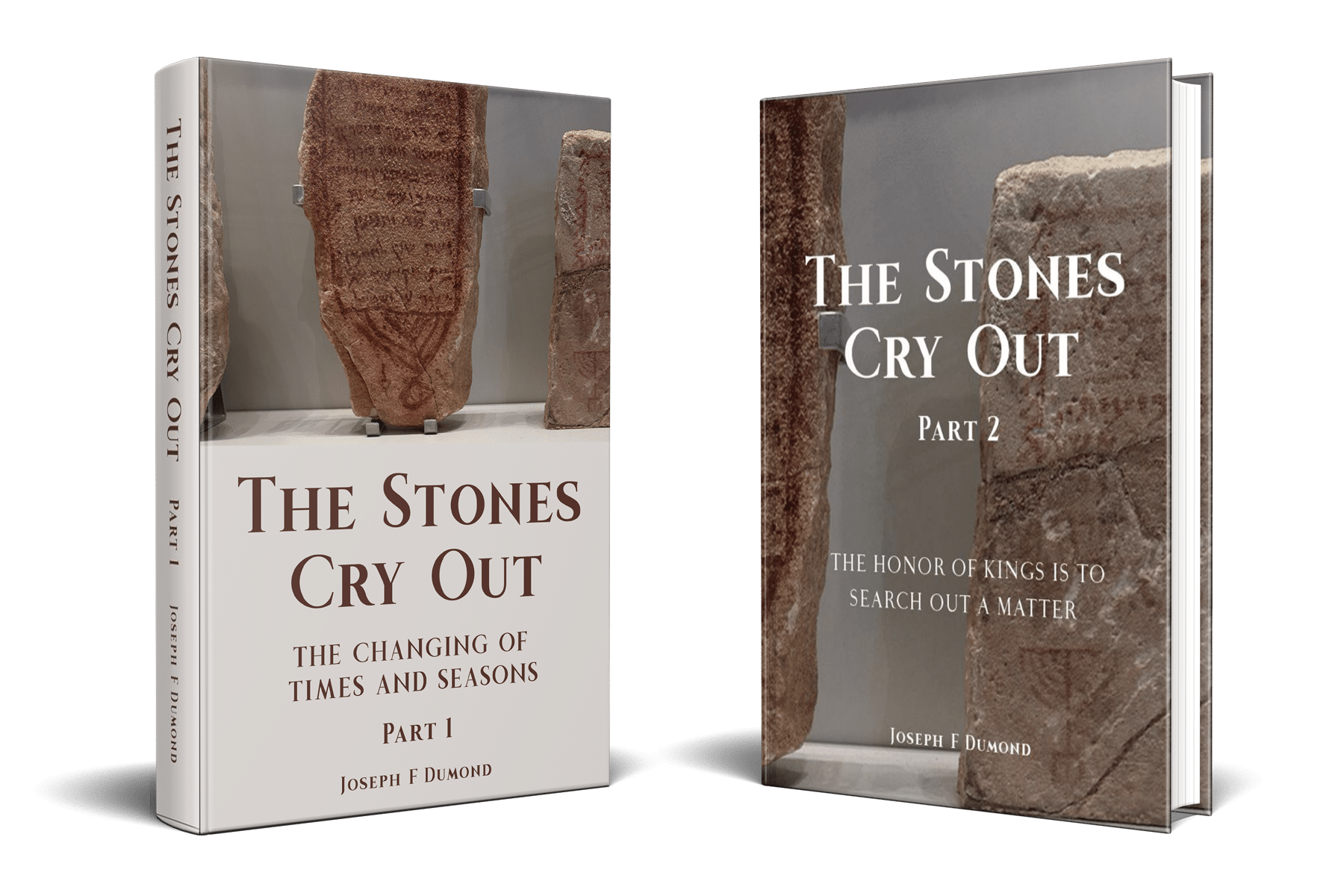
The Stones Cry Out Part 1 & Part 2
The Stones Cry Out Part 1 & Part 2
Do you want to know how to prove the Zadok Calendar, the Enoch Calendar, and the Book of Jubilee Calendar false?
Do you want to know how the calendar issue became so confusing?
I got this awesome endorsement and I want to share it here now. with you.

In The Stones Cry Out, I walk you through the history of each change and why those changes came about, starting with the Maccabean days. Yes, it all began around 164 B.C. When Yehshua was here, he was dealing with two schools of thought. The Sadducees were all but wiped out when the Temple fell in 70 C.E. This left only the Pharisees, who began to be persecuted after the failure of the Bar Kochbah Revolt in 134 C.E.
The truth began to become out of focus around 160 C.E. when Rabbi Jose wrote the Seder Olam. This work originally was written to proof Simon Bar Kochbah was the Messiah. When that did not pan out the history was later revived and then redacted as the truth into the Mishneh Torah by Rabbi Judah ha Nasi in 180 C.E. After this the Jerusalem Talmud begins to debate these issues. It was then during this time as the Jerusalem Talmudist are forced to flee and the Babylonian Talmudist continue to grow until the 6th century that Hillel came up with a solution to help them keep the Holy Days at the proper time while they were out of the land of Israel. He did this in 358 C.E. This work was then modified and adjusted over the next 800 years with additions added and other rejected. Until it was finally redacted once again in 1177 by Rambam. And with that we now have the modern Hillel calendar which includes the errors passed on during each redaction. These errors included the time of the Sabbatical and Jubilee years.
Once the Temple was destroyed in 70 C.E., the Jews recorded time by counting from the time It was destroyed. This is why the 40 tombstones of Zoar, which record this information, are crucial to understand.
When you understand why the Postponement rules were first created so that the crescent moon would not be seen in another part of the world before it was seen in Israel then you can understand how they were still trying to follow the crescent moon to begin the month. The Tombstones show us this exact thing. The tombstones also show us when the Jews changed from a crescent moon to a Conjunction moon to begin the month. They also show us when the Jews changed the year from the month of Aviv to the Tishri to begin the year.
I really want you to understand these things so you know why you do what you do as far as following a calendar to keep Yehovah’s moedim.
Get your Free copies of The Stones Cry Out Part 1 and Part 2 here https://sightedmoon.com/the-stones-cry-out-lp/
And share this information with your FB friends and Bibles Study groups. If they don’t like it, it never cost them anything.
Get your copy today. If you want a paperback copy, I have them on Amazon for the least amount they would let me post them there. Order both of them and start to understand the history of how these changes affect those who follow Yehovah and keep His Feasts.
I would like to add this recent comment to encourage you all to get this book and learn these truths. And the Book is FREE. You have no reason not to get it.
Most people assume that Hillel created the calendar in 358 C.E. They then assume that because it was a Sanhedrin, they are not allowed to change in order to obey Yehovah. The Hillel calendar has been changed many times since 358 C.E. up until 1177 C.E. Few people talk about these changes but we do in our latest Book The Stones Cry Out Part 1 which is free on our website. The Hillel calendar was changed on many occasions and many sought to make other changes during this time. They never needed a Bet Din to approve those changes. They just did them. So this excuse that we do not have the right to obey Yehovah because the Bet Din has not approved it is a crock of crap.
You have the obligation to obey Yehovah. You have the duty to prove which calendar you are to go by. You must prove it beyond all doubt. Yehshua never followed the Hillel calendar. Nor did any of the Apostles.
The reason no man can know the day or the hour is because it refers to a crescent moon to begin the 7th month. That is the day He was born on and the day He comes to judge on. At a day and hour no one can know. Using the Hillel calendar predicts Yom Teruah years in advance so every one knows when to keep it. But even in the Hillel calendar they keep two days of Yom Teruah reckoning back to the sighted moon. Also in the postponement rules developed long after Hillel, they again state that if the conjunction is at a certain time then the day begins at such and such, in order that the moon will not be seen in another part of the world before it is seen in Israel. That was rule number 2.
Everyone has to choose. You have the right to be wrong. But if you choose to be wrong then you also must live with the consequences that come with sin. And that is the death penalty for not keeping the Holy Days, these Sabbath at the proper time. It is your choice.
Just because you write in to me to justify your position does mean it is right. It just means your sounding off.
Allow me to share this endorsement of our latest book again. If you have read our books, please share your thoughts about them with us in the comments below or email me.
And yes, many observe the Equinox. There are many who are deceived, improperly educated. And this is why Joe puts out a newsletter every week, why he writes books, why the SightedMoon Zoom Shabbat service started, why he travels to places like England and the Philippines to share this message and why were are going to the NRB in February. The calendar is always a divisive issue in social circles because the details are many, that’s why there are so many books Joe has written. I’m not looking to put Joe on a pedestal here. This is not about Joe worship. But Joe has tenaciously studied out the calendar from every angle, not to prove himself right, to to seek to find and share what Yehovah is telling us about His Calendar.
In The Stones Cry Out, Joe has shared the history of all the different groups within Israel, and the beliefs they had about the scriptures and the feast days and the calendar. When you line it all up, you can see for yourself the how and why these misunderstandings and arguments about how and where and why they came about.
This is my new favourite book and I’m only 60-70 pages in. And I encourage you to read the footnotes in this one. Sometimes there’s more footnote on the page than Joe’s words.
Sombra Wilson
When I wrote Stones Cry Out, I wanted it to be one of our FREE books so everyone would have it. It is more of an encyclopedia than a book to read. It will be your quick resource book; you will have access to every question about any calendar, how it got started, and who started it. You will also learn the history of how the Mishnah was assembled, when it was assembled and why. Then, you will learn how that information was transferred into both the Jerusalem and the Babylonian Talmud until it reached its final stage in the Mishneh Torah. Along with this progression, the calendar also progressed and changed long after 358 C.E. when Rabbi Hillel first published it. But…what was before the Hillel calendar? What does the Mishnah record about those things?
The Stones Cry Out was originally going to be one book explaining all the various proofs we have discovered, demonstrating when the Sabbatical and Jubilee years are throughout history.
You can know; it is not a mystery.
As I began to write The Stones Cry Out, I quickly found myself going back, time and time again, to explain how the calendar is behind the confusion of the Sabbatical and Jubilee years. The Rabbis, as they began to write the Mishnah, incorporated wrong understandings, and those errors were written into what became known as the Talmud and then the Mishneh Torah. The expulsion from the land and subsequent persecutions in trying to send out messengers to report the barley being found or the crescent moon being seen, proved to be more and more dangerous over time. All of these things took place over 14 centuries.
Then as I was working on The Stones Cry Out, I discovered that many people were now accepting the Zadok calendar as factual. This is when we pivoted to include all the details of the various calendars that have crept back into public knowledge today and are being used to mislead new people who are just starting to learn about the calendar. All of this was directly connected to the period starting with the Hasmonaeans, up to the destruction of the Temple. Then, with the compiling of the Mishnah, the studies that led into the writing of the Jerusalem Talmud, then the Babylonian Talmud and finally the Mishneh Torah, each error that was added is compounded over time.
The Stones Cry Out, Part 1 explains the history of how each compilation of the Oral Torah incorporated errors, leading the followers thereof away from the actual Torah. In understanding these facts, it is then possible to understand more readily how the Sabbatical and Jubilee years were then mixed and later changed. By explaining all this history, I will be able to help you the reader understand the tombstones when most authorities do not. They have assumed, to their error, the Hillel calendar to have always been in use since Mount Sinai. Not understanding the history of the calendars is why most authorities dismiss the tombstones as too confusing to use. Once you understand The Stones Cry Out Part 1, Part 2 will be very easy to grasp.
Daniel 7:25 tells us he will change the appointed seasons and commandments. Many assume Constantine did this when he made Sunday the Sabbath. Few have considered the calendar’s many changes and how they relate to us today. Hidden in this proverbial swamp of confusion is the truth about the Sabbatical and Jubilee years. The Sabbatical and Jubilee years reveal the truths about the calendar that have been hidden for almost 2000 years.
We are in the very last days and Yehshua warned us that during this time:
Mat 24:10 And then many will be offended, and will betray one another, and will hate one another.
Mat 24:11 And many false prophets will rise and deceive many.
Mat 24:12 And because iniquity shall abound, the love of many will become cold.
Mat 24:13 But he who endures to the end, the same shall be kept safe.
Paul also warned Timothy about these last days, warning that some would leave the truth and begin to follow demonic teachers:
1Ti 4:1 But the Spirit expressly says that in the latter times some shall depart from the faith, giving heed to seducing spirits and teachings of demons,
Paul again warned the Thessalonians that the Great Falling away would take place in the last days. How can you fall away if you have never come to know the truth? So who is Paul talking to? Those who are called and answer that calling begin to walk this road of restoration back to Yehovah, and then at some point along that walk, they change and leave this walk following the teachings of demons to false calendar.
2Th 2:1 Now we beseech you, my brothers, with regard to the coming of our Lord Jesus Christ and our gathering together to Him,
2Th 2:2 that you should not be soon shaken in mind or troubled, neither by spirit, nor by word or letter, as through us, as if the Day of Christ is at hand.
2Th 2:3 Let not anyone deceive you by any means. For that Day shall not come unless there first comes a falling away, and the man of sin shall be revealed, the son of perdition,
2Th 2:4 who opposes and exalts himself above all that is called God, or that is worshiped, so that he sits as God in the temple of God, setting himself forth, that he is God.
We must endure until the end. We must not let ourselves become offended by personalities and leave the faith once given.
I want you all to have access to and the ability to read this book and use it as a reference. https://sightedmoon.com/the-stones-cry-out-lp/ Click on the link fill in the form and you will have access to the FREE PDF anywhere in the world. If you want a copy you can hold in your hands we have published it at Amazon for the lowest price they would allow us. Order you copy after Shabbat and begin to read it today.
Torah Portion
Torah Portions
We read through the entire Torah along with the Prophets and the New Testament, once over the course of 3 1/2 years. Or according to the Sabbatical Cycle which means we read it all twice over a 7-year period. This allows us to cover more in-depth rather than being rushed to cover as much as is covered on an annual basis. We allow all to comment and take part in the discussions.
Septennial Torah Portion
If you go to Torah Portion in our archived section, you can then go to the 1st year, which is the 1st year of the Sabbatical Cycle, the one we are in now, as we state at the top of every Newsletter. There, you can scroll down to the proper date and see that this Shabbat, we could very well be midrashing about:
Leviticus 16
Ezekiel 1-3
Proverb 29
Acts 25
We are in the 1st Sabbatical Cycle in 2024-2025. We go through the entire bible twice in a 7 year cycle. This means we cover the entire bible once every 3 1/2 years. It gives us more time to debate and discuss each portion we read.
If you missed last week’s exciting discoveries as we studied that section, you can go and watch past Shabbats on our media section.
Our Celtic Roots
Our Celtic Roots
A big thanks to our very first underwriter of the podcast. Joseph Dumond is an international speaker. He teaches the ancient roots of the Gaelic people at Sightedmoon.com.
You’ll hear me mention him in each episode of the podcast at the end of the show. This is not exactly advertising. It’s awareness promotion. I have no more than four more slots available every month if you, your business or your band want to be mentioned as an underwriter of the podcast.
Join Our Sabbath Meetings
Join Our Sabbath Meetings
There are many people in need of fellowship and who are sitting at home on the Sabbath with no one to talk to or debate with. I want to encourage all of you to join us on Shabbat, and to invite others to come and join us as well. If the time is not convenient then you can listen to the teaching and the midrash after on our YouTube channel.
What are we doing and why do we teach this way?
We are going to discuss both sides of an issue and then let you choose. It is the work of the Ruach (Spirit) to direct and to teach you.
The medieval commentator Rashi wrote that the Hebrew word for wrestle (avek) implies that Jacob was “tied”, for the same word is used to describe knotted fringes in a Jewish prayer shawl, the tzitzityot. Rashi says, “thus is the manner of two people who struggle to overthrow each other, that one embraces the other and knots him with his arms”.
Our intellectual wrestling has been replaced by a different kind of struggle. We are wrestling with Yehovah as we grapple with His Word. It is an intimate act, symbolizing a relationship in which Yehovah and you and I are bound together. My wrestling is a struggle to discover what Yehovah expects of us, and we are “tied” to the One who assists us in that struggle.
Today, many say Israel means “Champion of God”, or better — the “Wrestler of God”.
Our Torah sessions each Shabbat teaches you and encourages you to constantly challenge, question, argue against, as well as view alternative views and explanations of the Word. In other words, we are to “wrestle with the Word” to get to the truth. Jews worldwide believe that you need to wrestle with the Word and constantly challenge Dogma, Theology, and views or else you will never get to the Truth.
We are not like most churches where “The preacher talks and everyone listens.” We encourage everyone to participate, to question and to contribute what they know on the subject being discussed. We want you to be a champion wrestler of the Word of Yehovah. We want you to wear the title of Israel, knowing that you not only know but are capable of explaining why you know the Torah to be true with logic and facts.
We have a few rules though. Let others talk and listen. There is no discussion about UFO’s, Nephilim, Vaccines or conspiracy-type subjects. We have people from around the world with different world views. Not everyone cares who is the President of any particular country. Treat each other with respect as fellow wrestlers of the word. Some of our subjects are hard to understand and require you to be mature and if you do not know, then listen to gain knowledge and understanding and hopefully wisdom. The very things you are commanded to ask Yehovah for and He gives to those who ask.
Jas 1:5 But if any of you lacks wisdom, let him ask of God, who gives to all liberally and with no reproach, and it shall be given to him.
We hope you can invite those who want to keep Torah to come and join us by hitting the link below. It is almost like a Torah teaching fellowship talk show with people from around the world taking part and sharing their insights and understandings.
We start off with some music and then some prayers and it’s as though you were sitting around the kitchen back in Newfoundland having a cup of coffee and all of us enjoying each other’s company. I hope you will grace us with your company someday.
Sabbath services begin at 12:30 PM EDT where we will be doing prayers, songs and teaching from this hour.
Shabbat midrash will begin at about 1:15 pm Eastern.
We look forward to you joining our family and getting to know us as we get to know you.
Joseph Dumond is inviting you to a scheduled Zoom meeting.
Topic: Joseph Dumond’s Personal Meeting Room
Join Zoom Meeting
https://us02web.zoom.us/j/3505855877
Meeting ID: 350 585 5877
One tap mobile
+13017158592,,3505855877# US (Germantown)
+13126266799,,3505855877# US (Chicago)
Dial by your location
+1 301 715 8592 US (Germantown)
+1 312 626 6799 US (Chicago)
+1 346 248 7799 US (Houston)
+1 669 900 6833 US (San Jose)
+1 929 436 2866 US (New York)
+1 253 215 8782 US (Tacoma)
Meeting ID: 350 585 5877
Find your local number: https://us02web.zoom.us/u/kctjNqPYv0
“Ben Ha Arbayim or Between the Evenings – When is it?”
“Ben Ha Arbayim or Between the Evenings – When is it?”
We wrote this article back in 2012. You can find many articles on Passover in our library each year. I do hope you all study there often.
I have had many discussions with people stuck on a teaching promoted by Fred R. Coulter in his book The Christian Passover. Many in the Churches of God are also confused: they call the evening before the 14th starts “Passover,” and the next night they call the Night to Be Much Observed. This is the evening they meet at each other’s house for dinner. However, they do not consider this meal the actual night of the Passover.
So the Churches of God have said that the night of the Foot Washing which is after the 13th day has ended and the 14th begins, that this is Passover, and that the Night they get together, at the end of the 14th and the start of the 15th, the Night to be observed, is just the start of the first Holy Day of Unleavened Bread.
Some then keep the Passover at the start of the 14th day, and others at the end of the 14th as the 15th begins. Which is it?
We will walk you through these events chronologically so you can better understand them.
March 31, 2012
Shabbat Shalom Brethren and Family,
I did not realize when I posted the newsletter for this Shabbat how many were confused by the chronology of Passover and when it is to be eaten. I have received phone calls and many emails, all stating I am wrong and basing their position on the Ben Ha Arbayim or the between-the-evenings understanding. Or should I say misunderstanding. I have also received many thanks for making the chronology of the events of Passover very plain.
I would like us to keep each feast as commanded in the Torah. But over time, Satan has confused and muddied many of the scriptures.
Let me say right here, I am not going after any one person or group. I feel it is of utmost importance to keep the Passover. And to keep the Memorial that Yehshua established. But we are warned by Paul in
1Co 11:28 But let a man examine himself, and so let him eat of that bread and drink of that cup. 29 For the one who is eating and drinking unworthily, eats and drinks judgment to himself, not discerning the body of the Master. 30 Because of this many are weak and sick among you, and many sleep. 31 For if we were to examine ourselves, we would not be judged. 32 But when we are judged, we are disciplined by the Master, that we should not be condemned with the world.
When an issue like this arises, it forces me to double-check my understanding and search for the reason many have it differently, and which version is correct.
Given the importance of this issue, I have decided to send this newsletter before Passover so those who need it have time to address it before the end of this coming week.it gets here.
We are commanded to go and tell our brother when we see him sinning in both the Torah and Brit Chadasha, New Covenant.
Lev 19:17 ‘Do not hate your brother in your heart. Reprove your neighbour, for certain, and bear no sin because of him.
Mat 18:12 “What do you think? If a man has a hundred sheep, and one of them goes astray, would he not leave the ninety-nine on the mountains, going to seek the one that is straying? 13 “And if he should find it, truly, I say to you, he rejoices more over that sheep than over the ninety-nine that did not go astray. 14 “Thus it is not the desire of your Father who is in the heavens that one of these little ones should be lost. 15 “And if your brother sins against you, go and reprove him, between you and him alone. If he hears you, you have gained your brother. 16 “But if he does not hear, take with you one or two more, that ‘by the mouth of two or three witnesses every word might be established.’ 17 “And if he refuses to hear them, say it to the assembly. And if he refuses even to hear the assembly, let him be to you like a gentile and a tax collector.
Let us now read in Clarks commentary what these two verses actually mean.
Clarke’s Commentary on the Bible
Thou shalt not hate thy brother – Thou shalt not only not do him any kind of evil, but thou shalt harbor no hatred in thy heart towards him. On the contrary, thou shalt love him as thyself, Leviticus 19:18. Many persons suppose, from misunderstanding our Lord’s words, John 13:34, A new commandment give I unto you, that ye love one another, etc., that loving our neighbor as ourselves was first instituted under the Gospel. This verse shows the opinion to be unfounded: but to love another as Christ has loved us, i. e., to lay down our lives for each other, is certainly a new commandment; we have it simply on the authority of Jesus Christ alone.And not suffer sin upon him – If thou see him sin, or know him to be addicted to any thing by which the safety of his soul is endangered, thou shalt mildly and affectionately reprove him, and by no means permit him to go on without counsel and advice in a way that is leading him to perdition. In a multitude of cases timely reproof has been the means of saving the soul. Speak to him privately if possible; if not, write to him in such a way that himself alone shall see it.
Luke 17:3 So watch yourselves. “If your brother sins, rebuke him, and if he repents, forgive him.
1 John 2:9 Anyone who claims to be in the light but hates his brother is still in the darkness.
1 John 2:11 But whoever hates his brother is in the darkness and walks around in the darkness; he does not know where he is going, because the darkness has blinded him.
1 John 3:15 Anyone who hates his brother is a murderer, and you know that no murderer has eternal life in him.
If we do not tell our Brother of their sins when we see them, it is the same as hating our Brother and walking in darkness and the same as if we had murdered him.
In the 613 Mitzvot this command to warn your Brother is found in Mitzvot #30
(30) Do not cherish hatred in your heart. “You shall not hate your brother in your heart.” (Leviticus 19:17) Could it be that the rabbis actually got one right? This is apparently a no-brainer, the converse of #26, “You shall love your neighbor as you do yourself.” But look at what follows: it almost sounds like a contradiction: “You shall surely rebuke your neighbor, and not bear sin because of him.” In light of this close contextual connection, we shouldn’t automatically assume Moses has moved on to a different subject. Actually, I believe the second phrase defines what it is to “hate your brother.” And the truth that emerges if we make this connection has stunning relevance for us today: we are not to be tolerant of false teaching, but are rather to “rebuke” those in error—to neglect this correction is to hate our brother. Remember the rabbinical mitzvah (#27) that said Do not stand by idly when a human life is in danger? This is the practical outworking of the principal: if your brother is in spiritual error, if he espouses doctrines that Yahweh’s Word says will kill him in the end, then to withhold rebuke and admonition is to hate him. By tolerating his heresy, you are sending him to hell, like indulging a diabetic’s sweet tooth.
What does it mean to “bear” sin? The Hebrew word is nasa, meaning to lift, or carry. It is “used in reference to the bearing of guilt or punishment for sin” leading to the “representative or substitutionary bearing of one person’s guilt by another.” (B&C) Yahweh did not want false teaching tolerated in Israel because the guilt—and thus the punishment—incurred would eventually be borne by the entire nation. He would have spared them that pain. He would spare us that pain.
This ought to shed new light on Yahshua’s confirmation of the principle that loving Yahweh and our fellow man is the path to life. “One day an expert in religious law stood up to test Jesus by asking him this question: ‘Teacher, what must I do to receive eternal life?’ Jesus replied, ‘What does the law of Moses say? How do you read it?’ The man answered, ‘You must love the Lord your God with all your heart, all your soul, all your strength, and all your mind.’ And, ‘Love your neighbor as yourself.’ ‘Right!’ Jesus told him. ‘Do this and you will live!’” (Luke 10:25-28 NLT) Friends don’t let friends fall prey to false teaching.
I will let you read from someone who has done the research on this subject, which I am not able to explain satisfactorily. Please forgive me for my inability to explain this to those with whom I have been communicating. May Yehovah guide us all into the truth. Please read this in order to understand and not to argue and fight.
http://www.hope-of-israel.org/arbayim.htm
Hope of Israel Ministries (Ecclesia of YEHOVAH):
The Mystery of Ben Ha Arbayim —
When Was the Passover Killed?
Some proponents of observing the Passover insist that the Hebrew expression Ben Ha Arbayim — translated literally as “between the two evenings” — has to refer to dusk or twilight, the period of time after sunset and before dark. The Jews and orthodox Judaism, however, maintain that this expression refers to the period between noon and sunset. Which is the truth? Since the Passover lamb was killed “ben ha arbayim,” this question is of vital importance in determining when Passover should be observed! Let us lay aside the opinions of men, and tradition, and prove from the Scriptures exactly when the Passover was to be killed!
In Exodus 12:6, YEHOVAH God commands Israel,
“And you shall keep it [the Passover lamb] up until the fourteenth day of the same month: and the whole assembly of the congregation of Israel shall kill it in the evening.”
Many have been perplexed by this expression, “in the evening.” The margin of my National Bible says, “from the ninth to the eleventh hour.” In Israel, the day had twelve hours, beginning around 6:00 AM our time as the first hour. Therefore, the ninth to the eleventh hour would have been from 3:00 PM in the afternoon till 5:00 PM.
However, another Bible I have has a marginal rendering of this expression, saying, “Hebrew, between the two evenings.” The question is, does this period of time refer to the afternoon of Nisan 14, especially from 3:00-5:00 PM? Or does it refer to the BEGINNING of Nisan 14, which begins about 6:00 PM the previous evening, from the time the sun sets until dark sets in — a period of about forty minutes or so?
Some who observe “Passover” at the beginning hours of Nisan 14, shortly after sunset, claim this expression means twilight, between sunset and dark. Is this really true?
In his book entitled The Christian Passover, Fred R. Coulter, former minister of the Worldwide Church of God, asserts that this expression is “the vital key to understanding.” He claims that the Scriptural meaning of ben ha arbayim is the period of time after sunset, normally referred to as dusk or twilight — definitely NOT “late afternoon”! Coulter simply rejects out of hand Jewish explanations and exegesis on this expression, as well as the studies of most scholars. Coulter claims that the traditional Jewish explanation of this term, such as that of Rabbi Rashi, a renown scholar of the Torah, simply contradicts Exodus 12:8, which, he says, shows that the entire Passover was to be kept on the 14th of Nisan, and the Passover lambs were to be eaten on the night of the 14th, not the 15th!
These are very strong words. Coulter claims that Exodus 16 is the KEY PROOF that he is right, and all the rabbis and scholars are wrong. He accuses various scholars, including Robert Kuhn and Lester L. Grabbe, formerly with the Worldwide Church of God, of “either ignoring or overlooking the plain commands of God which were given in the original Passover and which have been preserved in His Word” (p. 28, The Christian Passover ).
What is this “proof” which he refers to?
The Mystery of the Word “Evening”
Asserts Fred Coulter, the Hebrew term generally translated “evening,” or “even” — ba erev — means “sunset.” Therefore, according to him, all the common Bible translations are in error, as well as Strong’s Concordance and every Hebrew lexicon in existence! Coulter does not bother to “prove” that ba erev should be translated “sunset.” He simply asserts it is so, saying so dogmatically, without providing any evidence whatsoever. Coulter declares that “the meaning of ba erev is without controversy,” and further says it means “sunset.”
But is this really true?
The apostle Paul says that we are to “prove ALL things” (I Thess.5:21). Otherwise, slick, oily, and imperious deceivers will twist Scripture and have us believing white is black and sweet is sour, truth is error and error is pure truth! Isaiah the prophet warns,
“Woe unto them that call evil good, and good evil; that put darkness for light, and light for darkness; that put bitter for sweet, and sweet bitter! Woe unto them that are wise in their own eyes, and prudent in their own sight!” (Isaiah 5:20-21).
The Jews and rabbis most emphatically do NOT agree with Coulter’s claim that ba erev should be translated “sunset.” This is a blatant untruth. Therefore, his assertion that his statement that ba erev means “sunset” is “without controversy” is simply amazing, to put it mildly. According to the Jewish rabbis and all scholars, the term ba erev simply means “evening,” in a general sense. Notice! Here is the proof to back up my statement:
Says the Gesenius Hebrew-Chaldee Lexicon of the Old Testament, of the term erev,
“(1) evening (m. and fem., I Sam. 29:5) . . . at evening . . . Dual, arbayim, the two evenings; only in the phrase, ben ha arbayim, between the two evenings, Exodus 16:12; 30:8, used as marking the space of time during which the paschal lamb was slain, Ex. 12:6; Lev. 23:5; Num. 9:3; and the evening sacrifice was offered, Ex. 29:39, 41; Num. 28:4 . . .” (p. 652).
Gesenius shows that the word erev simply means “evening,” and makes no mention at all of its meaning “sunset.” However, he points out that the expression ben ha arbayim, “between the two evenings,” is controversial.
“…according to the opinion of the Karaites and Samaritans…the time between sunset and deep twilight. The Pharisees, however (see Josephus Bellum Jud. vi. 9, par 30), and the Rabbinists considered the time when the sun began to descend to be called the FIRST EVENING (Arabic ‘little evening’; when it begins to draw towards evening); and the SECOND EVENING to be the REAL SUNSET” (p. 652, emphasis mine).
Coulter, having asserted that ba erev means “sunset,” then proceeds to the next step in his explanation: He states that there is a “legitimate, Biblically sound, chronologically defined, Scripturally documented way to prove, beyond any shadow of doubt whatsoever, that ben ha arbayim originally meant the time period from sunset to dark” (p. 37). He says this “proof” is in Exodus 16. Let’s take a look.
The Mystery of the Quail
Coulter quotes Exodus 16:6,
“And Moses and Aaron said unto all the children of Israel, AT EVEN, then shall ye know that the LORD hath brought you out from the land of Egypt.” Coulter inserts in parentheses, after the words “AT EVEN,” the following interpolation: “ba erev, or sunset-ending that Sabbath on which this message was given” (page 41, The Christian Passover). Notice! He defines ba erev as “sunset.”
Coulter is building a “case.” Once he gets the reader to accept this “re-definition” of the expression ba erev, he has the reader at his mercy. For he then refers to verse 8 of Exodus 16. Notice, once again:
“And the LORD spake unto Moses, saying, I have heard the murmurings of the children of Israel: speak unto them, saying, AT EVEN [Heb. ben ha arbayim, “between the two evenings”] ye shall eat flesh . . .” (verses 11-12). “And it came to pass, AT EVEN [ba erev ] the QUAILS came up, and covered the camp” (verse 13).
Coulter says YEHOVAH God sent the quail at ba erev, which he says is “sunset.” Therefore, since the quails came at sunset, and were EATEN at ben ha arbayim, “between the two evenings,” Coulter reasons that this “proves” that ben ha arbayim must refer to the time after sunset, or dusk!
The problem with this interpretation is that ba erev does not mean “sunset,” as a point in time, but means “EVENING”! Therefore, this passage in Exodus 16, which Coulter admits is the “KEY” to the whole question, turns out to be an argument based solely on his own personal definition of ba erev. Therefore, Coulter’s case falls flat on its face! He has proved nothing.
Says The New Westminster Dictionary of the Bible:
“It [the daylight portion of the day] was divided into morning, noon, and evening (Psa. 55:17; cf. Dan. 6:10)” (“Day,” p. 214).
This authority adds:
“The festival [Passover] began on the 14th of Abib at EVENING, that is, in the beginning of the 15th day, with the sacrificial meal (Lev. 23:5-6). A lamb or kid was slain between the evenings, that is, TOWARD SUNSET (Exo. 12:6; Deut. 16:6; cf. between the 9th and 11th hours . . .” (“Passover,” p. 705).
In the remainder of this article, we will prove beyond any reasonable doubt that this authority is correct — and that the Jewish tradition is correct. Rather than be misled by Coulter’s definition of “at even,” let’s see what the Scriptures themselves tell us about this expression. And, afterward, let’s see how the Scriptures themselves interpret the expression “between the two evenings.”
Letting The Bible Interpret “At Even”
Can the term ba erev mean later afternoon? Coulter says it means “sunset.” However, if you look in a Bible Concordance such as Strong’s, you will find this expression is translated “evening” 49 (7 x7) times in the Old Testament! It is never translated “sunset.” Let us notice some of the places where it is used, and how it is used.
In Genesis 24, Abraham sends his faithful servant to find a wife for Isaac back in his own original country, so he will not marry a Canaanite woman. When the servant travels back to the land of Mesopotamia, to the city of Nahor, he stops. We read:
“And he made his camels to kneel down without the city by a well of water at the time of the EVENING, even the time that the women go out to draw water” (Gen. 24:11).
What time would women go out to draw water? This would refer to late afternoon, not after sunset when it is getting dark outside. Women would not wait until it is growing dark, or till dusk or twilight, before getting their water from the well. Remember, these were communal wells, and supplied water for the entire community, and would have been used by many women. They would certainly allow themselves plenty of time so that they would not be lined up at the well, in the dark, waiting their turn to draw water.
Let’s look at another example. Turn to the story of David and Goliath. Notice:
“And there went out a a champion out of the camp of the Philistines, named Goliath, of Gath, whose height was six cubits and a span…And he stood and cried unto the armies of Israel, and said, Why are ye come out to set your battle in array? am not I a Philistine, and ye servants to Saul? choose you a man for you, and let him come down to me. If he be able to fight with me, and to kill me, then will we be your servants: but if I prevail against him, and kill him, then shall ye be our servants, and serve us….
“And the Philistine drew near morning and evening, and presented himself forty days” (I Samuel 17:4-16).
When did Goliath approach the Israelite army, to utter his defiant challenge? Do you think he waited until sunset, or twilight, the period after sunset, to make his boast? Logically, this challenge would have been uttered before the Israelite army mid-morning and mid-afternoon — long before sunset!
Jeremiah the prophet, however, makes it very plain that the term “evening,” or ba erev in the Hebrew language, can mean afternoon. Notice his words!
“Prepare ye war against her; arise, and let us go up at noon. Woe unto us! for the day goeth away, for the shadows of the evening are stretched out” (Jeremiah 6:4).
When are shadows lengthened or stretched out? At high noon, there is no shadow cast. As the sun goes toward the western horizon, the shadows are lengthened out. As the sun nears the horizon, the shadows become their longest. But after sunset, there are no shadows cast at all — for it is the sun which casts shadows. Therefore, here we find proof positive that the term ba erev or “evening” refers to the time of late afternoon, before sunset!
Now then, with this understanding, notice how this word is used to denote the beginning and ending of a “day.”
The Day of Atonement and Passover Week
In Leviticus 23:27 we read:
“Also on the tenth day of this seventh month there shall be a day of atonement . . .” There is no question that the Day of Atonement is the tenth day of Tishri — nobody argues otherwise. But now notice how YEHOVAH God Himself delimits and defines this period of time! Notice how YEHOVAH God uses the term “at even” to refer to the END of a day rather than the beginning hours!
In Leviticus 23:32 we read,
“. . . in the ninth day of the month AT EVEN, from even unto even, shall ye celebrate your sabbath [the Day of Atonement].” The expression “at even” here is obviously used to mean the ENDING portion of the ninth day. Thus the Day of Atonement starts after the concluding portion of the ninth of Tishri. It lasts until the concluding portion of the tenth of Tishri. The “evening” of the 9th would be the afternoon, up until sunset; the evening of the 10th would be the afternoon of the 10th, until sunset. A grade school student could see that principle. The Day of Atonement begins at sunset, when the 9th day of Tishri ends, because the Day of Atonement IS the “tenth day” of the month!
However, in stating this fact, the Bible says the Day of Atonement, the 10th of Tishri, begins “in the ninth day of the month, AT EVEN . . .” Clearly the “AT EVEN” here has to refer to the ending of the ninth day, NOT ITS BEGINNING! If this expression referred to the twilight portion of the day, beginning the day right after sunset, then the Day of Atonement would be the 9th day of Tishri!
Another Biblical example of this truth is found in the instructions YEHOVAH God gives on when to keep the days of Unleavened Bread. Notice! We read:
“In the first month, on the fourteenth day of the month AT EVEN, ye shall eat unleavened bread, until the one and twentieth day of the month at even” (Exodus 12:18).
If “at even” here meant the beginning of Nisan 14, then this verse would be saying the 14th of Nisan is the first Day of Unleavened Bread, and we should therefore be observing the Feast from Nisan 14 to Nisan 20 — not from Nisan 15 to Nisan 21! Obviously, “on the fourteenth . . . AT EVEN,” refers to the END of Nisan 14! And the 21st day “at even” refers to the ENDING of the 21st day of the month! Even those who argue that Passover should be observed at the beginning of Nisan 14 admit that the Feast of Unleavened Bread is from Nisan 15 to 21. They admit that the “even” mentioned in Exodus 12:18 refers to the END of the day. Logically, then, the same should be true, in speaking of the Passover (Exodus 12:6)!
Letting the Bible interpret the Bible, then, “on the fourteenth day AT EVEN” plainly means at the END of the fourteenth — as Exodus 12:18 says. The Bible is consistent. YEHOVAH God does not contradict Himself. “The Scripture cannot be broken” (John 10:35). Therefore, the rule of consistency proves that the term “even” or “evening” as used in both Exodus 12:18 and Exodus 12:6 means the same thing in both verses — that is, the word “even,” as used in verse 6, which deals with the slaying of the Passover lambs, also means at the ENDING PART of Nisan 14. However, since the actual expression in Exodus 12:6 is a variation of the term “evening” in Hebrew — a term which would technically be translated as “between the two evenings,” let us see just how this term relates to the term “evening” in the Scriptures.
Evidence from Deuteronomy
When, then, was the Passover to be killed? Before or after sunset? Let’s understand!
Notice Deuteronomy 16:4. This verse shows that the Passover is a part of the days of Unleavened Bread, leading right into them. We read:
“And there shall be no leavened bread seen with thee in all thy coast seven days; neither shall there any thing of the flesh, which thou sacrificed the first day AT EVEN, remain all night until the morning.”
Here the 14th of Nisan is called “the first day.” That is because it is the late afternoon of the 14th that the Passover was sacrificed, leading right into the First Day of Unleavened Bread that same sunset!
This shows, too, that the “first day” when all leaven was to be put out of the houses of the Israelites was Nisan 14 (Exodus 12:15; compare Deut.16:4 and Exodus 12:18-19). From the end of Nisan 14 they ate unleavened bread until the end of the 21st day of Nisan.
Now, notice verse 6 of this chapter. Here is the solution to the problem! Here Moses is told by YEHOVAH God,
“But in the place which the LORD thy God shall choose to place his name in, there thou shalt sacrifice the passover AT EVEN, at the GOING DOWN of the sun . . .”
Letting the Bible interpret the Bible, then this expression ba erev or “evening” when the Passover was killed, and the expression ben ha arbayim, which also denotes the time the Passover lambs were killed, was the same moment or time period described as “the going down of the sun.” Literally, the expression “at the going down of the sun” can only mean when the SUN IS IN THE PROCESS OF DESCENDING IN THE WESTERN SKY! That is, from the time the sun BEGINS to DESCEND, at high noon, until SUNSET — when it has completed its descent to the point where it is below the western horizon and has disappeared from sight!
Notice! It is the “going down” — present progressive tense — showing the action of the sun moving down in the western sky. This period of time must be, has to be, by logical, careful analysis, from the moment after NOON, at the earliest, lasting until the sun disappears behind the horizon, or the actual moment of SUNSET! Once the sun has “set,” it is no longer “going down” — it has, rather, “GONE DOWN”!
The expression “at the going down of the sun” means “as the sun goes down” — showing it was during the action of the sun moving down in the sky toward the western horizon. In English, this is the present progressive tense. If YEHOVAH God had meant to convey the idea that the lambs were to be killed AFTER the sun went down, that is, after sunset, then He would have stated it differently. He would have said, “AFTER the sun goes down,” or, “After the sun HAS GONE down.” The sun “goes down” until it “sets.” After it “sets,” it has technically “gone down.” YEHOVAH God commanded that the lambs be slain as the sun sinks in the western sky — not after it has already plunged beneath the horizon! The Jews have always faithfully done this, as long as the Passover was sacrificed, throughout their history.
The Septuagint makes it perfectly clear. We read:
“Thou shalt not have power to sacrifice the passover in any of the cities, which the Lord thy God gives thee. But in the place which the Lord thy God shall choose, to have his name called there thou shalt sacrifice the passover at even AT THE SETTING OF THE SUN . . .”
The command is plain that the lambs had to be slain ON THE FOURTEENTH of Nisan, in the late afternoon, BEFORE the sun had set! But if the lambs were not slain till AFTER SUNSET of the 14th, they would have been slain on the FIFTEENTH! That would have been a violation of the commandment! Also, if they were slain at the beginning of the 14th, after sunset of the 13th of Nisan, that would not have been during the “going down” or “setting” of the sun.
Could anything be plainer? Even a small child can understand this truth! Why is it that so many cannot grasp these plain and simple Spiritual, Biblical truths?
“The Going Down of the Sun”
This same expression is used elsewhere in the Old Testament. “And when the sun was going down . . .” (Gen. 15:12). The Hebrew Scriptures state: “AS THE SUN WAS ABOUT TO SET . . .” Clearly, this expression refers to the time BEFORE SUNSET, not afterward!
“And afterward Joshua smote them (the Canaanite kings), and slew them, and hanged them on five trees: and they were hanging upon the trees UNTIL THE EVENING. And it came to pass at the TIME OF THE GOING DOWN OF THE SUN, that Joshua commanded, and they took them down off the trees, and cast them into the cave wherein they had been hid, and laid great stones in the cave’s mouth, which remain unto this very day” (Josh. 10:26-27).
The Septuagint also makes this verse clearer. Notice!
“And Joshua slew them and hanged them on five trees; and they hung upon the trees until the evening. And it came to pass toward the setting of the sun, Joshua commanded, and they took them down from the trees, and cast them into the cave into which they had fled for refuge, and rolled stones to the cave, which remain until this day.”
This event shows that the expression “going down of the sun” refers to the time right up until sunset or sundown, but not after. The Israelites were commanded, in the law of YEHOVAH God, not to allow the dead bodies of criminals to hang on a tree at night. God told Moses,
“And if a man has committed a crime punishable by death and he is put to death, and you hang him on a tree, his body shall not remain all night upon the tree, but you shall BURY HIM THE SAME DAY” (Deut. 21:22-23).
Since each day begins and ends at SUNSET, to bury such a criminal “THE SAME DAY” means he had to be buried PRIOR TO SUNSET! Thus, we read again of Joshua who slew the king of Ai.
“And he hanged the king of Ai on a tree UNTIL EVENING; and AT THE GOING DOWN OF THE SUN Joshua commanded, and they took his body down from the tree. . .” (Joshua 8:29, RSV)
This same expression is used in the Bible of the death of king Ahab. As Ahab was fighting the Syrians, he was struck by an arrow from a bowman and was sorely wounded.
“And the battle increased that day: and the king was stayed up in his chariot against the Syrians, and DIED AT EVEN: and the blood ran out of the wound into the midst of the chariot. And there went out a proclamation throughout the host about the going down of the sun, saying, Every man to his city, and every man to his own country” (I Kings 22:35-36).
The Hebrew Tanakh, or “Holy Scriptures,” has this verse, “as the sun was GOING DOWN . . .”
Again, the reference is to the time just prior to sunset or sundown, as the sun’s disk begins to move toward the horizon and set in the west.
YEHOVAH God’s Covenant with Abraham and the 400 Years
After YEHOVAH God brought Abraham out of the land of the Chaldees, He made a covenant with him, promising him that his children would someday be innumerable like the stars of heaven. Then, that afternoon, YEHOVAH had Abraham sacrifice a heifer of three years age, a she goat of three years, and a ram of three years, and a turtledove, and a pigeon. These sacrifices were a type of the coming sacrifice of Yeshua the Messiah, who became a Son of God at his resurrection. His ministry lasted exactly three years, which is the age of the sacrificed heifer, she goat, and ram. After he completed the sacrifice, Abraham drove away the birds that attempted to alight on the carcasses of the sacrifices (Gen. 15:1-11). Then we read:
“And when the sun was going down, a deep sleep fell over Abram; and, lo, an horror of great darkness fell upon him. And he said unto Abram, Know of a surety that thy seed shall be a stranger in a land that is not theirs, and shall serve them; and they shall afflict them four hundred years; and also that nation, whom they shall serve, will I judge: and afterward they shall come out with great substance…In the same day the LORD made a covenant with Abram, saying, Unto thy seed have I given this land . . .” (Gen. 15:12-18).
Why did a “horror” or a “nightmare” come over Abraham, as the “sun was going down”? This is the same expression we have just been studying. This “horror” came over Abraham at the same time the future Passover lambs would be slain — at the identical time when Yeshua the Messiah our Passover would be slain for us! No wonder Abraham felt this sense of horror — the innocent “lamb of God” would be slain at the very time the Son of God would die upon the tree of crucifixion!
These sacrifices pictured the Messiah, and they were performed in the late afternoon, as the sun was going down, and descending in the sky. Four hundred years later, on the very same day, YEHOVAH God brought the children of Israel out of Egypt!
“Now the sojourning of the children of Israel, who dwelt in Egypt, was four hundred and thirty years. And it came to pass at the end of four hundred and thirty years, even the selfsame day it came to pass, that all the hosts of the LORD went out from the land of Egypt: this is that night of the LORD to be observed of all the children of Israel in their generations. And the LORD said unto Moses and Aaron, This is the ordinance of the Passover . . .” (Exo. 12:40-43).
What Abraham was permitted to preview, some 400 years earlier, to the very self-same day, was the ordinance and sacrifice of the Passover! Therefore, for the typology to be complete, just as these sacrifices he performed were done in the afternoon, at the going down of the sun, before sunset, even so the Passover lambs some 400 years later would be slain in the afternoon of Nisan 14, and eaten on Nisan 15 — the very night of the Passover, when the LORD “passed over” the children of Israel, and slew the firstborn of the Egyptians — the very night YEHOVAH God freed His people from slavery and bondage by the act of the “Passover”!
A New Look at “Between the Two Evenings”
Since the term ben ha arbayim, “between the two evenings,” is so controversial, let us see how this expression is used in the Scriptures. According to the Word of YEHOVAH God, there were four things which were to be performed at the time period known as “between the two evenings” — it was the time the Passover was to be killed, the time of the evening sacrifice, the time the lamp-stand in the Temple was lit, and the time the incense was offered.
Notice, now, how this expression denotes the time of the “evening sacrifice.”
In the book of Numbers YEHOVAH God gives instructions concerning the daily sacrifices which were to be offered before Him. YEHOVAH God commanded,
“And thou shalt say unto them, This is the offering made by fire unto the LORD; two lambs of the first year without spot DAY BY DAY [Heb. ‘IN A DAY’], for a continual burnt offering. The one lamb shalt thou offer IN THE MORNING, and the other lamb shalt thou offer AT EVEN [Heb. ben ha arbayim, or between the two evenings] . . .” (Num. 28:3-4).
Notice carefully! Both these offerings were to be offered DAILY, “day by day,” “IN A DAY” — that is, WITHIN THE SAME DAY! The first one is the morning sacrifice, and the second one is the EVENING sacrifice. In order for the evening sacrifice to be offered the SAME DAY as the morning sacrifice, it had to be offered BEFORE SUNSET! Otherwise it would have been the NEXT day! What could be clearer? Thus, here we find incontrovertible, inexorable, yet simple proof that “between the evenings” has to refer to the period of time BEFORE SUNSET, not after sundown, as the Samaritans taught!
Notice it again! In this plain passage of Scripture, we are told that the DAILY SACRIFICE involves both a morning and an “evening” sacrifice, and the “evening” sacrifice occurs “between the two evenings.” Yet this passage says plainly that these two sacrifices were “IN A DAY.” The morning sacrifice, which was done first, was in the SAME DAY as the “evening” sacrifice, which was made that same day, “between the two evenings”! Since the day ENDS at sunset, this expression ben ha arbayim HAS to refer to late AFTERNOON! If it referred to dusk, or twilight, after sunset, as some claim, then it would be THE NEXT DAY!
How clear it all is, when we simply let the Bible interpret the Bible! It’s really NOT complex at all. It’s simply a matter of following the Bible and not a man, even if that man happens to some self-anointed “scholar” or swaggering minister who is “wise in his own eyes” and a “legend in his own mind.” The question is, will we follow the INSPIRED WORD OF YEHOVAH GOD — or will we follow the opinions of a man?
Lighting of the Lamp, and the Incense
The lighting of the Lampstand in the Temple, and the incense offering, both also occurred at ben ha arbayim, or “between the two evenings.” Interestingly, at the time of the morning sacrifice, which was offered at 9 o’clock in the morning, the Temple lamps were “dressed,” and incense was also offered, together with the morning sacrifice (Exodus 30:7). Then at the time of the evening sacrifice, we read:
“And when Aaron lighteth [Heb. “setteth up” or “causeth to ascend”] the lamps at even [“between the two evenings”], he shall burn incense upon it, a perpetual incense before the LORD throughout your generations” (Exo. 30:8).
Therefore, the daily sacrifice, the incense offering, and the lamp lighting and trimming, was done every day, throughout the generations of Israel, as long as there was a Sanctuary or a Temple, at the appointed time called “between the two evenings.”
Can we establish this as being in the mid-afternoon, or about 3:00 o’clock, by another approach to the subject?
The Appointed “Time of Prayer”
The daily sacrifice was a time of “prayer” at the Temple, and the daily sacrifice and incense were physical types of prayer and sacrifice of ourselves to the service of YEHOVAH God. The apostle Paul speaks of prayer as “the sacrifice of praise to God continually, that is, the fruit of our lips giving thanks to his name” (Heb.13:15). David declared,
“Let my prayer be set forth before thee as incense; and the lifting up of my hands as the evening sacrifice” (Psalm 141:2).
In the book of Revelation, we read:
“And another angel came and stood at the altar, having a golden censer; and there was given unto him much incense, that he should offer it with the prayers of all saints upon the golden altar which was before the throne. And the smoke of the incense, which came with the prayers of the saints, ascended up before God out of the angel’s hand” (Rev. 8:3-4).
Thus it is clear that “incense” and the time of prayer are connected in the Word of YEHOVAH God. They are connected with each other, and with the time of the “evening sacrifice” (Psalm 141:2). What is this “time”? Is it after sunset, or before? Is it after dark, or during the afternoon? Let us continue.
It was customary for the people of Israel to be at the Temple, and to pray, at the time of the offering of the incense, and the evening sacrifice. We read in the book of Ezra, Ezra the priest declared:
“And at the evening sacrifice I rose up from my heaviness; and having rent my garment and my mantle, I fell upon my knees, and spread out my hands unto the LORD my God” (Ezra 9:5).
Likewise, Elijah the great prophet of YEHOVAH God, at the time of the evening sacrifice, prayed to YEHOVAH, and fire came down from heaven and devoured his offering atop Mount Carmel. The scene was Mount Carmel in northern Israel. The prophets of Baal have been crying out to their god to bring fire down from heaven to consume their sacrifices. But nothing happens. We pick up the story:
“And it came to pass, when midday was past, and they prophesied until the time of the evening sacrifice, that there was neither voice, nor any answer, nor any that regarded. . . . And it came to pass at the time of the offering of the evening sacrifice, that Elijah the prophet came near and said, LORD God of Abraham, Isaac, and of Israel, let it be known this day that thou art God in Israel, and that I am thy servant, and that I have done all these things at thy word. Hear me, O LORD, hear me, that this people may know that thou art the LORD God, and that thou hast turned their heart back again. Then the fire of the LORD fell, and consumed the burnt sacrifice, and the wood, and the stones, and the dust, and licked up the water that was in the trench. And when all the people saw it, they fell on their faces: and they said, The LORD, he is the God; the LORD, he is the God” (I Kings 18:29, 36-39).
Here again, prayer to YEHOVAH God is connected with the evening sacrifice — it is the time of “evening prayer.” As David said in the Psalms, “Evening, and morning, and at noon, will I pray, and cry aloud: and he shall hear my voice” (Psalm 55:17). Daniel also prayed three times a day to YEHOVAH, at the hours of prayer (Daniel 6:10). One of these times was the time of the evening sacrifice — as Daniel records:
“Yea, while I was speaking in prayer, even the man Gabriel, whom I had seen in the vision at the beginning, being caused to fly swiftly, touched me about the time of the evening oblation” (Dan. 9:21).
This custom continued into New Testament times. Luke records of Zecharias, the father of John the Baptizer:
“According to the custom of the priest’s office, his lot was to burn incense when he went into the temple of the Lord. And the whole multitude of the people were praying without at the time of the incense” (Luke 1:9-10).
When Was the “Time of Prayer”?
Thus the time of incense, the time of the daily sacrifices, morning and evening, was the time of prayer. But when was the “hour of prayer”? Does the Bible tell us elsewhere when the appointed, traditional, customary “time of prayer” at the Temple occurred? Yes, it does! The book of Acts, in the New Testament, gives us the literal, undeniable answer:
“Now Peter and John went up together into the temple at the hour of prayer, being the NINTH HOUR” (Acts 3:1).
“And Cornelius said, Four days ago I was fasting until this hour; and at the ninth hour I prayed in my house, and, behold, a man stood before me in bright clothing, and said, Cornelius, thy prayer is heard . . .” (Acts 10:30-31; also 10:1-4).
The ninth hour of the day, Jewish time, would be 3 o’clock in the afternoon, our time. This was therefore the time of evening devotions, the evening sacrifice, the evening incense offering, the time of the lighting of the lamps in the Temple — and it is the time called “between the two evenings,” or ben ha arbayim!
The morning time of devotion and prayer, was the time of the morning sacrifice, the morning incense, and morning lamp trimming in the Temple. It was the time Peter and the disciples went to the Temple, to worship, on the Day of Pentecost, in 31 A.D. At that time of prayer, the Holy Spirit descended from heaven and lighted on the disciples, like a flame of fire, and enabled them to speak in many different languages, miraculously (Acts 3:1-13). Peter said to the assembled multitude, worshipping at the Temple:
“But Peter, standing up with the eleven, lifted up his voice, and said unto them, Ye men of Judaea, and all ye that dwell at Jerusalem, be this known unto you, and hearken to my words: For these are not drunken, as ye suppose, seeing it is but the third hour of the day” (Acts 3:14-15).
What is the real significance, then, of these times of prayer — 9 o’clock in the morning and 3 o’clock in the afternoon? We read in the gospel of Mark:
“And it was the third hour [9:00 AM], and they crucified him. . . . And at the ninth hour Jesus cried with a loud voice, saying, Eloi, Eloi, lama sabachthani? which is, My God, my God, why hast thou forsaken me? . . . And Jesus cried with a loud voice, and gave up the ghost. And the veil of the temple was rent in twain from the top to the bottom” (Mark 15:25, 34-38).
Yeshua the Messiah was nailed to the tree of crucifixion, at 9 o’clock in the morning, where he remained all day, suffering, until 3 o’clock in the afternoon, when he died. Thus he was nailed to the tree as the “morning sacrifice,” and died at the same time as the “evening sacrifices” were normally killed. He died at the very time of ben ha arbayim, or “between the two evenings.” But there is even more to the story. Yeshua the Messiah died at the very time of the Passover sacrifices in Jerusalem, which also were offered at ben ha arbayim — in the afternoon, before sunset!
During the Time of the Messiah — an Eye-Witness Speaks
During the time of the Messiah, the Jews were slaying their Passover lambs at the Temple of YEHOVAH God — about 250,000 lambs at each Passover celebration during the first century. We are not told precisely how so many lambs were killed during the afternoon of Nisan 14, but undoubtedly hundreds of priests were conscripted into service, so that the logistics of the problem could be met. Additional areas on the Temple Mount, including the sacred area of the Mount of Olives, where the red heifer sacrifice was performed, may also have been drafted into service to accomplish the task. However it occurred, Josephus the Jewish historian who lived during the first century, relates:
“So these high priests, upon the coming of their feast which is called the Passover, when they slay their sacrifices, from the ninth hour to the eleventh, but so that a company not less than ten belong to every sacrifice . . . and many of us are twenty in a company, found this number of sacrifices was two hundred and fifty six thousand five hundred: which, upon the allowance of no more than ten that feast together, amounts to two million seven hundred thousand and two hundred persons that were pure and holy” (Wars of the Jews, Book VI, 9:3).
Josephus, the Jewish historian of the first century, used Jewish time reckoning, so when he says the lambs were killed from the “ninth to the eleventh” hour, he means from about 3 o’clock in the afternoon until about 5 o’clock.
Yeshua the Messiah — Perfect Passover Lamb, Perfect Proof!
Yeshua the Messiah was killed at 3:00 PM in the afternoon of Nisan 14, according to Scripture. At the ninth hour, when the Jews began killing their Passover lambs, Yeshua himself hung on the tree.
Matthew’s gospel states,
“Now from the sixth hour [noon] there was darkness over all the land until the ninth hour [3:00 PM]. And about the ninth hour Jesus cried with a loud voice, saying, Eli, Eli, lama sabach-thani? that is to say, My God, my God, why hast thou forsaken me? Some of them that stood there, when they heard that, said, This man calleth for Elias [Elijah]. And straightway one of them ran, and took a spunge, and filled it with vinegar, and put it on a reed, and gave him to drink. The rest said, Let be, let us see whether Elias will come to save him. Jesus, when he had cried again with a loud voice, yielded up the ghost” (Matt. 27:45-50).
Yeshua, the Saviour and Messiah, YEHOVAH God’s Anointed One, the “Lamb of God” (John 1:36), IS YEHOVAH’s suffering servant who gave his life for the sins of the world, fulfilling the prophecy of Isaiah, who wrote:
“Surely he hath borne our griefs, and carried our sorrows: yet we did esteem him stricken, smitten of God, and afflicted. But he was wounded for our transgressions, he was bruised for our iniquities: the chastisement of our peace was upon him; and with his stripes we are HEALED.
“All we like sheep have gone astray; we have turned every one to his own way; and the LORD hath laid on him the iniquity of us all. He was oppressed, and he was afflicted, yet he opened not his mouth: he is brought as a LAMB to the slaughter [the Passover lamb!], and as a sheep before her shearers is dumb, so he openeth not his mouth. He was taken from prison and from judgment: and who shall declare his generation? for he was CUT OFF from the land of the living: for the transgression of my people was he stricken.
“And he made his grave with the wicked [the two robbers slain with him], and with the rich in his death [he was given Joseph of Arimathea’s tomb]; because he hath done no violence, neither was any deceit in his mouth. Yet it pleased the LORD to bruise him; he hath put him to grief: when thou shalt make HIS SOUL [LIFE] AN OFFERING FOR SIN, he shall see his seed, he shall prolong his days [be resurrected!], and the pleasure of the LORD shall prosper in his hand” (Isaiah 53:4-10).
As Paul put it plainly:
“For even Christ our passover is sacrificed for us” (I Cor. 5:7-8).
Yeshua the Messiah fulfilled the symbolism of the ancient Passover lambs perfectly. He was YEHOVAH God’s “lamb without blemish.”
The Perfect Proof
Certainly the Messiah, the Passover Lamb, had to be slain at the proper time! Those who claim that the Passover is to be observed at the BEGINNING of Nisan 14, and admit that the lambs were slain in the afternoon of Nisan 14, have a very serious problem. According to their chronology, Yeshua was therefore not slain until some twenty or twenty four hours LATER than the time they claim the Passover is to be observed!
On the other hand, those who claim that the Passover lambs were slain after sunset of Nisan 13, during the dusk or twilight of the beginning of Nisan 14, have an even greater problem. According to their reckoning, the Messiah died about 20 hours AFTER the Passover lambs were to be slain, at the beginning of Nisan 14 — thus invalidating and compromising his claim to being our Messiah! By their reckoning, his death was at the wrong time, and did not therefore perfectly fulfill the Passover typology!
If that were the case, then the Messiah could not truly have been our Saviour, YEHOVAH God’s Passover Lamb — he would be a fake, a fraud, an impostor, a counterfeit!
But thank YEHOVAH God, the Messiah was the PERFECT fulfillment of the Passover. Therefore, he was slain at the VERY MOMENT the Passover lambs were being slain at the Temple of YEHOVAH God! He was slain at the VERY TIME YEHOVAH God commanded for the Passover to be killed — “between the two evenings”!
Even as these sacrificial lambs were being slaughtered at the Temple, in 31 A.D., YEHOVAH God’s own True Passover Lamb, Yeshua the Messiah, was being slain for all of us who accept his shed blood for the forgiveness of our sins (II Cor. 5:20; I Cor. 5:7-8). Thus Yeshua the Messiah fulfilled the TYPE of the Passover lambs PERFECTLY — RIGHT ON TIME, exactly on schedule!
If the lambs were sacrificed the previous evening, as come claim, then Yeshua missed the correct time by twenty hours — and did not fulfill the type of the Passover perfectly! If that were true, then he could not be our SAVIOUR! He would be an impostor! But Yeshua fulfilled EVERY Scripture that prophesied of his coming TO THE MOST INFINITE DETAIL, in every respect — PERFECTLY in all points!
Now, let’s look at this question from the reverse angle. We know the Messiah was our Passover lamb (I Cor. 5:7). Therefore, we know that he must have died at the right time, when the Passover was to be killed. The fact that the gospels plainly show that Yeshua was killed at precisely 3:00 PM on the afternoon of Nisan 14, then, PROVES that the original Passover lambs were to be killed at that same time! This is further proof, then, that ben ha arbayim has to mean the late afternoon!
Here, then, is the ultimate proof — the example of Yeshua the Messiah himself, our Passover lamb! HE was slain at 3:00 PM in the afternoon; he HAD to fulfill the commandment to be slain “between the two evenings” (Exodus 12:6). Therefore, ben ha arbayim, “between the two evenings,” MUST refer to a time which includes 3:00 PM in the afternoon!
What More Proof Do We Need?
If the Pharisees were wrong in sacrificing the Passover in the late afternoon, then Yeshua would have been wrong to say they sit in Moses’ seat and that we are to follow their interpretation of the Law (Matt. 23:1-3). If they were wrong in the time they sacrificed and observed the Passover, then Yeshua would have been derelict in his duty as the Son of YEHOVAH God and the one “greater than Moses” for never chiding or faulting them for such a heinous error of the greatest magnitude.
If the Pharisees were wrong, then the apostle Paul, who said he was a Pharisee, and that he kept the law of YEHOVAH God “blamelessly” as a Pharisee (Phi. 3:6), would have been a liar. But both Yeshua, and Paul, endorse the teachings of the Jews, and the Pharisees, as the correct teachings concerning the time of killing the Passover, and observing the Passover. They never faulted the Pharisees on this teaching.
To know and understand the truth of YEHOVAH God is a wonderful blessing. To obey YEHOVAH God is even better! The times of ignorance YEHOVAH has winked at, but now commands all who learn the truth to repent of error, and to correct their mistakes.
It may not seem to men to be a very important thing as to when they observe Passover, or how they keep it. But it is important in the sight of YEHOVAH God. YEHOVAH God Himself sets the parameters of true worship — not men, ministers, priests, or other human beings. Will we obey YEHOVAH in this matter? Or will we follow men? Will we serve YEHOVAH God? Or follow Baal?
I know that many have gone through traumatic changes, in recent years, concerning church doctrines, teachings, and fellowship. Some don’t want to see any more “changes” for a long time — even if they happen to be wrong! But isn’t the truth of YEHOVAH God worth more than all the accolades of men? Isn’t fellowship with YEHOVAH God the Father and Yeshua the Messiah, by observing His Passover at the correct time — which He appointed “for ever” (Exo. 12:14-16), and He does not change (Mal. 3:6) — worth far more than fellowship with erring, sinning, human groups and churches which are too traumatized or too intransigent, to face this truth honestly?
Thank YEHOVAH God for His wonderful, inexpressible, glorious Truth!
— Edited By John D. Keyser.
Hope of Israel Ministries — Preparing the Way for the Return of YEHOVAH God and His Messiah!
Hope of Israel Ministries
P.O. Box 2186
Temple City, CA 91780, U.S.A.
www.hope-of-israel.org
If I am understanding you correctly you are stating that New Moon Day is a single day when the first sliver of the renewed moon is sighted. If you are stating that New Moon Day (a Commanded feast day) is a single day then how was it that King Saul was keeping two New Moon Day feasts where he was enraged that David was absent two evenings in a row with Jonathan was helping David to stay hidden from his father King Saul? To my reconning if there are two New Moon Days being observed that means it relates to the phenomenon of the sometimes occurrence of two dark of the moon conjunction days, not a single day when the first sliver of the moon is sighted. How do you reconcile this Scripturally?
Thank you for your question—it gets right to the heart of how we observe the biblical calendar.
To be clear: New Moon Day (Rosh Chodesh) is NOT a commanded Feast Day in the Torah. The seven annual Feasts/Appointed Times (moedim) are listed in Leviticus 23 and include Passover/Unleavened Bread, Firstfruits, Shavuot, Trumpets, Atonement, and Tabernacles. New Moon is mentioned separately (Numbers 10:10; 28:11–15; Ezekiel 46:3) as a time for trumpet blowing and special offerings, but it is not one of the seven commanded Feasts.
Regarding 1 Samuel 20 and the two evenings of Saul’s feast:
The text describes a royal/family banquet extended around the new moon occasion—not two separate New Moon Days. David says “tomorrow is the new moon” (v. 5), implying a known single start. Saul’s rage comes from David missing two consecutive evenings of the same multi-day celebration (common in ancient Near Eastern courts, similar to extended Passover meals or modern holiday gatherings). The “two days” are two evenings of feasting, not a calendar rule requiring two New Moons.
Astronomically, the period from the last visible old crescent (seen in the morning) to the first new crescent (seen after sunset in the evening) is typically 2–3 days (sometimes 1.5–3.5 days depending on conditions). This natural gap is why we do not start the month during the dark/invisible phase or at conjunction. The biblical month begins only when the first renewed sliver is sighted—a visible, witness-confirmed sign (Genesis 1:14; Deuteronomy 19:15). The dark days are simply the transition between months; they are not observed or counted as part of New Moon Day.
Scripture never commands a two-day New Moon, nor ties it to conjunction uncertainty. New Moon Day is one day, marked by the first visible crescent, and the extended feasting in 1 Samuel 20 reflects cultural practice, not a doubled commanded observance.
Concerning New Moon day not being a feast day, I meant it is to be a moedim. That’s what I get for not proof reading before hitting the send button. Thank you for bringing that to my attention.
Numbers 10:10: This verse commands the blowing of trumpets at the New Moon, indicating it was an ordained time for worship.
1 Chronicles 23:31: Mentions offerings during the New Moon, highlighting its significance as a holy time set apart for God.
Psalm 81:3: Calls for the trumpet to be blown at the New Moon, emphasizing its observance as a special occasion.
It does appear there was conjunction uncertainty not knowing when New Moon would end as if it wasn’t just a single day by the question in Amos 8:5 “When will the New Moon be over that we may sell grain?”
Doesn’t it stand to reason if New Moon was a single day there would be no reason to ask when the New Moon will be over? Certainly they were not having a controversy of when a day ends like the Rabbinical ruling of waiting till three stars are visible or 45 minutes after sunset?
I don’t believe there has ever been any disagreement that the sighted first sliver of the new moon is a single day, but there are sometimes two dark of the moon days before the first sliver of the new moon appears which might lead the unobservant and oblivious one to ask, “When will the New Moon be over so we may sell grain?”
Nehemia Gordon teaches that Amos 8:5 refers to the Sabbatical (Shmita) year, not the monthly new moon. And I agree. In his “Torah Pearls #32 – Behar” episode (Leviticus 25:1–26:2), he explains that the greedy merchants in the verse are impatient for the annual land rest (Shmita) to end, so they can resume selling grain that was freely available during that year. He argues the “new moon” here marks the start of the new year (when Shmita concludes), not a monthly observance, and contrasts it with claims that new moons prohibit work (which he says lacks Torah support).Key quote from the transcript:
“What it’s really talking about here is… a Sabbatical year… the Sabbath he’s talking about is the annual Sabbath, not the weekly Sabbath. And the annual Sabbath ends on the first day of the first month. So as soon as that day has passed, then they can start selling the grain and making the money. Until then, God’s giving it away for free.” This interpretation ties the verse to the broader context of Shmita observance in Israel, emphasizing annual rather than monthly holy days.
Because “no one knows the day or the hour” the new moon will be sighted, we need to try and sight the moon after the 29th day at evening. If at least two witnesses do not sight it after the 29th day, then for sure we know the month will be 30 days. This is what happened in 1 Samuel 20, because when the new moon wasn’t sighted after the 29th day, they knew the new moon day would begin after the 30th day the next evening (thus declaring a 30-day month):
1Sa 20:5 And David said to Jonathan, Behold (end of 29th), tomorrow (end of 30th) is the new moon, and I should not fail to sit at table with the king. But let me go so that I may hide myself in the field until the third day at evening.
There are seven holy days (moedim) of Leviticus 23:
1. the first day of the Feast of Unleavened Bread (Chag ha-Matzot, a pilgrimage)
2. the seventh day of the Feast of Unleavened Bread
3. the Feast of Weeks (Chag ha-Shavuot, a pilgrimage), a.k.a. the Feast of Harvest (Chag ha-Katzir, Exo 23:16) or the Day of Firstfruits (Yom ha-Bikkurim, Num 28:26)
4. the Day of Shouting/Trumpets (Yom Teruah)
5. the Day of Atonement (Yom ha-Kippurim)
6. the first day of the Feast of Booths/Tabernacles (Chag ha-Sukkot, a pilgrimage), a.k.a. the Feast of Ingathering (Chag ha-Asif, Exo 23:16)
7. the Eighth of Assembly (Shemini Atzeret)
Hello Joseph
It is true as you have written in this Newsletter, that we are Ambassadors of the kingdom of Heaven which is soon to be established on this planet.
SECOND DEDICATION OF MY NEW BOOK By Ambassador George Spiteri
Second, I am the AMBASSADOR OF JESUS CHRIST AND THE COMING KINGDOM OF GOD, as written in 2Corinthians 5:20 Now then, we are ambassadors for Christ, I want to assure the reader OF THIS BOOK, that I had to prove to myself that the events that are written and are recorded in the Books of the Bible happened and did take place, as they are recorded in the books of the Bible. I tremble when I read the following as written by the Prophet Ezekiel, because it has been given to me to understand the writings in the Books of the Bible, and I am held responsible, of what I do with my understanding, if I keep it to myself, or to broadcast it to the world. Ezekiel 3:17 “Son of man, I have made you a watchman for the house of Israel; therefore hear a word from my mouth, and give them warning from me:
Shalom, Joseph, I am reading the article with great interest. Stumbled about one passage though, Gen 15:17, where it also says “it was very dark/thick darkness”. I looked it up on
https://www.sefaria.org/Genesis.15.17?lang=bi&with=Translations&lang2=en
not sure if this is a reliable source but the various translations came out as “it was” dark (not the present progressive tense that you mentioned for other bible verses), not getting dark. This somewhat does not align with the time before sunset or are the English translations not correct?
Shalom Alex, so great to hear from you again. Yes the source you are using is a reliable source. The word you are referring to is H5939 (Ancient Hebrew)
H5939 = AHLB# 2543 (N1)
2543) Ulo% (Ulo% AhLTh) ac: ? co: Twilight ab: ?
Nf1) Eulo% (Eulo% AhL-ThH) – Twilight: [freq. 4] |kjv: twilight, dark| {H5939}
H5939 (Brown-Driver-Briggs) עלטה ‛ălâṭâh
BDB Definition:
1) thick darkness
The verse in question (Genesis 15:17) reads in most English translations:“When the sun had gone down and it was dark, behold, a smoking oven and a burning torch passed between those pieces.” (NKJV, ESV, etc.) Some translations say “thick darkness” or “very dark” (e.g., KJV: “it was dark, behold, a smoking furnace…”).You asked: Why does it say “it was dark” (past tense) instead of “it was getting dark” (progressive), and does this contradict the idea that bein ha-arbayim refers to the period before sunset or around sunset? Here’s the simple answer:The Hebrew word for “dark” here is not ordinary darkness.
It is עֲלָטָה (alatah, Strong’s H5939) — a rare word used only four times in the Bible. It means thick, intense, or oppressive darkness — the kind that comes suddenly or feels heavy, not just regular night. In Genesis 15:17, this “thick darkness” descends after the sun has gone down — it describes the deep night that has now fully arrived.
This is not the same phrase or timing as bein ha-arbayim. Bein ha-arbayim (“between the evenings”) in Exodus 12:6 (Passover lamb) and other places refers to the transition period around sunset — from late afternoon through twilight until full dark. It is the time when the sun is going down and light is fading but not yet complete night.
In Genesis 15:17, the text says the sun had already gone down (past tense) and thick darkness had come. This is after sunset, in the full night phase.
So the two expressions describe different moments: Bein ha-arbayim = around sunset / twilight (the “between” time).
Genesis 15:17 = after sunset, when full, thick darkness has fallen.
The Passover lamb was to be killed at bein ha-arbayim on the 14th (Exodus 12:6) — around sunset, as the 14th ends and the 15th begins. The meal was then eaten that night (start of the 15th), with unleavened bread.
Genesis 15:17 uses different language because it is describing a different event: the covenant ceremony happening after dark, in the deep night, not at twilight.
Most English versions correctly use past tense (“it was dark”) because the Hebrew is describing a completed state — the sun had set, and thick darkness had arrived. The progressive “it was getting dark” is not needed here because the text is emphasizing the full darkness after sunset, not the process of it arriving.
In short: Genesis 15:17 describes full, thick darkness after sunset — a different moment than the twilight transition of bein ha-arbayim.
Both are correct and complementary: the lamb is killed around sunset (bein ha-arbayim), and the covenant in Genesis 15 happens in the deep night that follows.
I dont know why some have mish mash everything. There are 4 watches. Take a pie and cut 4 EVEN pieces. From the even peice 6 to 9pm is and EVEN piece the first watch. The second even peice is 9pm to 12 mid night. I lived for a time in the southern caribbean. At 6pm the sun set. 6:15 it was pitch black , not much twilight. In the morning 6am it was fast.. the same. Not much twilight. It would be difficult to butcher in the dark back then with oil lamps. I believe that according to the watch they killed the lamb near 6pm and roasted it in the early evening. Sun dials dont work at night. So think about that.